



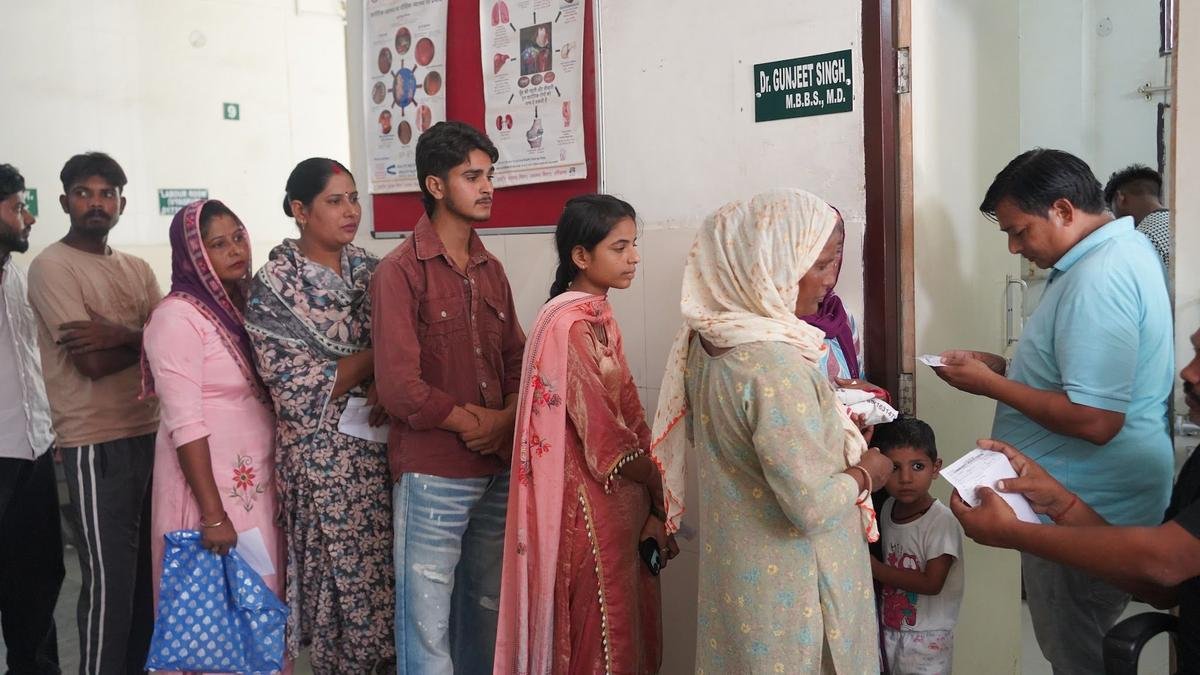
On July 15, Raj Rani, 52, an ASHA worker in Yamunagar, Haryana had just completed her tasks for the day when she felt a throbbing pain in her left arm and in the middle of her chin. Since this pain had persisted for a few days, she went to the Community Health Centre (CHC) in Vyaspur to get an electrocardiogram (ECG) done.
The Additional Senior Medical Officer at the centre, Gunjeet Singh, saw the results of the ECG, gave her a dose of drugs including blood thinners and clotbusters, called a ‘loading dose’, and asked her to rush to the district hospital at Ambala Cantonment, two hours away, for further treatment.
Raj Rani had single-vessel disease, with a major coronary artery blocked. “At the district hospital, they scheduled my angioplasty the next day and I got one stent in my heart,” said Raj Rani. “I told my doctors to give me good treatment so I could resume my work as an ASHA. They reassured me that I would be able to do my duties, because I was lucky: I came in time,” she said.
Had this happened even two months ago, Raj Rani would not have received the diagnosis that would have led to quick treatment. Even though the Vyaspur CHC had an ECG machine, there was no technician to conduct it and while the medical officers could interpret the results, they were not very confident.
Raj Rani, 52, an ASHA worker working in Yamunagar, Haryana was detected with a single vessel disease
| Photo Credit:
Courtesy, Nivarana
What changed
On May 29 this year, the Haryana government tied up with Sunfox Technologies, a health-tech startup, as part of Public-Private Partnership (PPP), to set up a tele-ECG network called Spandan One. Each medical centre in Haryana received a tele-ECG device that connects to smartphone and tablets, can be operated by frontline workers and gives a clinician-reviewed result in less than three minutes.
To date, nearly 600 government health facilities including primary health centres (PHCs), CHCs, sub-divisional hospitals and district hospitals have been equipped by a tele-ECG device along with training in using it. As of September 17, 33,854 ECG tests were conducted; 9,287 ECGs were abnormal and 1,342 critical cases were detected according to the Spandan dashboard.
In the remote Ranjitpur PHC in Yamunagar district, there is a steady increase in the footfall of patients due to the tele-ECG service available. “This is a new building we started using just six months ago; there is no fixed nurse or staff or even furniture,” said Varun Singh, medical officer who has been running the centre with staff on deputation and through borrowed furniture from other centres. “Ever since we got the tele-ECG, people have been coming to the centre asking for it,” he said.
Ram Saran, 75, with his son Mangaram at Ranjitpur PHC
| Photo Credit:
Courtesy, Nivarana
One recent morning, Ram Saran, 75, come to the PHC with his son Mangaram to get his reports examined by Dr. Singh. Mr. Saran had been experiencing a feeling of his heart racing and breathlessness for many months. He had gotten an ECG and blood tests for ₹1200 at a private hospital at Vyaspur but wanted confirmation from the government doctor. The nursing officer at the PHC put the electrodes on Mr. Saran and an ECG graph formed in the tablet in her hands, with a message that the report was being analysed. Two and half minutes later, the report was ready to be downloaded. Mr. Saran had an ‘abnormal ECG’ and he was asked to consult a cardiologist and a copy of the report was sent to his mobile phone.
Dr. Singh then consulted with Mr. Saran and his son and told them to visit the hospital at Ambala Cant. at the earliest. “Before this initiative, I would not be able to interpret ECGs with this level of sophistication. The patient would need to visit a cardiologist available two hours away and wait a long time in the OPD for the diagnosis,” said Dr. Singh. For patients who are diagnosed with critical ECGs, an alarm goes off in the tablet to draw the attention of the healthcare worker and a prescription is generated so that patients receive life-saving medicines while the referral to a higher centre is being made.
Dr. Varun Singh, Medical Officer, Ranjitpur PHC in Yamunagar district with the tablet showing an ECG report of a patient
| Photo Credit:
Courtesy, Nivarana
“We never thought that we would get results within a few minutes of doing the ECG. This tele-ECG service is available in all centres in Yamunagar and is available in even other remote locations in the districts. This is a very welcome step,” said Shama Parveen, senior medical officer, Yamunagar CHC.
Primary care matters
Even though PHCs are the first point of contact of medical care for rural patients, they often do not have the necessary equipment or manpower to diagnose and treat heart ailments. A 2024 pre-print that assessed the availability of cardiac care in Vadodara district in Gujarat found only 44.11% of the surveyed PHCs had functional ECGs and employed them where indicated. In most cases patients were simply referred to higher centres for treatment. The time lost due to travel between centres can prove to be fatal for patients.
Dr. Kuldeep Singh, former Director General, Health Services, Haryana who spearheaded the tele-ECG network
| Photo Credit:
Courtesy, Nivarana
The impact of Haryana’s initiative has been incredible, said Kuldeep Singh, former Director General, Health Services (DGHS), Haryana who spearheaded the partnership. ECGs and early treatment for heart attacks is now available in rural centres that had earlier not registered a single heart attack due to lack of diagnosis. “We are already witnessing a 20% reduction in deaths in the emergency departments of district hospitals because patients are being stabilised before rushing here,” he said, adding that these are early assessments and more data is still being collected.
After primary care
Once the patient is stabilised with a loading dose, they are sent to higher centres such as district hospitals with Catherisation Labs where angiographies and angioplasties are performed. “Given the geography of Haryana, most patients reach the higher centre within one hour of the diagnosis, saving lives and heart muscles,” said Dr. Singh.
The Haryana government is also in a PPP with private providers to equip and run cath labs in four locations in the State–Panchkula, Gurugram, Faridabad and Ambala Cant. and is planning to soon expand to more locations.
As part of the agreement with the Haryana government, Sunfox Technologies provides equipment, training and on-going support for its tele-ECG system apart from maintaining a live dashboard monitoring cases. “Through the dashboard, we have real-time patient information which has given us rich insights–for example we now know that patients between 30-49 years have a higher incidence of cardiac issues than those over 50 years,” said Rajat Jain, CEO of the startup. Data has also shown that the incidence of critical ECGs among women in the age group of 30-49 is as much as men and greater than men in the age group of 70+, dispelling the belief that men have a greater risk for heart disease than women. “These kinds of insights are very important for policymakers but were never accessible before,” he said.
Challenges in the process
While the project is picking up steam in Haryana, there are some teething issues – many of the centres have to conduct repeat ECGs to get accurate ECG readings if they were not conducted properly the first time. A bump in the road was that the State’s nursing union had issued a diktat stating that nurses should not be conducting the ECGs as the post of ECG technicians has remained vacant in most health centres. The DGHS, however, later issued a letter stating that healthcare workers cannot deny conducting life-saving diagnosis and would face disciplinary action if they failed to do so. There is also the question of what happens when the partnership between the government and Sunfox Technologies ends: would the pathway to diagnosis and treatment change or would it have improved by then?
Looking ahead
Making ECGs available at PHCs is a great start but we need to do much more to improve the public health system as a whole to respond well to non-communicable diseases and their complications, said Chetanya Malik, a doctor who practices in Surguja, a remote district in Chattisgarh for the non-profit Sangwari. In Chhattisgarh, an ECG facility is only available at the district hospital, revealing the vastness of the need and the unevenness of primary care provided within the country. Dr. Malik also noted the need for patients to be given support in finding transport and for referrals to higher centres to be seamless to help solve the problem of cardiac emergencies.
India’s public health systems have, for decades now, remained focused on infectious diseases and maternal and child health — both still important, but the time has come to also realign the systems to care for non-communicable diseases. Heart disease alone is estimated to account for nearly 27% of all deaths in India. The need is enormous, and the technology is available. It is time all States implement such programmes, pointed out Dr. Kuldeep Singh.
(Swagata Yadavar is a communications specialist and former independent journalist. She is based in Ahmedabad. swagatayadavar@gmail.com)
(This is the final part of a three-part series on the health system’s response to heart attacks. You can read the first two parts here and here. This series is a project of Nivarana, a digital public health platform and has been supported by Sunfox Technologies)
