



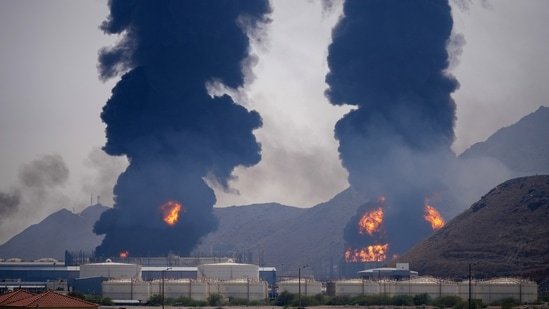
As the US-Israeli war in Iran continues, neither an exit plan nor an end in sight is predictable. The only thing certain remains the uncertainty, and Europe’s silence. Following the recent European Council Summit, which saw leaders call for de-escalation in the region, increasing protection of civilians and infrastructure, and protection of EU interests through maritime defence operations, Europe still finds itself stuck on the sidelines of this war. Not long ago, when US President Donald Trump and Vice President JD Vance dismissed the Russia-Ukraine War as “Europe’s war to fight,” with Vance’s blistering attack at the Munich Security Conference 2025, questioning whether European values are even worth defending, they planted a seed. That seed has now flowered into Europe’s coolly delivered response to Trump’s Iran adventure: We didn’t start it, we weren’t consulted, it’s not our war! While Trump’s ask for help from NATO allies has been backed by loose threats such as “if there is no response, or if there is a negative response, I think it will be very bad for the future of NATO,” Europe seems to have grown immune to his tactics.


Although the threat to European shipping lanes is real with Iranian strikes on crude oil and LNG carriers, most European nations have maintained a cautious response to the war, with a few allies openly opposing it. German Chancellor Friedrich Merz has underlined that “this war has nothing to do with NATO- it is not NATO’s war,” and UK Prime Minister (PM) Keir Starmer has also reiterated that “Britain will not be drawn into the wider war.” Estonia’s foreign minister has pointedly questioned Trump’s strategic goals and the plan ahead. Spanish PM Pedro Sánchez has been among the strongest critics of the war from the outset, describing the strikes as a violation of international law and a “serious mistake,” and even refusing to allow US forces to use jointly operated bases for strikes on Iran. It remains clear that while Europe shares America’s hostility towards Iran, sharing an enemy has not made it willing to share a war.
The Russia-Ukraine War is now in its fifth year and years of supplying Ukraine have left European defence stockpiles in a critically weakened state. Military allocations from the European countries have fallen by 57% in the second half of 2025, compared to the first half of the year, not because the will disappeared, but because the capacity had. The financial toll has been constantly staggering and Ukraine’s total “price tag” for the EU, adding together military aid, EU budget programmes, and refugee-related expenditure touches close to €90-100 billion annually. That is not an abstraction. It is money pulled from social budgets, borrowed against future growth, and felt in the pockets of ordinary Europeans, who have been already battered by inflation. In 2022-23 alone, the EU economy grew nearly two percentage points below pre-war forecasts, with countries bordering the conflict absorbing the sharpest economic blows.
This financial blow continues into 2026, making the European economics of staying out of the war, clear. With domestic economies under strain and national stockpiles depleted, Europe is not a continent holding back on Iran out of sheer indifference, it is a continent running on fumes. The Ukraine conflict never left the chat. Even as missiles strike across Iranian skies, the unresolved war on Europe’s eastern frontier continues, making it expensive, inconvenient, and strategically impossible for the European governments to pivot towards Iran. As many EU countries ramp up their defence spending to match or exceed the previous NATO target of 2% GDP defence spending and aim to achieve the new target of 5% annually by 2035, agreed upon at last year’s NATO Summit, Europe still lacks the operational capacity and political mandate to pull up a chair at Washington’s Iran table. Europe’s reluctance on Iran is not just political, it is arithmetic.
The transatlantic partnership has held strong through decades–through the Cold War, through the Balkans, through Afghanistan. The Trump administration didn’t just step back from Ukraine, it reframed the entire conflict in terms designed to absolve America of responsibility, in essence also re-writing the terms of the historic alliance. Ukraine became Europe’s war, Europe’s border, Europe’s problem. Trump cut military aid, reopened back-channels with Moscow without consulting Brussels, excluded the EU from negotiations that directly affected it, and nudged Kyiv toward a ceasefire that looked less like peace and more like managed defeat. For Europe, that experience left a mark and translated into institutional caution. Trust, once broken at this scale, doesn’t quietly repair itself between summits. That experience is now the invisible hand shaping every European statement on Iran. It is measured, non-committal, and fluent in the language of strategic restraint that America itself wrote.
Rather than an isolated emotional response to past grievances, Europe’s restraint on Iran is a rational recalibration of how alliances function in a realist world when reciprocity is no longer guaranteed. The Ukraine experience exposed a structural vulnerability at the heart of the transatlantic partnership, indicating that when collective security is treated as selectively applicable, it no longer functions as a credible deterrent for burden-sharing. Alliances held together by shared interest, rather than shared values, are nothing but transactional; and transactional arrangements are re-negotiated when the terms shift.
The more consequential question remains what this moment extrapolates for the future of the transatlantic partnership. Europe has been rearming at an unprecedented pace, deepening defence cooperation within the EU, and recalibrating its strategic autonomy. These trends were already underway before Iran, but have been meaningfully accelerated due to the war. A Europe less dependent on Washington for its security is not necessarily a Europe hostile to Washington, but it is one that will engage on its own terms. For NATO, the July 2026 Ankara Summit will be a critical test of whether the alliance can absorb this tension and articulate a renewed and mutually binding framework, or whether it continues to fragment along the fault line that Ukraine first exposed and Iran has since widened. History suggests that alliances do not collapse dramatically; they erode quietly, one unanswered ask at a time.
This article is authored by Shreya Sinha, postdoctoral researcher, School of Law and Government, Dublin City University.


