



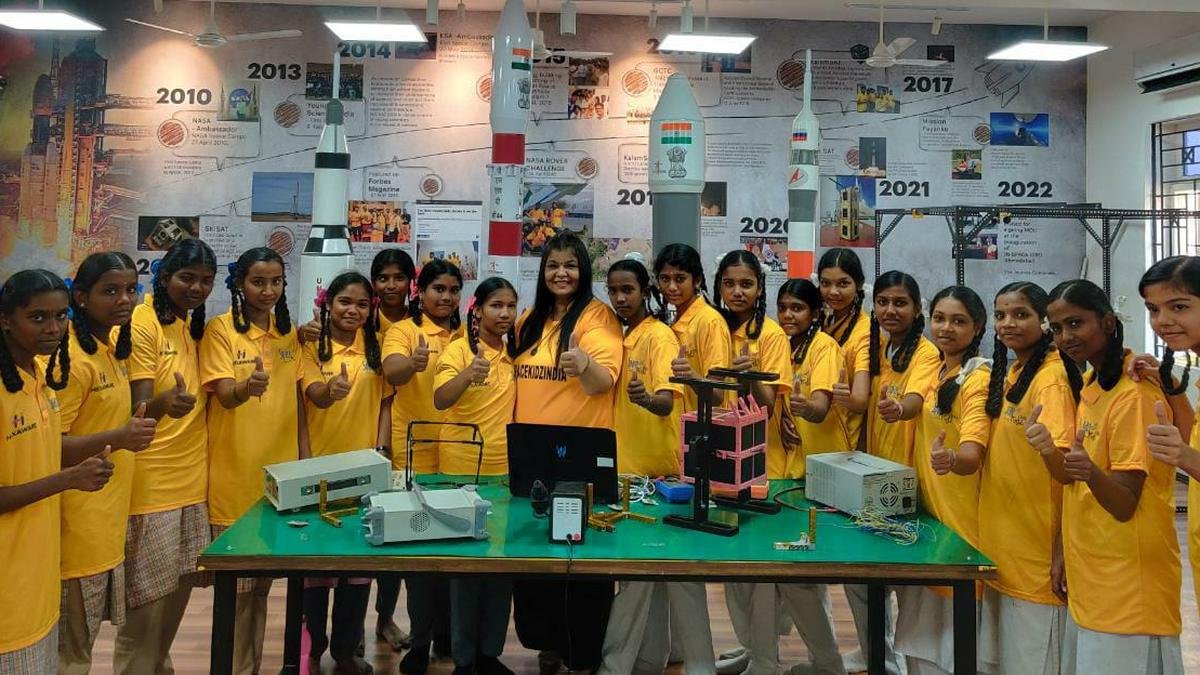
If there’s one thing that keeps Dr. Srimathy Kesan going, it is her “unwavering desire to create a platform for girls who are curious about space exploration and deep tech”.
The CEO and founder of Space Kidz India, a Chennai-based aerospace and defence start-up pioneering in the launch of small satellites and spacecraft, is all smiles as she talks about Mission ShakthiSAT — the first-ever female-led lunar satellite mission, supported by ISRO, IN-SPACe, and the UK-based Meridian Space Command.
Developed with a budget of ₹150 crore, the mission aims to train 12,000 girls from government schools in India and across 108 countries. The programme offers 120 hours of online training for students aged 14 to 18, with a focus on payload development, space technology, and spacecraft systems.
The mission was officially launched on January 16, 2025.
ShakthiSAT’s vision is not just about technical goals; it represents empowerment, innovation, and inclusivity.
“There’s a myth that rockets and satellites are predominantly for boys, and girls were discouraged from coming into this deep tech industry for ages,” Srimathy says.
“We need more women in this industry. Given an opportunity, women will excel, and there will be wonderful things that come out for humanity.”
Global mission
ShaktiSAT team at Rashtrapati Bhawan.
The launch of AzaadiSAT — an 8U Cubesat built by 750 girl students from rural India — by Space Kidz India, in association with ISRO (in August 2022), marked an attempt to bridge the gender gap in the space ecosystem and make space science accessible for more girls.
Though the mission was unsuccessful, failing to reach the Lower Earth Orbit, its successor AzaadiSAT-2 was successfully launched in the following year, a significant milestone for the student-led satellite project.
The success of the second mission made Srimathy ponder: why make the next mission just for Indian girls? That idea led to collaborations with 108 countries, including the UK, Brazil, Mexico, the UAE, Argentina, and some African countries joining the list.
“I thought this was the right time to scale it globally, and the response was tremendous, as if they were waiting for something like this,” Srimathy says with joy.
To take the mission forward, women ambassadors, who have made strides in the space and STEM fields, were selected to promote the mission’s goal in schools in their respective countries.
Despite the stringent timeline, a comprehensive curriculum consisting of 21 modules — touching upon what is space to propulsion data relevant for satellite or spacecraft development — was designed.
“We had about 20 professors from across the globe to prepare the curriculum, which is now available in English, Spanish, French, Portuguese, Hindi and Tamil,” she adds.
Workshop and online training
Students from Equatorial Guinea attending an online session.
For seamless sessions, students were given online training on the ZOHO platform.
“We posted the curriculum on their Learning Management System, onboarded students and gave them access to the study materials. We also provided them with videos in their respective languages to understand complex topics,” Srimathy says.
Tiya Jerath, a class XI student from Punjab, is all excited for the mission. She, along with 20 other girls in the class, has been training since August 2025.
“In the modules, the first section is divided into four parts — science, technology, engineering and mathematics, followed by activities and quizzes,” says the 15-year-old who wants to build a spacecraft when she grows up. Another student, Frida Oyana Edu’s entry to the mission, as she says, was “totally unexpected.”
The Equatorial New Guinea girl was never passionate about space or science, but during the course of the training, she realised what her true calling was.
“It was really difficult to go through the modules because it was fully online training and was not like a physical environment where I could ask the professor questions, but that has allowed me to improve my research skills,” she says.
For Sabine Manriquez from Mexico, acceptance to the programme was a dream come true. The 16-year-old student discovered Mission ShakthiSat through the social media of Mexico’s Ambassador Dafne Reyes.
“She called on young girls to apply to the programme, and I decided to participate,” says Sabine, who has passed out of high school.
And here’s the cherry on top: at the end of 21 modules, one student from each country, along with the ambassador, will travel to India on August 22 this year.
“Since I was a kid, I knew I liked space, but I never had the opportunity to access information as this course provides. It helped me a lot to know about Physics, and the structure of CubeSats.”Pilar González DepetrisStudent, Argentina
They will be building two satellites with Space Kidz students — one for Lower Earth Orbit (LEO) in collaboration with ISRO’s PSLV or SSLV, eyeing a launch on October 11, 2026, and the other for a lunar mission in partnership with ispace, a Japan-based lunar exploration company, planned for 2027.
“I have learnt about the process of design and development of CubeSats and the different subsystems that compose them,” she says.
“If selected to come to India, I will be looking forward to meeting girls from all around the world who share the same passion for space exploration, and I am also excited for the opportunity to gain hands-on experience by building a CubeSat,” a thrilled Sabine adds.
Students from Argentina during the ShaktiSAT workshop.
Payload development
When students from 108 countries come to India, they will be divided into four teams building four payloads, which will be integrated into an 8U Satellite — a high-performance CubeSat platform.
A 15 to 16kg payload will be launched into LEO through a satellite bus developed by the Space Kidz team.
“We are interacting with universities in Europe, Australia, and North America,” Srimathy says.
Payloads will be integrated with an ADCS (Attitude Determination and Control System) — an onboard system controlling a satellite’s orientation in space — that points towards the Earth, radiation sensors, and an Inertial Measurement Unit (IMU) device.
“We are planning to advance the satellite communication from the Ultra High Frequency dish to the S-band frequency,” she adds.
S-band signals are less susceptible to atmospheric attenuations (reduction in the light and radio signals due to particles present in the atmosphere), allowing reliable communication for satellites.
The ground station will communicate with the satellite, and the data received will be disseminated to all 108 countries, enabling students to conduct experiments and analysis.
“For the lunar probe, we are going to keep it as simple as possible. We will be launching a new satellite through ispace’s lander, which will carry a girl mascot, having the names of the children and people who donate to us for this mission.”
A greater vision
Srimathy’s entry to the field of space research was not planned, but a visit to NASA proved transformative when she realised the need to bring youth and mentor them through a platform that unlocks their potential. She believes this vision, realised through Mission ShaktiSAT, will have a far-reaching impact on India’s space ecosystem.
By bringing in around 300 students, the mission is expected to boost the economic, tourism, and education sectors.
“India is one of the most welcoming countries to come and launch a satellite, with no restrictive barriers. The students will experience the culture and development. What better word-of-mouth do we need?” Srimathy asks with a hint of pride in her voice.
Additionally, the programme will strengthen educational ties, with some countries already committing to scholarships for girls to study in India. “The High Commission from Mozambique and Eswatini have promised two girls from the mission scholarships to come to India to study,” she says.
Srimathy says, “More than anything, I think the girls will be instilled with hope, courage, and understanding of deep tech during the course of the mission. They need to have perseverance.”
Mission ShakthiSAT is just the beginning — the beginning of a global movement for girls who dared to dream big.


