



In the 2026-27 budget, the outlay for the PM-KUSUM scheme nearly doubled to Rs 5,000 crore, signalling the government’s renewed emphasis on increasing solar power production centred on India’s farmers. Specifically, the scheme aims to provide energy and water security to farmers, enhance incomes, and decarbonise the farm sector through decentralised solar pumps and power plants.
But as the scheme evolves, India also faces a question: how can solar be expanded on agricultural land without compromising food security?
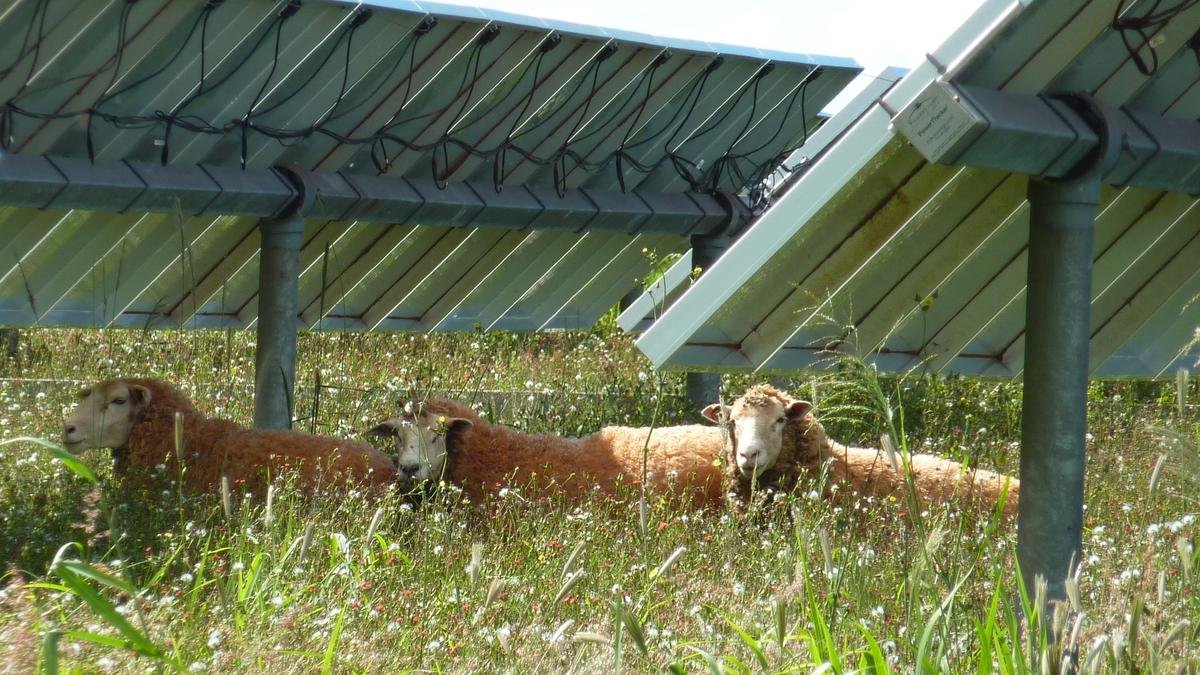
Agri-photovoltaics (agriPV) is emerging as a promising answer to this question. AgriPV integrates solar systems with farming, allowing farmers to generate electricity and cultivate crops on the same parcel of land. The panels are mounted at a suitable height to allow farm operations below, and are spaced between crop rows or integrated into greenhouses to minimise conflict between agricultural production and energy generation.
Selecting right crops
The designs vary by crop and region. Elevated systems have panels mounted a few metres above ground to allow crops to grow below. Row-based systems have panels positioned between crop rows to minimise shading. Vertical systems use upright panels that can capture sunlight from both sides. Greenhouse-integrated systems feature solar panels on roofs or walls to maintain a controlled growing environment. The suitability of a design also depends on the local climate, irrigation practices, and the crop. So systematic and region-specific planning is essential to optimise both agricultural and energy yields.
Careful crop selection is also key to the success of agriPV systems because the amount of sunlight available changes based on how solar panels are placed. Shade-tolerant crops generally perform well in partially shaded areas under solar panels while crops that need more sunlight grow better in the spaces between rows of panels.
Crop selection also varies across India’s diverse agro-climatic regions. For instance, suitable crop options include tomato, onion, garlic, turmeric, ginger, leafy vegetables, and tulsi in Madhya Pradesh, and ragi, jowar, grapes, tomato, potato, chillies, banana, and brinjal in Karnataka and Maharashtra — all of which can perform well in agriPV systems.
Beyond technical considerations such as crop selection, the scalability of agriPV hinges on developing viable business models. Farmers can own and operate agriPV systems, use a portion of the electricity generated, and sell the surplus. With the help of Farmer Producer Organisations or cooperatives, multiple farmers can also aggregate land and collectively develop projects, enhancing their bargaining power and access to finance.
Private developers could also lease farmland and share revenues or pay fixed rents to farmers. Alternatively, State governments or public agencies could develop agriPV systems to support local energy needs.
Why agriPV matters for India
India’s ambitious energy transition goals — to have 300 GW of installed solar capacity by 2030 and achieve net-zero emissions by 2070 — put land at a premium. Utility-scale solar projects require large tracts of land while agriculture is already under pressure from competing land uses.
AgriPV can ameliorate this conflict. With more than half of India’s land under agriculture, dual-use deployment is valuable. And in an economy that depends heavily on agriculture, the technology’s appeal lies in both farmers diversifying their incomes and producing clean energy. Farmers can earn from selling electricity, leasing land or sharing revenues while continuing to cultivate.
AgriPV also delivers environmental co-benefits. In certain agro-climatic conditions, partial shading can reduce evapotranspiration — the combined loss of water to the atmosphere through evaporation and plant transpiration — and soils retain more moisture, thus enhancing the overall water-use efficiency. Solar panels can also protect crops against extreme heat, rainfall, and hail. By lowering the farm’s need for diesel, such systems can also support rural entrepreneurship and local economic growth.
AgriPV can power ancillary services as well, including cold storage, food processing units, and chaff cutters, strengthening rural value chains. However, this requires clear governance frameworks, tariffs, and accessible finance.
Status in India
There are around 50 pilot agriPV installations nationwide, with various panel-crop combinations and economic feasibility under evaluation. Recent policy discussions have also increasingly referenced agriPV but large-scale replication has yet to commence. Both policymakers and experts need more empirical evidence across agro-climatic zones to say which configurations, crop matrices, and financial frameworks are most suitable.
The technology’s large-scale adoption in India does face economic, regulatory, and institutional barriers. Elevated structures and specialised mounting systems significantly increase capital costs, well above those of conventional solar systems. A crop’s responses to shading can vary and poorly designed systems may even reduce agricultural yields.
System ownership between farmers and developers could also raise doubts, particularly if long-term land rights and revenue-sharing arrangements are not fully clear. Land classification, grid connectivity, and tariffs hinge on regulatory clarity and the lack of design benchmarks adds to investor uncertainty.
Policy pathways
With the right policy support, agriPV has the potential to scale beyond pilot projects. Recent consultations on PM-KUSUM 2.0 have indicated that the government may include agriPV in a proposed ‘National Agri-photovoltaics Mission’ as a dedicated 10-GW component, with viability gap funding to offset the capital costs. Such measures could remarkably improve the bankability of agriPV projects and reduce the financial risk.
Clearly recognising dual-use configurations within PM-KUSUM 2.0 could help align agriPV with farmer-centric solarisation. States can reinforce this by identifying suitable clusters, streamlining approvals, and integrating agriPV into farmer training and advisory programmes.
As India rapidly advances in its energy transition, agriPV offers a pathway for renewable energy to complement agricultural productivity. Its inclusion under PM-KUSUM 2.0 could move it from scattered pilots to a more structured, scalable model, strengthening farmer incomes and easing land pressures.
Shantanu Roy is the Sector Coordinator of the Renewables and Energy Conservation sector at the Center for Study of Science, Technology and Policy (CSTEP), a research-based think tank.
Published – March 23, 2026 07:15 am IST


