


What kind of person feels compelled to archive a modern city as it disappears? Perhaps one whose earliest understanding of space was shaped not by the city itself, but by the village that once bordered it.


I was raised in Holambi Khurd, a small village on the northern edge of Delhi. It was a settlement of Jats, with a residential school, a little railway station, and many lakes and ponds. The centre of the village was surrounded by large agricultural fields. The settlement followed a spatial order that was neither accidental nor localised. It was a form repeated across north India. At its core lay the “abadi” land – the permanently inhabited nucleus of the village, densely populated and largely undocumented, yet sustained through unquestioned continuity of residence. These households often belonged to families with substantial agricultural holdings extending beyond the abadi area, binding land, lineage, and occupation into a certain social fabric.
Surrounding this core were lanes assigned to occupational communities. Barbers, potters, and blacksmiths all lived in defined proximity to the centre, integrated yet hierarchically arranged. Beyond them lay the Dalit settlements, spatially segregated by drains, fields, or roads, a pattern still visible across Delhi’s villages. This segregation was not incidental. It was, unfortunately, mandated by Brahmanical codes that prescribed it.
The dilution of this system has been slow and uneven, constrained by entrenched landholding structures and political realities that continue to shape access and exclusion.
These spatial distinctions persisted into my childhood, intersecting with social customs such as purdah and rigid gender hierarchies. Growing up within this framework, and later stepping outside it through boarding school, allowed for a gradual differentiation between inherited structure and lived constraint.
Daily travel across Delhi further sharpened this awareness. The city revealed itself through its Ring Roads. The Grand Trunk Road, laid out by Sher Shah Suri which still carries medieval alignments beneath modern traffic. Its earliest alignments can be traced to ancient trade routes described in Mauryan sources, particularly during the reign of Chandragupta Maurya in the 4th century BCE, when a road linked Pataliputra to the northwestern frontiers of the empire. The Wazirabad flyover marks an early moment of infrastructural ambition. The Red Fort, Metcalfe House, Rajghat, and the Yamuna ghats align imperial, colonial, and nationalist histories along a single axis. Entering south Delhi through Pragati Maidan, the Hall of Nations once stood as a monument to post-Independence confidence, a modernist assertion now erased.
In the 1990s, Civil Lines embodied elite aspiration through bungalows echoing Chandigarh’s visual language. Areas like Greater Kailash and Defence Colony developed a recognisable domestic architecture. Brick facades, ornamental mouldings, exposed concrete finishes, modest gardens, and functional rooftops formed a distinct urban vernacular.
This architectural language began to erode rapidly in the early 21st century. Regulatory changes after 2011 enabled vertical expansion, transforming scale and proportion. Houses that once defined Delhi’s streetscape were replaced by generic structures.
My academic training in history, archaeology, and art history sharpened my response to this transformation.
The disappearance of vernacular domestic architecture signals a deeper loss.
Houses in Delhi’s villages hold the flourishing social and cultural histories of the city’s early populations. Unlike the post-medieval Old Delhi, which underwent a profound demographic rupture during Partition, villages experienced relatively little displacement. Their houses, therefore, preserve long continuities of habitation, kinship, and local identity that urban neighbourhoods could not retain.
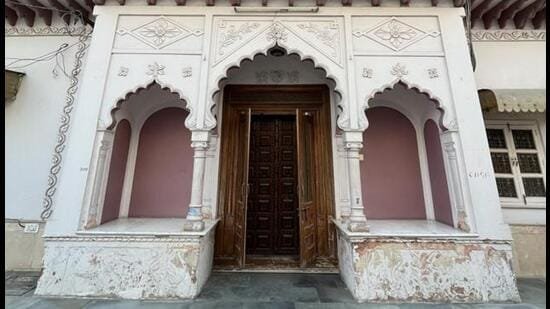
In documenting Delhi Houses, one observation became clear: they were stylistically plural. Art Deco forms were common, marked by pastel facades, geometric reliefs, and curved balconies. Art Nouveau houses stood beside them, distinguished by intricate ironwork, floral ornamentation, and saturated colours. These were not exceptional commissions, but ordinary domestic expressions shaped by local masons interpreting global styles.
Today, Delhi villages are undergoing a more fundamental rupture. The flexibility of land use classifications has enabled widespread misuse. Residential plots are converted into commercial spaces, rental blocks, factories, and entertainment venues. The village is marketed as an experience even as its material and social coherence collapses.
Hauz Khas Village and Shahpur Jat illustrate the commodification of heritage. Munirka, Holambi Khurd, Khera Khurd, and areas around Narela reveal a different trajectory, where agricultural land is absorbed into unregulated industrial activity.
Water systems have failed. Canals that once sustained cultivation now function as waste channels. Groundwater has receded. Municipal services rarely penetrate village interiors, leaving waste management to burning and informal disposal. The village is legally urban, yet administratively neglected.
What once signified continuity, memory, and obligation is now reduced to exchange value. Houses are rebuilt, subdivided, or sold. With this shift comes a quiet erosion of legacy, an understanding that something foundational has been surrendered without ceremony.
Coming from a Delhi village, my impulse to archive Delhi arises from this recognition. A city’s history does not reside only in monuments or master plans. It persists in neighbourhoods and in the passed-down way of living of people. To record this moment is not nostalgia; it is an attempt to read Delhi before its grammar disappears.


