








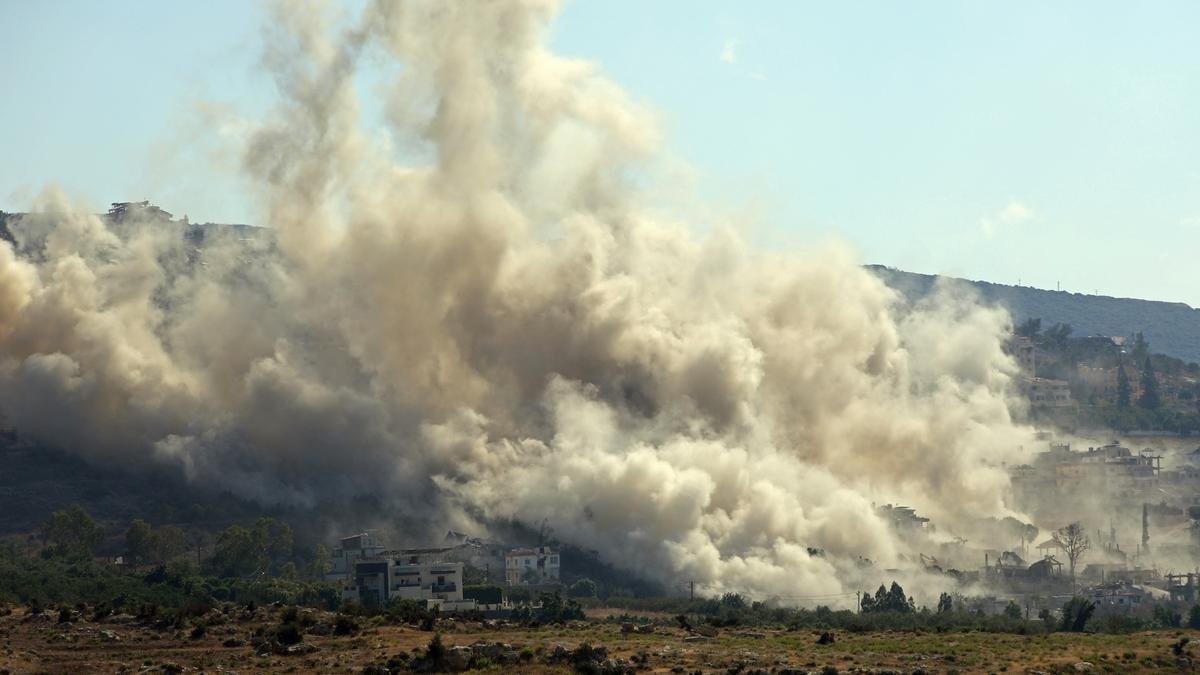
A southern Lebanese village shows smoke rising from the site of a controlled explosion on September 8, 2026.
| Photo Credit: AFP
Tensions between the United States and Iran flared again on Tuesday (September 8, 2026) night after U.S. forces struck five Iranian oil tankers in retaliation for what Washington said was Tehran’s attack on its warships near the Strait of Hormuz.
Iran responded by firing a barrage of ballistic missiles at the U.S. base in Al-Azraq in Jordan, and targeted at least 20 ships trying to pass through the Strait, according to the Islamic Revolutionary Guard Corps (IRGC).
This is the second U.S. strike on Iranian oil tankers in less than a week, which U.S. Central Command (CENTCOM) said was a direct response to Iran’s attacks on American warships enforcing a naval blockade on Iranian ports. Following the flare-up, Brent crude futures breached $100 a barrel on Wednesday, for the first time since July 2024.
West Asia conflict LIVE- September 9, 2026
On Tuesday night, CENTCOM said in a statement that U.S. forces destroyed five Iranian crude oil carriers after the IRGC targeted a Navy warship with ballistic missiles twice over the past two days. Iran’s attacks against the U.S. warships are seen as a risky move aimed at breaking the naval blockade which has largely prevented Tehran from exporting oil out of the Gulf waters.
Oil tankers destroyed
“In response to Iran’s most recent failed attacks, CENTCOM destroyed the IRGC crude oil carriers M/T Kaviz, M/T Charminar, M/T Horizon 1, and M/T Riesco in the Gulf of Oman as well as M/T Derya near Kharg Island. American forces directed the crews to abandon ship before the vessels were struck and rendered inoperable,” CENTCOM said.
On September 5, CENTCOM had announced that it had “destroyed” three Iranian tankers after the IRGC launched missiles at a U.S. aircraft carrier and a guided-missile destroyer. On Tuesday, the IRGC claimed that it had struck two U.S. Navy destroyers operating near the Strait of Hormuz. CENTCOM, however, said on Wednesday that no U.S. Navy warship had been hit.
“All IRGC attempted attacks failed. Meanwhile, U.S. forces have successfully destroyed 10 Iranian tankers in just the last week. These vessels were part of a multibillion-dollar shadow network that funds the IRGC, and Iran cannot defend them,” CENTCOM claimed in a social media post.
Crude futures cross $100/barrel
The war that U.S. and Israel initially launched against Iran on February 28 has gone through phases of escalation and temporary respite over the past six months. The latest phase has seen both sides increasingly target oil tankers, opening a new front in the naval war. As the crisis deepened, Brent crude futures breached $100 a barrel on Wednesday, for the first time since July 2024.
The IRGC said in a statement that its forces continue to exercise full control over the Strait of Hormuz. “The IRGC Navy, in response to the aggression and hostility of the U.S. military in its attack on five Iranian oil tankers in the Persian Gulf, targeted two U.S. vessels and eight oil tankers in the area, inflicting heavy damage on them,” it said, adding that 10 ships attempting to pass through “a prohibited and unsafe area” of the Strait were also targeted. “The Strait of Hormuz remains firmly under the surveillance and management of the capable and valiant IRGC Navy,” it added.
After striking the U.S. base in Jordan on Tuesday night, the Guards said the “punitive operation” damaged maintenance and repair facilities, deployment locations, and shelters for fighter jets. Jordan’s army said it had shot down 18 Iranian missiles targeting the kingdom.
The Guards also said on Tuesday that they had seized “one of the most modern, unmanned” American submarine drones in the Strait of Hormuz. According to the U.S. military, the drone was an “older model” and had “malfunctioned” and did not carry any sensitive data.
Published – September 09, 2026 09:47 am IST


