



From dark rooms to deep dives, the best music finds you when you’re actually listening


I wrote last time about a Pitchblack Playback deep-listening session I attended in Helsinki, and how it altered my view of an album I thought I knew intimately: Who’s Next by The Who. Hooked, I attended another session a couple of weeks later. This time it was another fabulous 1971 album, Marvin Gaye’s What’s Going On.
Such sessions are among the newer routes I have found to enjoy great music and perhaps discover new sounds. I promised more, last time, on routes to new music that did not involve Spotify and other algorithmic methods. Here we go.
NTS Radio, the revered London-based online station, is one such elsewhere. Earlier this year, Stephen O’Malley and Greg Anderson of the pioneering 1990s drone-metal band Sunn O))) took over the station for a three-part residency, and the results were a masterclass in unexpected connections. Anderson’s episode ranged from Nirvana and Mudhoney to Codeine and Sunny Day Real Estate. O’Malley’s two-part programme moved from Black Sabbath and Judas Priest through Terry Riley and John Coltrane to Olivier Messiaen and medieval sacred music. Messiaen to Sunn O)))… why had I never thought of that?
One may not think of it as a music platform, but the Internet Archive is a gift too: a vast, chaotic democracy of recorded sound. There, I found the complete works of Aadam Jacobs, a collector and archivist whose accumulation of live and unofficial recordings constitutes a kind of shadow history of 20th century music. Here were versions of songs I thought I knew, performed in rooms I will never visit, in years I did not live through.
Think, 22-year-old Kurt Cobain at a small Chicago club called Dreamerz, saying: “Hello, we’re Nirvana. We’re from Seattle,” captured on a Sony cassette recorder, in 1989. Surreal.
Streaming platform Mixcloud rewards patience of another kind. I have lost entire evenings to DJ 2tee’s long-form mixes there. These are sprawling genre-agnostic journeys that feel less like playlists and more like conversations. The platform’s architecture — no skipping, no shuffling — forces one to actually attentively listen.
Social media, for all its failures, occasionally delivers. I discovered the Canadian duo Angine de Poitrine (literally, Angina) through a fragment on YouTube. Their sound is something between post-punk and chamber music, built with a microtonal dexterity that suggests formal training refreshingly deployed in the service of total weirdness. I found an album or two and almost nothing else about them, which is itself a kind of recommendation.
Metacritic’s weekly new-releases listings have been quietly useful, less for the aggregated scores than for the names they bring to the surface. It is here that I first came to Noah Kahan, a while before he became a success story. His Vermont-inflected confessional folk-rock turned out to be rather more interesting than the genre description suggests.
Then there is Bandcamp, which occupies a philosophically distinct position from everything else on this list. It is a platform constitutionally opposed to algorithmic logic, its recommendations made by human writers, and its commerce model routing money directly to artists. Browsing here feels like walking through a well-curated record shop. This is how I found KLONNS, part of the new wave of Japanese hardcore, playing with controlled, mathematical ferocity something genuinely new in a form at least 40 years old.
KCRW, the Los Angeles public radio station, operates in a similar way. Its flagship show, Morning Becomes Eclectic, has been defying format since 1977, and its presenters’ instincts for placing the unfamiliar next to the canonical — a new Lagos funk band alongside a classic D’Angelo track — is something the algorithms genuinely cannot replicate.
The more established sources retain their place. Pitchfork magazine remains indispensable, despite a recent restructuring and downsizing. Its institutional snobbery has often been the cost of admission for wide-ranging coverage, and I pay it.
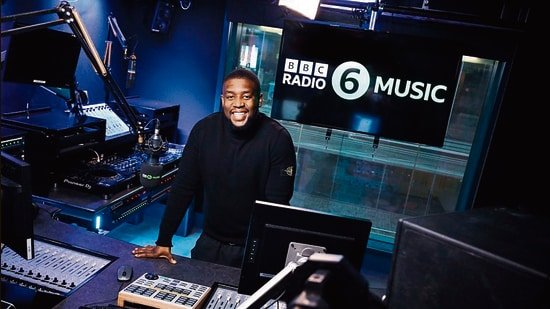
BBC Radio 6 Music remains the closest thing we have to the great late-night radio shows of the pre-internet era. Its recent scheduling has been quietly remarkable. Elbow’s Guy Garvey brings a musician’s ear and genuine warmth. Gilles Peterson evangelises for jazz and Afrobeat with the urgency of someone still amazed this music exists. Femi Koleoso, drummer and bandleader of Ezra Collective, now hosts The People’s Party on Friday evenings. Beth Ditto presides over Indie Forever Disco, going crazy in the gap between indie guitar music and the dance floor with the gleeful authority of someone who has always known these worlds belong together. And Jarvis Cocker, sitting in now for Iggy Pop on Sunday afternoons, might pair Ennio Morricone with a Sheffield post-punk obscurity, and it will make complete sense by the time he’s done.
The algorithms will catch up with some of this, eventually.
But the Pitchblack Playback session reminded me that there are things they cannot offer, like the experience of listening to music as an act of collective attention, to the exclusion of all else. Who’s Next has been available for over 50 years. I have heard it hundreds of times. Yet I heard it that evening as if anew, because the conditions of listening had changed, and because 44 minutes passed without a single notification, suggestion, interruption, distraction or invitation to skip ahead.
The algorithm has its uses. But it cannot give us that.
(To reach out, email sanjoy.narayan@gmail.com. The views expressed are personal)


