



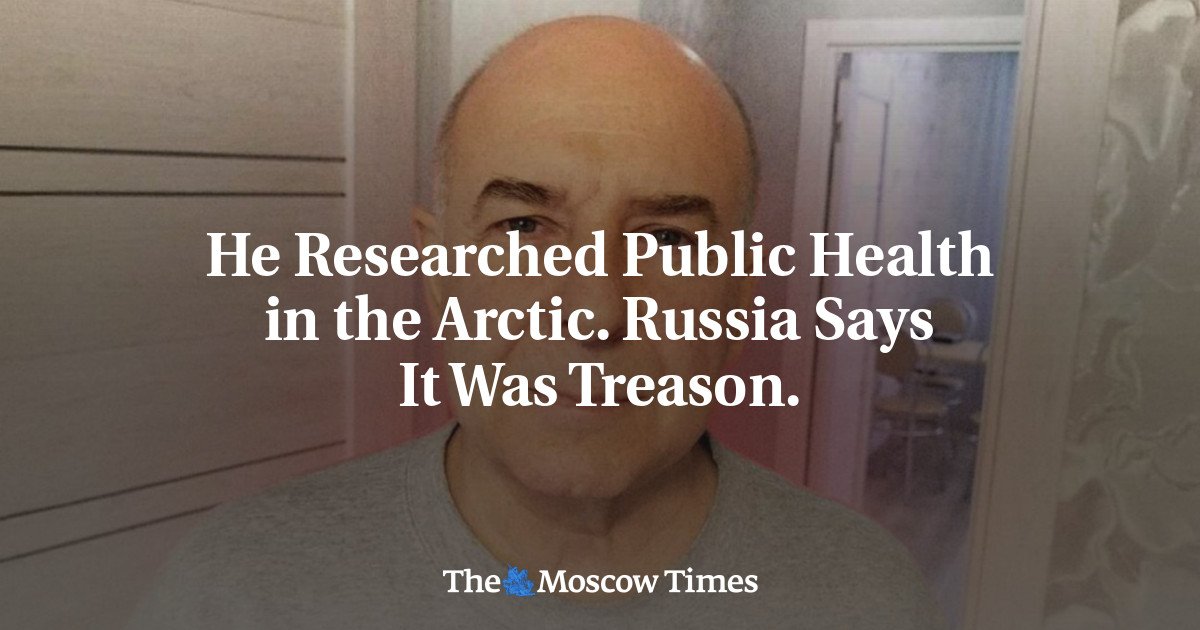
One of the last times his colleagues outside of Russia heard from him, Alexei Dudarev was excited to learn that a series of articles he’d co-authored was nearing publication. If he believed that he was in danger, he didn’t show it.
“I am very glad to hear from you,” the scientist and doctor wrote in an email to fellow members of a research group on Feb. 7, 2023, seen by The Moscow Times. “Otherwise I have already lost all hope of finding out what is happening with the articles.”
Until recently, Dudarev, 64, worked at a state-funded institution in St. Petersburg studying the health of people who live in Russia’s northernmost regions. Last month, reports started cropping up that left those same colleagues dumbfounded: he had been arrested for treason.
In proceedings shrouded in secrecy, authorities are advancing the dubious argument that Dudarev revealed sensitive information about Russia’s activities in the Arctic in published reports. He has denied the allegations.
Recent years have seen a surge in similar charges brought in Russian courtrooms, a development activists link to Kremlin paranoia and political repression amid the war in Ukraine. According to human rights advocates, prosecutors last year secured a record-setting 468 convictions for espionage, a category which includes treason and cooperation with state enemies.
Dudarev, who was arrested on his way to work on Jan. 14, has been in pre-trial detention for two months and faces up to life in prison.
Authorities say the evidence against him exists in broad daylight, but all that people who know him see is a victim of circumstance.
The dark side of the Far North
Before he was detained, Dudarev was a well-respected contributor to the Arctic Monitoring and Assessment Program (AMAP). The group is run by the Arctic Council, a forum composed of governments in the region, and focuses on understanding and finding solutions to the compounding effects of climate change and pollution on public health in the Far North.
Scholars in AMAP — which did not respond to an interview request about Dudarev’s work — come from universities and research institutions in the eight countries with territory above the Arctic Circle. That makes the program “a kind of global village,” said Pál Weihe, the co-chair of AMAP’s working group for human health assessment, which Dudarev also sat on.
Russian Defense Ministry
Dudarev joined in the mid-2000s and was one of AMAP’s longest-serving members. His geographic remit was also the largest: 53% of all Arctic coastline is contained in Russia, and north of the Arctic Circle its territory extends across a staggering 4.8 million square kilometers — a land of tundra, cities built on heavy industry and vast boreal forests where 2.5 million people live.
Relying on a mixture of surveying, interviewing and blood sampling, Dudarev published studies showing locals contending with both the toxic legacies of Soviet industrialization and global pollutants carried in through air and ocean currents.
Because treason cases are tried behind closed doors, the official reason for Dudarev’s arrest is murky. Authorities allege some of his AMAP reports contain sensitive information, presumably related to the military, that could have been used by Norwegian intelligence services.
Which reports contained the information in question, and what that information is, remain unclear.
Norway’s Armed Forces declined to answer questions about Russia’s allegations.
“We have no role nor knowledge regarding this case,” spokesperson Caroline Lysne said in a brief statement to The Moscow Times.
Pollution and its consequences
The Moscow Times contacted more than a dozen of Dudarev’s former AMAP colleagues. Most did not respond or declined to be interviewed, but two of them agreed to speak about their work with Dudarev and his character.
Both said that the news of his arrest had come as a shock.
“I was a bit astonished to see it,” said Weihe, the AMAP working group co-chair who is also a professor of public health at the University of the Faroe Islands. “I never associated him with any wrongdoing.”
Weihe had an especially close professional relationship with Dudarev. As part of their AMAP work, he had even visited the Russian scientist in St. Petersburg.
Weihe recalled Dudarev’s gift for entertaining a tableful of peers with stories and his love of fishing. On trips to the Faroe Islands, he would make a point of carving out time to go out casting for flounder and porbeagle, a small species of shark found in the north Atlantic.
“I will say he was a nice chap to have on board,” Weihe said. “I enjoyed his company.”
He finds it hard to imagine that Dudarev ran afoul of the Russian authorities — but this is the version of things he’s come to accept.
“Perhaps I’m a naive person who underestimates [how much] the authorities don’t like what we’re doing,” Weihe said. “We are documenting pollution, and pollution comes from polluters. And these polluters are not happy to see the consequence of their pollution.”
A former European colleague who requested anonymity due to the sensitivity of Dudarev’s case expressed similar confusion. Both she and Weihe said that Dudarev never voiced concern about angering the wrong people or being punished for his work.
“I don’t think he thought his work was sensitive. He probably thought if he didn’t do it, no one else would be doing it,” the researcher said. “He wasn’t doing anything but helping these people.”
PersonalLook (CC BY 3.0)
It was clear that Dudarev operated in the most ossified system of anyone at AMAP. Effecting change in Russia’s bureaucracy is hard. But she said that Dudarev, a trained doctor, was motivated by humanitarian concerns, like making sure people in rural areas had access to healthcare.
“After the Soviet Union collapsed, these people were not getting very much support,” the colleague said, remembering how Dudarev explained it.
She recalled how, in the early 2000s, Dudarev showed colleagues photographs of DDT pesticide barrels leaking in populated areas to convey the seriousness of Russia’s situation.
“I’ve often wondered,” she continued, “‘How does he have the energy to travel out into the boonies, stay there for a while, take blood from people, inform them and get their consent to participate?’ I mean, it took a lot of work on his part.”
New taboos
In recent weeks, the dominant reasoning among experts for the case against Dudarev has come to center around the nature of his research.
Ilya Shumanov, the co-founder of Arctida, which publishes investigations about the Arctic, believes authorities wanted to silence Dudarev because his work harmed Russia’s image.
“It looks like his articles were not in favor of the Russian official strategy to say that everything is good in the Russian Arctic,” Shumanov told The Moscow Times. “I think this is the main reason for his persecution.”
The region plays an increasingly important role in Russian domestic policy. Last year, President Vladimir Putin said that the Arctic “has become central to our development efforts,” and a 15-year strategy adopted in 2020 lays out a blueprint for the region’s future.
Russia is now investing billions of rubles into developing local industry, improving military preparedness, mining, drilling for oil and burnishing the Arctic’s reputation as an attractive place to live.
Something else may have aroused authorities’ suspicion, Shumanov added: Dudarev’s focus on the region’s largely marginalized Indigenous communities, which is “a very fragile and very sensitive topic for the Russian authorities.”
Yevgeny Smirnov, a lawyer from the human rights organization Perviy Otdel, which first reported Dudarev’s arrest, pinned the charges on authorities’ growing interest in suppressing unfavorable facts.
“This is a terrible case,” he told The Moscow Times. “More and more topics are becoming off-limits in Russia.”
Stanislav Krasilnikov / TASS
At the same time, he added, Dudarev’s arrest is not necessarily surprising. That’s because security forces have long targeted academics with intimidation and imprisonment, a practice which has further increased in the last decade.
More than 30 scientists are currently in prison on treason, espionage or similar charges, according to data gathered by exiled science outlet T-Invariant, which excludes this year’s arrests.
When some locals saw news of Dudarev’s arrest on a popular St. Petersburg discussion forum, they immediately perceived it amid this broader trend. One commenter wrote that the situation evokes memories of “Stalinist trials.” Another said that authorities shouldn’t be surprised to find a few years from now that “there is no science left in Russia.”
‘This Soviet feeling’
Dmitry Anisimov, a human rights activist and the spokesperson for the independent rights group OVD-Info, analyzed the case against Dudarev at The Moscow Times’ request.
He explained that while Arctic and Indigenous issues have become increasingly politicized, other scientists also persecuted for treason “studied completely apolitical topics.”
And even though information blackouts hampered a full assessment, he added that Dudarev’s case was in line with the FSB’s long history of clamping down on “entirely legal and out-in-the-open” academic activity.
“This is in order to reinstill in citizens this Soviet feeling, that somehow nothing will change,” he said. “It’s so that a person will think 100 times about the risks to them personally; so they are afraid to show themself and to come out against what is happening in Russia.”
Dudarev’s arrest comes at a difficult time for Russian academics. Recent reports indicate the number of publications by Russia-affiliated scholars has plummeted since the start of the war in Ukraine, from roughly 185,000 in 2022 to under 60,000 in 2025.
Reflecting on the situation, Shumanov saw in Dudarev’s case a small tragedy that, when multiplied, has contributed to the country becoming a “black box” of information.
He added that while he didn’t know Dudarev personally, something became clear in his extensive reading about the case: he’s not someone who can easily be replaced.
“I don’t think there are even a dozen scientists like him in Russia,” Shumanov said. “He’s only one of the few people who do this research.”
A Message from The Moscow Times:
Dear readers,
We are facing unprecedented challenges. Russia’s Prosecutor General’s Office has designated The Moscow Times as an “undesirable” organization, criminalizing our work and putting our staff at risk of prosecution. This follows our earlier unjust labeling as a “foreign agent.”
These actions are direct attempts to silence independent journalism in Russia. The authorities claim our work “discredits the decisions of the Russian leadership.” We see things differently: we strive to provide accurate, unbiased reporting on Russia.
We, the journalists of The Moscow Times, refuse to be silenced. But to continue our work, we need your help.
Your support, no matter how small, makes a world of difference. If you can, please support us monthly starting from just $2. It’s quick to set up, and every contribution makes a significant impact.
By supporting The Moscow Times, you’re defending open, independent journalism in the face of repression. Thank you for standing with us.
Continue
Not ready to support today?
Remind me later.
×
Remind me next month
Thank you! Your reminder is set.


