



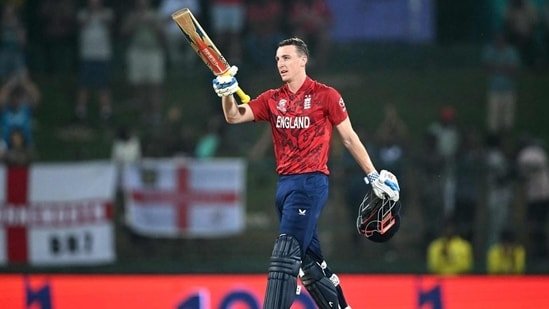
For every discussion about who could form the next Fab Four in world cricket, Harry Brook’s name inevitably surfaces. The “but” that follows, however, usually centres on his record away from home.
It was highlighted repeatedly ahead of England’s Ashes tour of Australia last summer. Brook averaged over 80 in overseas Tests, but those 11 matches had come only in New Zealand , where conditions mirror England’s, and in Pakistan, where flat pitches offered little assistance to bowlers. In Australia, he endured a modest campaign, scoring 358 runs at an average just under 40, with only two fifties.
In T20 cricket, Brook’s numbers away from home have been even less convincing. During his lone Big Bash League season with Hobart Hurricanes in 2021/22, he averaged just 6.28, managing 44 runs off 58 balls across seven innings. The stint was meant to prepare him for the 2022 T20 World Cup in Australia, but he returned for the ICC event and scored only 56 runs in five innings during England’s title-winning campaign.
In the IPL, where Sunrisers Hyderabad signed him for INR 13.25 crore, he produced a century to silence critics briefly. But that proved the lone highlight of his 2023 season, as he added just 90 more runs across his remaining 10 innings.
Which is why the 2026 T20 World Cup, played in testing conditions across India and Sri Lanka, was viewed as a defining examination of Brook’s credentials among the game’s elite. Yet his campaign began quietly. Aside from a half-century against Nepal in England’s opener, a match in which the former champions survived a scare, Brook managed only 102 runs in his first five innings.
Then came Pallekele.
On a night when England’s fielding was erratic and their batting faltered against Pakistan’s attack, Brook led from the front. Chasing 165 on a skiddy, previously unused surface, England slipped to 58 for four after Shaheen Afridi’s powerplay burst. Brook, promoted to No. 3 from his usual No. 5 role, had walked in at 0/1 after the first ball of the chase.
He never looked unsettled. There was fluency without recklessness. Control without caution. Even when Sam Curran fell and Will Jacks joined him with England wobbling, Brook maintained tempo. Their sixth-wicket stand, 52 off 31 balls, was defined as much by sharp running between the wickets as by boundaries.
That improvement was no accident. After taking a four-month break in 2022 following his grandmother’s death, Brook returned leaner and placed renewed emphasis on fitness and running between the wickets in the build-up to subsequent ICC tournaments. In Pallekele, that evolution was evident. Alongside his clean hitting, he ran nine twos, small margins that shift T20 games.
The composure England’s dressing room often speaks about was visible again after Tom Banton’s dismissal. Brook calmly took five successive singles, resetting the chase before launching again.
But the man Brook owed his performance to, and who did find a mention in his post-match chat with the broadcasters, was England head coach Brendon McCullum, who approached the batter on the morning of the big game to go up and bat at No. 3.
The tactical reasoning was clear. In the five innings leading into the Pakistan clash, Brook had been dismissed by spin four times in the middle overs. Against spin in T20Is, his strike rate hovered around 129. With the field up in the powerplay, however, he was freer. He swept Mohammad Nawaz for two boundaries and a six in the final over of the powerplay, shifting momentum decisively.
In the end, it was one innings, one statement, that carried England into the semifinals of the 2026 T20 World Cup with a Super 8 game still to spare.


