



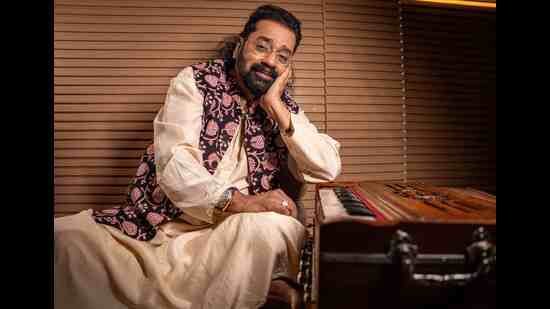
Your new album Jaan Meri marks 50 years of your journey as a ghazal singer. Do you remember the first ghazal that you sang?
That’s right; these 50 years have passed by so quickly! I am grateful to God and my audience for all the love they have given me. And yes, I clearly remember the ghazal that I started with: “Hasti apni habab ki si hai/ yeh numaish sarab ki si hai” by Mir Taqir Mir.
Ustad Ghulam Mustafa Khan Sahab, my guru from the Rampur-Sahaswan gharana taught me this and so many other beautiful ghazals. This musical training has been a blessing in my life.
Both my sons are involved in Jaan Meri. Akshay is the music producer. Karan has acted in the music video that accompanies one of the songs, Baat Se Baat. This makes me a proud father.
Poetry is the soul of ghazal gayiki. What was it like to work with Farhat Shahzad, who has written the lyrics for this album?
Words are chosen carefully for the meanings they carry and the stories they tell. They help you internalize the emotions in a song, and then express them with your singing. When Farhat Bhai shared the lyrics with me, I could visualize the characters in my mind and understand how they were feeling inside the depth of their hearts. This connection was important to make because I was not only singing all the songs but also composing the tu nes for them.
Working with Farhat Bhai is always special. We have known each other since 1983. All the songs in this album — Baat Se Baat, Bas Mere Khwaab, Lahu, Chala Gaya, and the title track Jaan Meri — are dear to me. Sufiscore has done a great job with presenting these songs.
How did you get to know Farhat-ji? What projects have you collaborated on?
Farhat Bhai is originally from Pakistan but he lives in the United States. Our friendship goes back a long way. We first met in Bombay, more than 40 years ago. I have sung many ghazals written by him — Kya Khabar Thi, Shaam Hai Pur Shabab, Yeh Waqt Dil, Kya Toota Hai Ander Ander, and Faisla Tumko Bhool Jaane Ka. The last two were part of an album to pay tribute to the late Mehdi Hassan Sahab, who was called Shahenshah-e-Ghazal.
Before the COVID-19 pandemic, I told Farhat Bhai that we should do an album together. When everyone was stuck at home, he began to write and send me ghazals, and I used to compose them. This musical back and forth is easily possible now because of technology. We enjoyed it.
Earlier, one used to hear of several collaborations between Indian and Pakistani musicians but that has become rare with political conflicts. You, for instance, worked with the Pakistani band Strings on a song called Bolo Bolo. How was that experience for you?
I had a lot of fun working with Bilal Maqsood and Faisal Kapadia from Strings. In fact, I remember the time when we shot the song in Dubai. I was running a fever. They were so helpful to me throughout that trip. I have also visited Pakistan, and done an album there. It is called Lahore Ke Rang Hari Ke Sang, and has songs written by Bulleh Shah, Amir Khusrau, Hasrat Mohani and others. When the situation between both the countries is good and peaceful, such collaborations can happen easily. But if there is a lot of tension, how will we do it? After all, we are citizens of the countries we live in. Politically, we have to be amicable to collaborate.
Your biography Ustad-e-Ghazal was released recently, and you are also working on a television show called Sartaj-e-Ghazal for Doordarshan. Tell us more about these.
It has been published by Sarv Bhasha Trust. Anand Kakkar, who wrote it in Hindi, has done a lot of in-depth research on my work. He has been immersed in the subject for many years. I was impressed by how exhaustive the book is. Hari Shankar Radhi translated it into English.
Sartaj-e-Ghazal is a musical reality show, a ghazal singing competition. I am responsible for the curation and the judging. We are inviting people from all over India to participate in it. What makes this show special is that it gives a platform to singers who want to devote themselves to ghazal singing. For any genre to sustain itself and keep growing, you need a lot of good practitioners, and a variety of musical talent. Just one or two people cannot keep it alive.
People like myself who grew up in the late 1980s and early 1990s associate you with Colonial Cousins, the pop music band that you formed with Leslee Lewis. What would you tell listeners who miss that kind of music, and are looking forward to a comeback?
Colonial Cousins got a lot of love from people across age groups. Both Leslee and I are very grateful for that. We are still together, and very much in touch. What a composer, what an arranger, what a person! He is like a brother to me. Let’s see. We might come up with something.
A lot of singers, composers and lyricists are now worried about Artificial Intelligence taking over human creativity and jobs. How do you feel about this issue?
Well, the reality is that you cannot stop machines from doing what they are created for. Let us look at how the Information Technology (IT) industry has grown. Initially, people were worried but they adapted themselves. They realized that it can bring prosperity. I think that something good will come out of the changes that are happening. There is no need to be fearful.
Chintan Girish Modi is a Mumbai-based journalist writing about books, music, films, theatre, and other art forms. He can be reached @chintanwriting on Instagram and X.


