



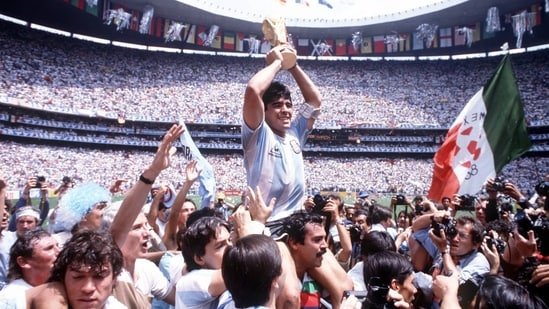
Forty years on, one afternoon in Mexico City still defines what football can be – Scandalous, sublime and utterly unforgettable.


The biggest World Cup in history is weeks away. Forty-eight nations, 104 matches, three host countries – the United States, Canada and Mexico, a tournament expanded so wide it can barely hold its own ambition. The Estadio Azteca in Mexico City will again host matches. Which means the grass of a ground that witnessed the most talked about eight minutes in football history will once more host the world’s game.
Forty years ago, on a sun-hammered June afternoon at the same Azteca, a stocky Argentine with a number 10 on his back compressed genius and deception in a single half, scored two goals that could not be more different, and sent his country to a World Cup final they would win. No single afternoon has shaped the sport’s mythology more.
The stage required context even then. The game was held four years after the Falklands War between Argentina and the United Kingdom, a key part of the intense rivalry between the two nations. Argentina had invaded the Falkland Islands, or Las Malvinas – the name you use determines your allegiance, a British overseas territory some 300 miles off the Argentinian coast. Hundreds had died on both sides. The wound was four years old and still raw. This was not just a quarter-final.
The fist of a nation
It was June 22, 1986. The Estadio Azteca was buzzing with tension as Argentina and England faced off. The first half had settled nothing. Then, six minutes into the second half, Diego Maradona initiated an attack before the ball was lobbed back in his direction by English midfielder Steve Hodge. Instead of his head making contact, it was his left hand, subtly flicking the ball past the goalkeeper, Peter Shilton. To the disbelief of the English players, the referee failed to see the handball, allowing the goal to stand.
England’s players erupted. The Argentine players, including Maradona himself, were rather calmer about it. “I was waiting for my teammates to embrace me, and no one came,” he later recalled. “I told them, ‘Come hug me, or the referee isn’t going to allow it.’”
After the match, when asked directly, he offered the line that would outlive him. “A little with the head of Maradona and a little with the hand of God.” The phrase stuck. The legend followed. Years later, Maradona acknowledged he had illegally handled the ball, saying he considered the goal symbolic revenge for Argentina’s defeat in the Falklands War.
Also Read: FIFA reveals 48 World Cup team base training sites
The goal the world stopped to watch
The England players were still furious, still wanting blood, when Maradona collected the ball four minutes later inside his own half. What came next rendered their anger irrelevant.
Maradona began a 60-yard, 10-second dash toward the English goal, passing four outfield players – Peter Beardsley, Peter Reid, Terry Butcher twice, and Terry Fenwick- before a feint left goalkeeper Peter Shilton on his bottom, the ball slotted into the empty net.
The men tasked with stopping him could only watch him go. The English players were still fuming, several surely wanting to snap his leg in two – in an era where violent tackles were the norm, they would have tried if given the opportunity. Maradona gave them one. He was unstoppable.
Argentine commentator Victor Hugo Morales, overcome, asked the question the entire planet was silently asking: “What planet did you come from?” Even Garry Lineker, the man who had pulled one back for England in the 81st minute, could not pretend otherwise. “I felt like applauding. I’d never felt like that before. It was impossible to score such a beautiful goal.” In 2002, a worldwide FIFA poll confirmed what the heart already knew, voting it the Goal of the Century.
What followed
The final was held at the same Estadio Azteca on June 29. Jose Luis Brown headed Argentina in front in the 23rd minute, and Jorge Valdano doubled it in the 56th. West Germany clawed back to 2-2 through Karl-Heinz Rummenigge and Rudi Voller. Then, in the 84th minute, although heavily marked throughout, Maradona slipped a pass to Jorge Burruchaga, who slid it home. Argentina 3, West Germany 2. The trophy was theirs.
No other player, not even Pelé in 1958 or Paolo Rossi in 1982, had dominated a single World Cup the way Maradona did in Mexico. Five goals, five assists, the Golden Ball, and a nation carried to glory on one man’s shoulders.
As the World Cup returns to these same latitudes – to North America, to the continent where Maradona made history, a generation of players will chase moments to call their own. They will find the bar impossibly high. On one afternoon in 1986, one man set it there and never came back down.


