









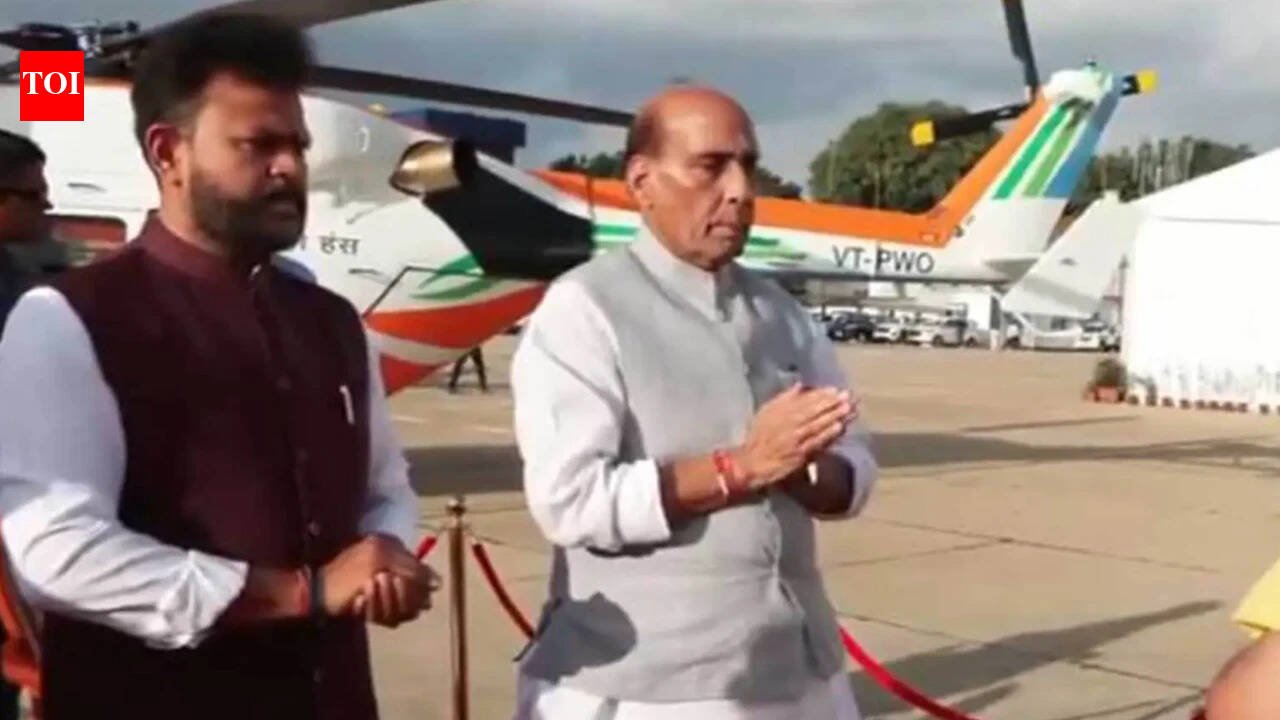
BENGALURU: Defence PSU HAL Friday handed over two LCA Tejas twin-seater trainers in the final operational clearance (FOC) configuration, and the first of the HTT-40 basic trainer to the Indian Air Force (IAF), while also handing over four Dhruv Next Generation (Dhruv-NG) helicopters to Pawan Hans Limited.The LCA trainer delivery completes the twin-seater deliveries under the FOC contract, while the Dhruv-NG and HTT-40, whose name “Ankur” was formally announced Friday, marks the beginning of the deliveries under those respective contracts.Defence minister Rajnath Singh, and civil aviation minister K Rammohan Naidu were present at the handing-over ceremony. The LCA FOC Trainer is a lightweight, all-weather, multi-role aircraft to support IAF’s Tejas training requirements. It can undertake fighter operations when required.“It incorporates contemporary technologies including: relaxed static stability, quadruplex fly-by-wire flight-control system, carefree manoeuvring, advanced glass cockpit, integrated digital avionics and advanced composite materials for the airframe. These have enabled India to develop and operationalise an advanced twin-seat fighter aircraft capability,” HAL said.A contract for 16 LCA fighter aircraft and four FOC Trainers was placed in 2010 by MoD/IAF, a year after Aeronautical Development Agency (ADA) achieved FOC.“In 2022–23, all 16 FOC fighter aircraft were delivered. Sept 2023 saw the release to service (RSD) milestone for the twin-seater. In 2024-25, delivery of FOC trainers began with SPT5 and SPT6, while the final two — SPT7 and SPT8 — were produced. In Nov-Dec 2025, software-defined radio (SDR) was incorporated on the final two,” HAL said.The SPT7 and SPT8 had enhancements of radar, autopilot, fuel-system, avionics software and air-to-air refueling probe. Looking ahead, HAL said it’s focussed on LCA-Mk1A twin-seaters being developed under the 83 and 97-aircraft contract. “While the 83 contract trainers will have enhanced capabilities, those under 97-contract will incorporate capabilities of Mk1A fighter,” HAL said.“The capabilities include AESA (Active Electronically Scanned Array) radar, electronic warfare suite, avionics upgrades, modernised mission and display systems, LDP4i (Litening 4i Laser Designator Pod) integration, IRNSS, HMDAS DASH V (an advanced helmet-mounted display system), additional weapons capabilities, including beyond visual range and advanced short range air-to-air missile,” HAL said, adding that it hopes to deliver 29 Mk1A twin-seaters by 2033–34.
HTT-40 ‘Ankur’
The HTT-40 handover marks the beginning of deliveries under MoD’s 70-aircraft contract. It is designed for multiple stages of basic pilot training, including basic training, aerobatics, general handling, instrument flying, navigation, night flying and close formation flying.“It is supported by a broader training ecosystem comprising cockpit procedure trainer (CPT), full base fixed mission simulator (FBFMS), computer-based training (CBT), which complement flying training and enable trainees to familiarise themselves with aircraft procedures, systems and mission-related activities,” HAL said.“Ankur, powered by a 1,100 SHP turboprop engine has a maximum speed of 300 knots, normal training weight of 2,960 kg, service ceiling of 6,000 m, range of 1,000km, endurance of around 3 hours with a fuel capacity of 450kg. It has a 11-m wing span, 10.06-m length, 3.5-m height, maximum load factor of +6/-3g, ejection seat and features an air-conditioned cockpit and modern avionics system, supporting the requirements of contemporary military pilot training,” it added.Designed by HAL’s Aircraft Research and Design Centre (ARDC), the aircraft can provide good low-speed handling characteristics and effective training for trainee pilots. It completed the first flight on May 31, 2016, underwent an extensive programme of development, evaluation and validation trials with HAL and IAF.“The aircraft has completed trials covering handling qualities, stability and control, systems performance, engine relight, hot-weather operations, sea-level operations, crosswind operations, night flying and range and endurance.
Dhruv-NG
The Dhruv-NG is a 5.5-tonne, light twin-engine, multi-role helicopter developed to address demanding operating conditions in India and upgraded for the requirements of the global civil aviation market.“It’s India’s first indigenously produced civil helicopter meeting the AS-4 requirements, making it suitable for offshore operations. The helicopter is equipped with twin Shakti 1H1C engines, and features civil-certified glass cockpit, modern avionics suite, advanced navigation systems and enhanced situational awareness,” HAL said.It added that safety features include crashworthy seats, self-sealing fuel tanks and a twin-engine configuration providing redundancy. “Dhruv NG has a configurable cabin that can be adapted for different civilian roles, including: VIP/VVIP transport (luxury for 4–6 passengers), passenger/utility (up to 14 passengers) air ambulance (four stretchers, a doctor and an attendant), specialised operations, including offshore operations, law enforcement, disaster relief and search & rescue,” HAL said.The PSU is also offering after-sales and lifecycle support. Integrated logistics support will include power-by-hour (PBH) and performance-based logistics (PBL) models for fleet serviceability.


