



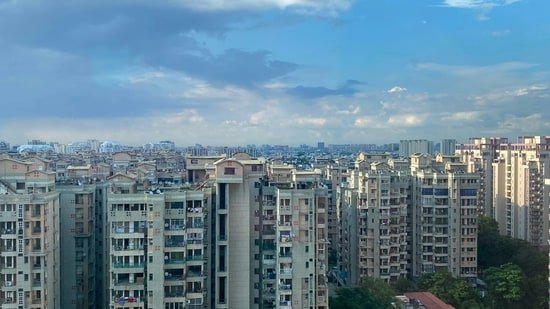
Gurugram has edged past Mumbai as India’s new luxury housing capital, with high-net-worth individuals (HNIs) and NRIs increasingly favouring the Millennium City. Buyers are drawn to expansive gated communities, golf-course living, and large-format, premium developments that offer lifestyle amenities and social capital where the country’s wealthy congregate, factors that increasingly shape purchasing decisions in the ultra-luxury housing segment.


However, a key question remains: can demand for ultra-luxury housing sustain its current momentum, or could a growing pipeline of high-end supply create a demand-supply imbalance and raise concerns of a potential bubble in India’s premium residential market?
A recent luxury housing report by India Sotheby’s International Realty and CRE Matrix shows that Gurugram surpassed Mumbai in total sales value of homes priced at ₹10 crore and above in 2025. The city recorded ultra-luxury transactions worth ₹24,120 crore during the calendar year, emerging as India’s fastest-growing premium residential market, compared with Mumbai’s ₹21,902 crore in the same category.
Aakash Ohri, MD and CBO, DLF, said that Gurugram has firmly transitioned into a market where luxury real estate is no longer niche but increasingly mainstream. Strong demand in the ₹10 crore+ segment reflects a decisive shift from mere ownership to the pursuit of a superior living experience, defined by larger, well-designed homes in gated projects offering privacy, security, lifestyle amenities, wellness, curated community amenities, and robust social infrastructure.
“This momentum is driven by sustained wealth creation across technology, start-ups and financial services, alongside a growing base of entrepreneurs and senior professionals. Importantly, the luxury buyer profile is becoming younger, with discerning buyers in their early 30s now actively investing. At the same time, consistent NRI demand underscores the appeal of these developments as they offer a global lifestyle benchmark aligned with what they are accustomed to overseas,” he said.
Another highlight of the week was a high-profile transaction involving Ajit Jain, vice chairman of insurance operations at Berkshire Hathaway, led by investor Warren Buffett. Jain purchased a 7,400 sq ft apartment at DLF The Camellias for around ₹85 crore. The transaction is understood to be the highest-priced deal for the project’s introductory 7,400 sq ft configuration, setting a benchmark of nearly ₹1.10 lakh per sq ft.
Gurugram versus Mumbai fuels online debate
This has sparked a discussion on Reddit about whether Gurugram has pipped Mumbai as the capital of luxury real estate. For years, Mumbai dominated India’s luxury real estate market, with most ₹10–20 crore home purchases concentrated in South Mumbai, Bandra and Worli. While Gurugram had a presence, it was not considered the country’s top luxury destination. That dynamic is now changing.
Larger ticket sizes, newer housing inventory and the availability of expansive land parcels suited for large-format luxury developments have helped Gurugram emerge as a strong contender. At the same time, Mumbai’s pricing has already stretched affordability even for wealthy buyers, the Reddit post said.
Another key driver is the evolving buyer profile. NCR’s growing corporate ecosystem and startup founders prefer Gurugram’s corporate culture over the traditional business environment in Delhi, said one Redditor.
For many affluent buyers, gated townships in Gurugram offer practical lifestyle advantages, including organised parking, access to amenities such as pools, tennis and badminton courts within walking distance, enhanced safety, and a community of like-minded residents, the post said.
“To avoid daily quarrels regarding parking, get access to pool/tennis/badminton court etc for their kids at walking distance, safety of a gated township, company of like-minded people,” the post noted
“This is why 100cr flats are selling and they are not buying a kothi in Vasant Vihar,” the Redditor said.
Generational preferences are also reshaping demand. Many younger Delhiites are choosing to move out of the capital unless they already own homes in its most elite neighbourhoods, while their parents continue to live in Delhi. Compared to Noida, Gurugram benefits from stronger connectivity to Delhi through multiple entry corridors such as MG Road, NH-8 and the Dwarka Expressway, further reinforcing its appeal as NCR’s preferred luxury residential hub, the post said.
Bigger homes, better value: Why HNIs are preferring Gurugram over Mumbai
Various factors, including value, supply dynamics and location advantages, are the reasons behind this trend.
“The ‘value for money’ factor or the ‘space vs price’ reality is seen to be attracting HNIs to Gurugram’s ultra-luxury market. For instance, in upscale South Central areas of Mumbai (Worli, Tardeo, Prabhadevi), one will get a relatively smaller-sized home in comparison to probably a large estate in Gurugram with private golf courses, Olympic-size pools and large green spaces,” said Santhosh Kumar, vice chairman, ANAROCK Group.
Further, there’s a surge in HNIs in Delhi-NCR, fuelled by the booming start-up ecosystem there, and many of these founders prefer to buy here in Gurugram rather than in Mumbai, he said.
“Gurugram’s ultra-luxury market is driven largely by deep-pocketed end users and long-term investors who view these homes as trophy assets rather than speculative inventory. Many HNIs continue to hold large-ticket residences acquired years ago that are today valued at ₹40–100 crore or more, reinforcing confidence and repeat buying. Compared with Mumbai and other cities, where ultra-luxury supply is fragmented and space constrained, Gurugram offers a more cohesive, master-planned ecosystem that supports long-term ownership, even for families not based in the city full-time,” explains Kshitij Jain, founder and director, Rizin Advisory.
Mumbai real estate firms enter Gurugram to tap rising demand for premium housing
Besides local prominent developers in the region, a few Mumbai-based developers have also shown interest by purchasing land in Gurugram. The city has attracted many large developers because of ample land availability, unlike land-starved Mumbai.
Further, projects in Gurugram recently sold out within days of launch, unlike the Mumbai market, where projects take time to sell due to ample availability. This may have also attracted developers, Kumar explains.
Will demand for ₹50-crore homes hold steady?
Unlike in previous years (2023, 2024), the ultra-luxury market ( ₹50 crore and above) in Gurugram is currently entering a normalisation phase, with sales entering a cool-off period.
“Going forward, demand in this segment will essentially remain resilient if there is no oversupply because several ultra-luxury buyers prefer limited trophy homes over homes that are in abundance,” notes Kumar.
The ₹50-crore-plus segment here has historically been defined by limited supply on Golf Course Road, where quality and lifestyle offerings have consistently improved. As long as this segment remains tightly controlled and not oversupplied, absorption should remain resilient, and pricing is likely to maintain a steady state, long-term upward trajectory, said Jain.
₹10-crore housing market may see moderation in sales, say experts
For homes in the ₹10-crore-plus segment, sales may taper due to high new supply, potentially leading to inventory pile-up if supply isn’t curtailed.
“Moreover, we have also seen investors come forward as new supply in this segment by leading developers began to enter the market in the last few years. But now these investors are also treading with caution as the market has somewhat stabilised after the frenzy seen earlier. Hence, major sales will be seen by the end-user HNIs and NRIs,” said Kumar.
Kumar added that while homes priced below ₹50 crore could continue to witness annual price appreciation of around 6–8%, supported by limited availability, the ₹10-crore segment may see limited growth. If not, a decline. The segment has seen substantial new supply over the past one to two years, reducing the scarcity premium that earlier supported price gains.
Also Read: Are ultra-luxury properties the new blue-chip stocks for India’s wealthy?


