



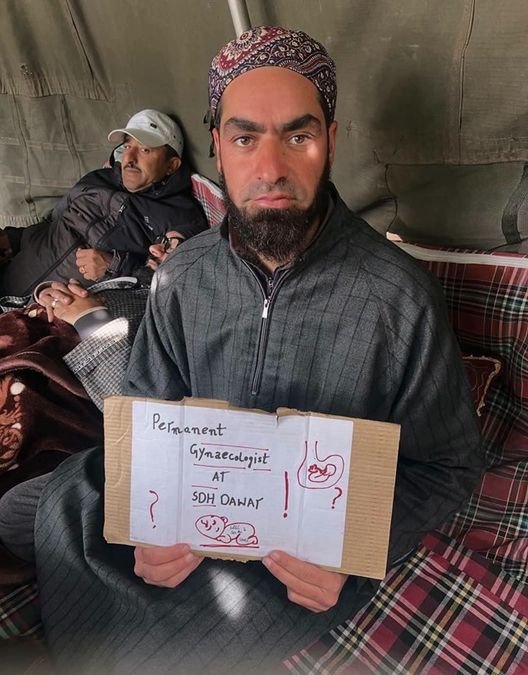
Srinagar, Oct 24: With healthcare facilities falling short of their basic needs and the harsh winter approaching, residents of Gurez in north Kashmir’s Bandipora district have begun an indefinite hunger strike, which entered its third consecutive day on Saturday, demanding urgent healthcare reforms and an end to what they describe as years of neglect.
The protest has brought together people from different walks of life, united by a demand they say is fundamental: access to timely and reliable medical care in their remote valley, where even a medical emergency can turn into a desperate race against time.
Arshad Ahmad, a resident of Gurez, said people had been gathering at the headquarters in Dawar to demand better healthcare facilities and round-the-clock availability of doctors at the centrally located hospital.
“There is no permanent gynaecologist, no blood bank, no radiologist and no functional operation theatre. How can people be expected to feel safe when even basic medical facilities are missing?” he asked.
For pregnant women, the lack of healthcare facilities becomes particularly distressing as winter approaches. With Gurez remaining cut off for nearly six months because of heavy snowfall, many women are forced to leave their homes as early as September and travel to Bandipora or Srinagar to ensure access to maternity care.
They often remain away from their families until spring, enduring months of separation at a time when they need comfort, care and the support of their loved ones the most.
“Imagine the pain a pregnant woman has to go through when she is forced to leave her home for six months just to deliver her baby safely. Think about the emotional and financial burden on these families. This is not just about hospitals; it is about the dignity and safety of our people,” Arshad said.
Gurez, with a population of around 40,000 spread across 29 villages, depends on the Community Health Centre (CHC) at Dawar as its principal healthcare facility. However, residents say the hospital continues to face severe staff shortages, with several essential specialist services unavailable.
The residents said there has been no creation of posts for a radiologist, and technicians. The shortage affects other facilities in the region, including PHCs at Sheikpora Tulail and Badugam, NTPHCs at Bagtoor, Barnal and Gujran, and the MAC at Badwan Gurez.
The crisis is particularly severe for low-income families and daily-wage workers, who struggle to meet the additional expenses of staying in Bandipora or Srinagar for weeks or months to ensure safe deliveries. For families dependent on seasonal employment, arranging accommodation, food and travel adds to an already difficult financial situation.
Although the district administration operates helicopter services to evacuate patients between Gurez and Bandipora during winter emergencies, residents say the service cannot offer a dependable solution in every situation.
“Patients can be airlifted only when the weather is favourable. What happens when someone is critically ill and the weather does not permit a flight? For people here, every delay can become a matter of life and death,” Arshad said.
The anger has intensified following the death of a pregnant woman and her unborn baby in Gurez around two weeks ago. The tragedy triggered a shutdown and protests, with residents alleging that a delay in shifting the woman to a hospital in Bandipora contributed to the deaths.
The incident has renewed concerns over the consequences of inadequate specialist care and the difficulties of transporting critically ill patients from the remote region.
A senior health official acknowledged that no new posts had been created for around a decade, despite an increase in population, and said the resulting gap between healthcare requirements and available manpower had become a concern.
The situation reflects wider challenges in rural healthcare delivery across Jammu and Kashmir. According to the Union Health Ministry’s Health Dynamics of India (Infrastructure and Human Resources) 2022–23 report, rural Community Health Centres in the Union Territory face shortages of specialist doctors and paramedical staff.
