


Walk into any neighborhood nursing home in India, and you’ll find something that large hospitals often struggle to replicate—trust.
These facilities are deeply embedded in their communities. Patients know the doctors, the staff recognizes returning families, and care feels personal. But behind this familiarity lies a structural challenge that has limited their growth for years.
Most nursing homes operate within just one or two specialties. Not because patients don’t need more—but because expanding beyond that has traditionally been difficult, expensive, and risky.
Why Growth is Hard
Adding a new specialty isn’t as simple as bringing in another doctor. It requires sustained patient volumes, investment in equipment, additional space, and the ability to retain specialists full-time. For smaller setups, this is a big ask.
So the default solution has been referrals. A patient walks in with a cardiac concern or a skin condition beyond the clinic’s scope—and is sent elsewhere. Clinically, that may be the right call. But from a business perspective, it creates a silent drain. Because more often than not, that patient doesn’t come back.
What gets lost in that referral is not just a single consultation fee. It’s everything that follows—diagnostics, pharmacy, follow-ups, and in many cases, the patient’s long-term loyalty.
Over time, this adds up. Nursing homes continue to see high footfall, but their ability to capture value from that footfall remains limited.
A Shift That’s Changing the Equation
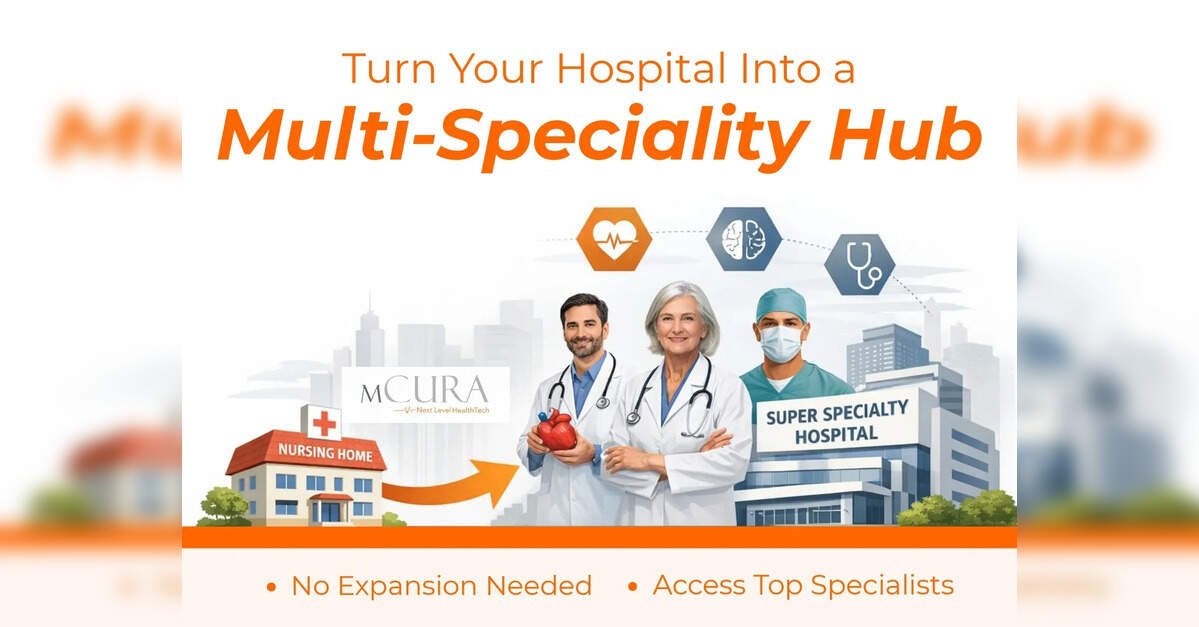
Things begin to change because instead of trying to build multi-specialty capabilities from scratch, many nursing homes are now tapping into a more flexible model—one that allows them to offer specialist care without owning it outright.
Think of it as “expansion without expansion.”
Through technology platforms like mCURA, providers can connect to networks of specialists and bring those services into their existing setup. The patient still visits the same clinic, sits in the same waiting area—but gains access to a much wider range of expertise.
The shift is subtle but powerful. A patient visiting a nursing home for a routine consultation can now be guided into a specialist consult—sometimes through a visiting doctor, other times through a digitally assisted setup. The entire interaction, from symptoms to prescriptions, is captured and managed through a structured system.
Platforms like mCURA’s Smart OPD are designed to make this seamless. They don’t just enable video consultations—they bring together patient records, clinical workflows, prescriptions, diagnostics, and follow-ups into one connected loop.
For the patient, it feels like continuity, and it opens up entirely new possibilities for the provider.
More Care, Same Infrastructure
What makes this model particularly compelling is that it doesn’t demand physical expansion. There’s no need to add beds, build new departments, or invest heavily in equipment.
Yet, the impact is tangible:
- More services can be offered under one roof
- Patients are less likely to be referred out
- Diagnostic and pharmacy conversions improve
- Revenue per patient increases
At the same time, patients benefit from easier access to specialists without the need to travel across the city or navigate large hospital systems.Built for How India Seeks CareHealthcare in India is not centralized—it’s local. People prefer going to facilities they know, in neighborhoods they trust. Speed, familiarity, and convenience often matter as much as clinical expertise.
This is why the multi-specialty hub model fits so naturally into the Indian context. It strengthens what already works—local trust—while layering on capabilities that were previously out of reach.
It’s important to understand that this isn’t just about putting a doctor on a screen.
What’s emerging is a far more structured OPD ecosystem—where patient intake, symptom capture, consultation, prescriptions, diagnostics, and follow-ups are all integrated.
This kind of system not only improves clinical documentation but also reduces leakages that typically occur in fragmented care journeys.
The Technology Question
As nursing homes adopt these platforms, one practical question often comes up: where does all this data live?
Some providers prefer an on-premise setup—a small server within the facility that keeps data local and reduces dependence on internet connectivity. Others lean toward private cloud models hosted within India, which allow easier access, scalability, and integration.
Increasingly, a hybrid approach is becoming common. Solutions like mCURA support this flexibility, allowing providers to choose what works best for their scale and setting.
For years, growth in healthcare has been synonymous with expansion—more beds, bigger buildings, larger teams.
But for nursing homes, that path isn’t always practical.
What’s emerging instead is a different way of thinking: growth through connectivity. The ability to plug into networks, extend capabilities digitally, and deliver more value without increasing physical footprint.
In that sense, the future may not belong only to large hospitals. It may well belong to smaller, smarter, connected care hubs—quietly transforming how healthcare is delivered, one neighborhood at a time.
Disclaimer- The views/suggestions expressed in the article are the sole responsibility of the brand connected, this should not be considered as a substitute for medical advice. Please consult your treating physician for more details.
