



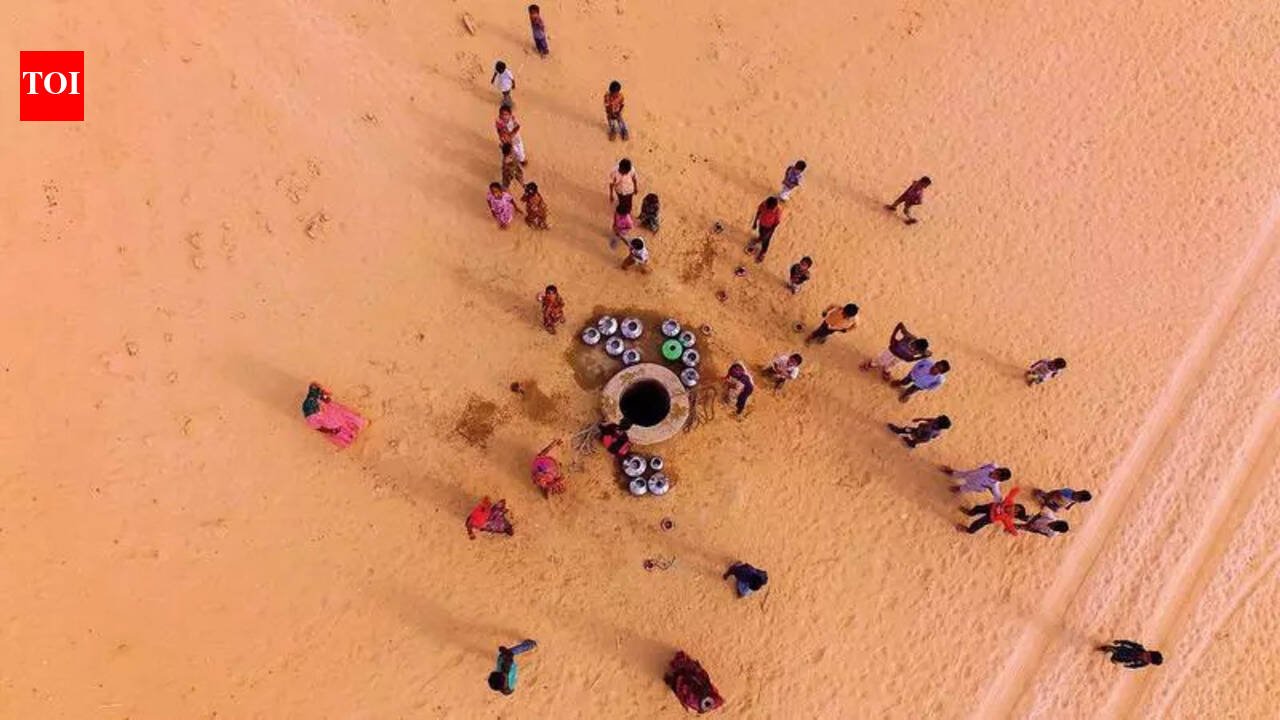
Rajasthan’s groundwater crisis has deepened into a structural emergency, with more than 70% of the state’s assessed groundwater units now classified as overexploited despite one of the wettest monsoons in recent years.The Central Ground Water Board’s Annual Report for 2024–25, based on data from June 2024 to March 2025, shows that 214 of Rajasthan’s 302 assessed groundwater units are overexploited, where extraction far exceeds recharge. Only 37 units, or 12.25%, remain in the safe category, while 21 are semi-critical and 27 critical, showing little improvement from the previous year and reinforcing a worsening trend.The scale of the crisis stands out because it has persisted despite unusually high rainfall. Rajasthan recorded 678.4 mm of rain between June and September 2024, or 156% of its long-period average, making it one of the wettest seasons in recent years. August alone saw the second-highest monthly rainfall in the state’s recorded history. Even so, groundwater levels have not recovered.The mismatch is stark at the district level. Dausa, which received the highest rainfall in the state at around 1,409.4 mm in 2024, has all five of its groundwater blocks — Lalsot, Dausa, Bandikui, Sikrai and Mahuwa — classified as overexploited. Sawai Madhopur, the second-highest rainfall district with about 1,285 mm, has four of its six blocks in the overexploited category.The figures point to a deeper problem: heavy rainfall is not translating into groundwater recharge, exposing structural weaknesses in water use and management.According to the report, nearly 85% of groundwater in Rajasthan is used for agriculture, compared with 14% for domestic use and 1% for industry. The state’s heavy dependence on groundwater for irrigation, especially for water-intensive crops such as wheat, paddy, oilseeds, pulses and sugarcane, is accelerating depletion in areas not naturally suited to such cropping patterns.In Ganganagar and Hanumangarh, canal-supported farming has expanded paddy cultivation, while parts of eastern Rajasthan continue to rely heavily on groundwater for wheat irrigation. In western districts such as Barmer and Jodhpur, even limited farming depends on deep borewell extraction, adding further stress to aquifers.The effects are already visible across the state. In many villages and towns in Jodhpur, Barmer, Bikaner and Jaipur, traditional wells have dried up, forcing residents to depend on deeper borewells or water tankers. “We have to depend on tanker water during peak summer as borewells no longer yield enough. It cost almost 2 lakh for fetching water every month from April till July,” said Hemant Patel, secretary of RWA of a prominent residential society in Jaipur.Experts say the crisis is also affecting water quality. “In several overexploited blocks, groundwater quality is deteriorating, with high salinity, fluoride, and contaminants like uranium and heavy metals making water unsafe without treatment,” said LK Sharma, Head of Environmental Science at Central University of Rajasthan.Environmentalists say a strong monsoon cannot undo years of overuse. “Recharge is slow and uneven, but extraction is continuous and rising. Once deeper aquifers are tapped, both quantity and quality decline,” said Praveen Mathur, retired HOD, Environment Science, MDS University in Ajmer.Climate variability is worsening the problem. “While rainfall may be above average, its erratic distribution and high-intensity bursts limit effective recharge, with much of the water lost as runoff. At the same time, rising temperatures are increasing demand across agriculture and urban centres like Jaipur,” said Sharma. The CGWB has called for urgent corrective steps, including tighter regulation of groundwater extraction, expansion of micro-irrigation, crop diversification away from water-intensive crops, large-scale rainwater harvesting, and a shift towards surface water-based supply systems in critically affected regions.


