



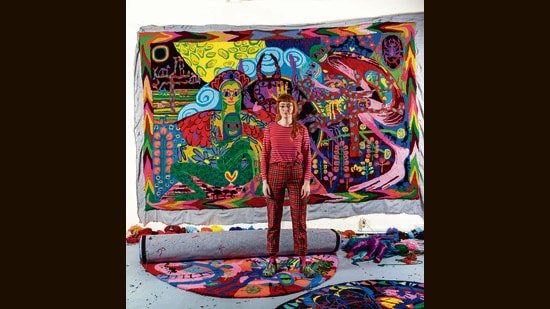
On the surface, her life looks like something out of a fairytale.


The Dutch artist Afra Eisma, 33, lives in the picturesque city of the Hague, with her girlfriend and two cats. She works at an artist-run fine-arts centre that sits alongside a school building, a gallery, artists in residence, and one of the largest literary archives in the Netherlands.
Her work has been shown around the world, with a major exhibition at The Tetley in Leeds in 2023 (more on that in a bit), space at the recently concluded Kochi-Muziris Biennale, and a show that just opened at the Museum of Art & Photography (MAP), Bengaluru.
Her work looks like something out of Wonderland too: vibrant colours, rich textures, and characters that could blend in at a theme park. One may encounter a large mural of a purple heart trailing tendrils; plushy, almost-anthropomorphic figures crafted from felt and fabric, a disembodied purple balloon arm; an installation of giant hands.
Move closer, and the layers begin to peel away, revealing something far darker.
Eisma’s practice is informed by a personal history of sexual abuse and violence. In 2020, she was among the women who filed cases of rape and sexual assault against the Dutch artist Juliaan Andeweg. “He was sentenced to less than two years in prison for rape, sexual assault and physical attacks involving multiple women. He was released early… We will have to see how it all goes,” Eisma says.
Meanwhile, as the case made headlines amid the global #MeToo movement, she and the others faced death threats. She was stalked. A group of right-wing extremists announced that they planned to re-create the rape on film. She had to file for a restraining order. “All these things… sound so absurd,” Eisma says. “It has been a very difficult time.”
Her art became a way to “process everything, reclaim agency, and find joy in things again”. This is part of why she paints in vibrant colours, and invites viewers to touch her creations, sit on the floor with them, hug them or pick them up.
Creating, in this way, a safe sensory space, she says, is the beginning of the end of silence; because no one should carry memories of violence alone.
***


Eisma’s unusual approach and the shapes her fight has taken have roots in two very distinct ideas: that art is for everyone, and that fear must be fought.
The first notion comes from growing up within a family of art-lovers and attending exhibitions since she was five years old. The second comes from writers such as the Black lesbian feminist poet Audre Lorde (1934-1992), who once said: “When I dare to be powerful, to use my strength in the service of my vision, then it becomes less and less important whether I am afraid.”
It was a friend who gave Eisma a book of poems by Lorde, during her darkest days, as she wrestled with the court case and the threats amid the pandemic.
The book was a turning point for her, Eisma says, offering her a framework for emotions she had been struggling to express. She began to locate her practice within a lineage of feminist thought, and understand it better from this perspective “in an almost academic way”.
Where she had worked with ceramics and textiles, she now settled on the latter. “I picked it because it is not just visual. It is also about touch. I really enjoy seeing how that becomes inviting and joyful for others,” she says.
“Of course, my practice also holds space for joy, celebration and imagination as feminist gestures,” she adds.
A prime example is boobie spider. First shown as part of the solo exhibition at the Tetley in 2023, this towering soft sculpture appears at once intimidating and tender, subverting the traditional, male-gaze-driven language of large-scale sculpture. Created collaboratively by a team of artists and assistants, the process itself became a site of connection.
“Most notably, stuffing the legs took time. We passed that time in the studio in conversation, eating and drinking together. This collective mode of making was not just logistical but integral to the work itself,” Eisma says, “reflecting how textile practices, for centuries, have created spaces of community, togetherness and shared social experience.”
***


In that spirit of community, and harking back to her original mission of art for all, Eisma also works with the Future Institute of Art, which offers free classes for young people who may not otherwise have access to a formal education in this field.
In addition to introducing students to art in a range of mediums, from painting to animation and video, she has co-developed a tufting workshop. As she stuffs, stitches, paints and builds, she demonstrates how physical form can be granted to memory and emotion. Amid crumples, contortions and splotches of bright colour, the tufting gun shoots thread into fabric, allowing her and her students to determine, freely, where it will go next (unlike weaving, which requires a predetermined path, she says).
At MAP, Eisma is showing a collection titled warrior garments: a series of imagined attires in silk and organza, layered with hand-painted text and expressive stitching.
Here, rage becomes an overt, transformative force, emotional intensity wrested into material form.


“These garments are a metaphor for being able to wear your anger,” Eisma says. “They also became a way of dealing with the complexity or duality I sometimes felt in my body: on the one hand, being a very cheerful, optimistic person with the most beautiful possibilities, like coming here to make this exhibition, and at the same time having to deal with trauma, police proceedings and ongoing harassment.”
The accessibility of her approach to art is a strategic tool too, she adds.
“Colour creates instant engagement across audiences.” Once drawn in, viewers begin to notice embedded texts and narratives that reveal the darker undercurrents of the work.
“I sometimes feel like I’m quite odd,” she adds, smiling. “My work is strange. It’s so very personal that it’s always a bit scary to show it for the first time. But it’s always lovely to see the different responses. That is really testament to the imagination, which is also a powerful political tool… because everybody, whatever language they speak, can access the imagination.”
(warrior garments is on display at MAP, Bengaluru, from April 11 to June 21)


