


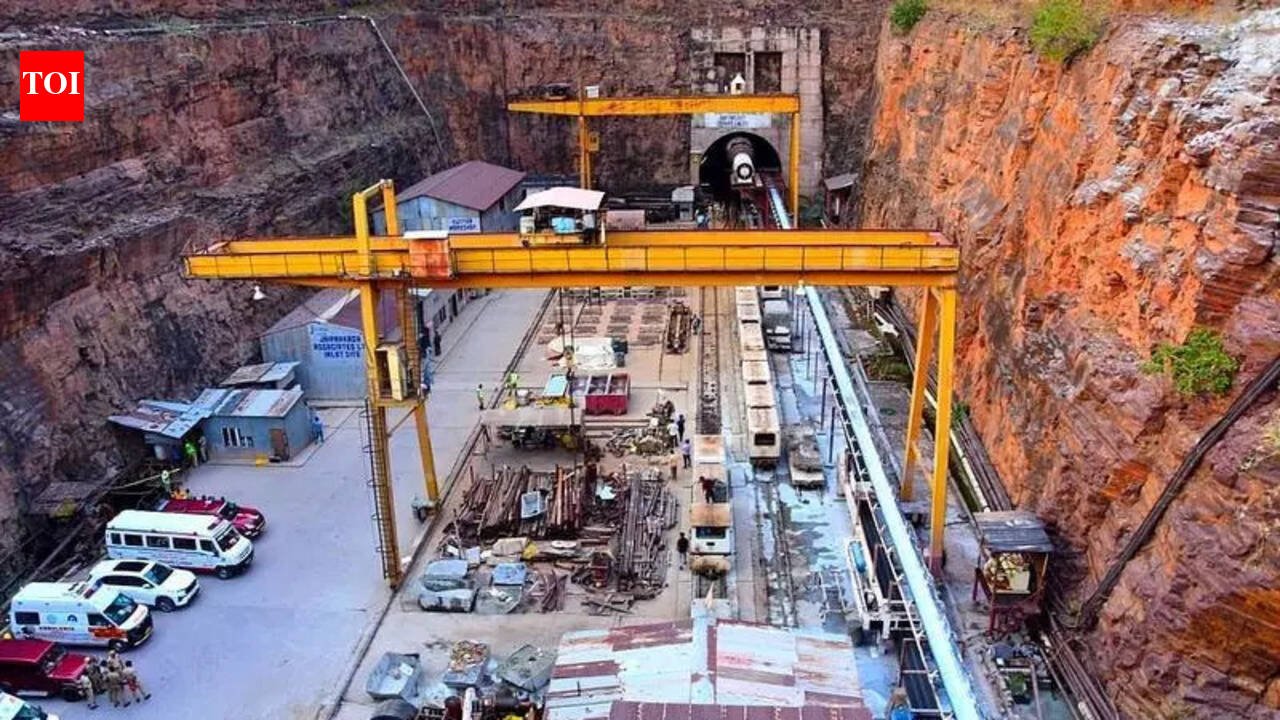
Hyderabad: With the aim of completing the Srisailam Left Bank Canal (SLBC) tunelling project at the earliest while ensuring all safety precautions, the Telangana govt has decided to adopt an advanced tunnelling method similar to the New Austrian Tunnelling Method (NATM), using observation-based technology. Trial runs began at the SLBC on Tuesday, and full-fledged work is expected to commence in the first week of March. Official sources said it would take a minimum of two years to complete the remaining 9.2-km stretch of the tunnel.“The tunnelling works will be taken up by using jumbo drills and controlled blasting. The observation-based technology is particularly useful in unpredictable terrain such as the SLBC area, where workers can monitor the support and carry out tunnelling works. It is completely safe and allows operational corrections after taking the local conditions into consideration,” said a senior govt official involved in the project. The new method is widely used in Europe and the USA, including in railway tunnels, and was also adopted in certain sections of the Kaleshwaram project, sources said.Works had stalled in Feb last year after a section of the tunnel roof collapsed near Domalpenta, trapping eight workers and engineers. While two were rescued, six bodies remain buried under debris due to persistent water seepage, posing challenges for recovery operations. The govt later declared them ‘presumed dead’ after suspending the nearly two-month-long rescue operations.Several months later, the irrigation department dismantled and removed the wreckage of the Tunnel Boring Machine (TBM) from the site. The Geological Survey of India (GSI) declared a 40-metre stretch around the collapsed roof area as “no-man’s zone.”Officials said drilling and blasting using advanced technology would be taken up from both ends of the tunnel — the outlet side at Devarakonda and the Domalpenta side. Of the total 42-km tunnel length, work on around 9 km is left. “While resuming tunnelling work from the Domalpenta side, the govt will create a bypass about 100 to 150 metres away from the collapsed section and take up the work,” a senior irrigation engineer said.Before resuming work, the National Geophysical Research Institute (NGRI) conducted a helicopter-borne electromagnetic survey to identify underground water flow patterns and shear zones, which are crucial for safety tunnelling up to a depth of 1,000 metres. Irrigation minister N Uttam Kumar Reddy also announced a dedicated division to monitor the SLBC tunnelling works.


