



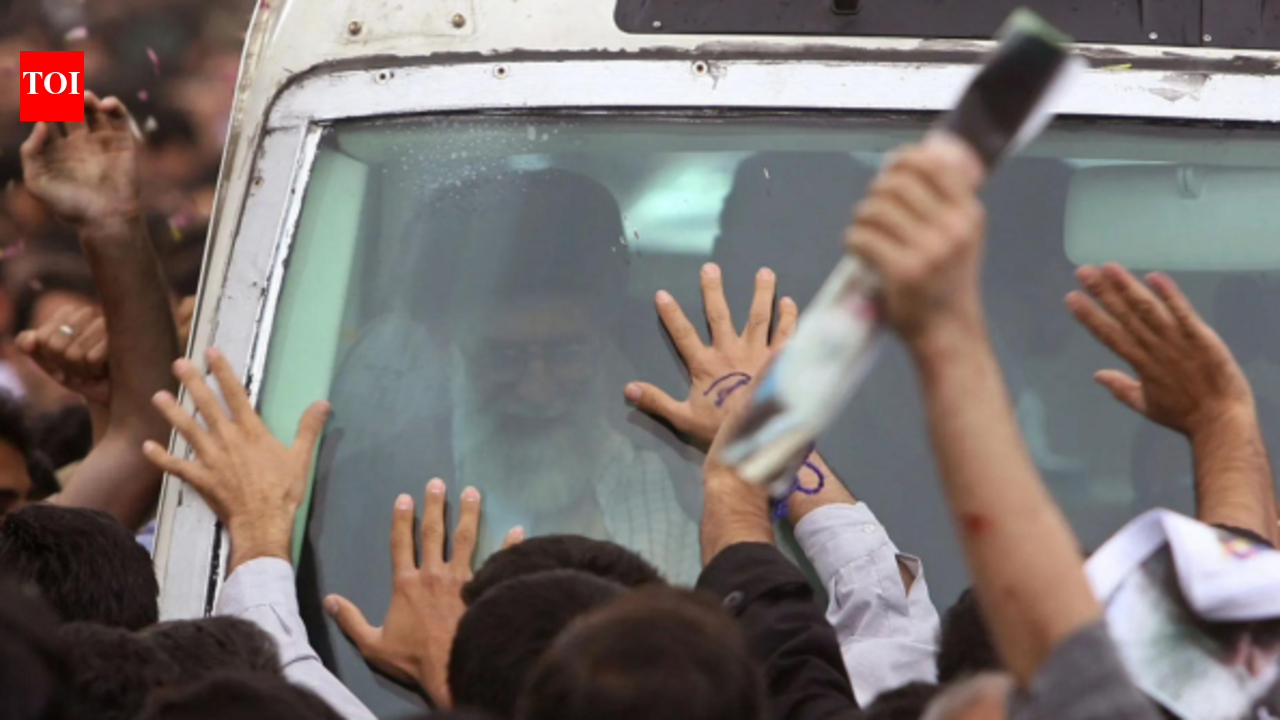
Israeli jets had been in the air for hours, carrying long-range munitions toward the Iranian capital. The strike package was lean by design, built for distance and precision, not spectacle.At 9.40am local time, long-range missiles hit a leadership compound in Tehran on Saturday. In near-simultaneous strikes “within 60 seconds,” Ayatollah Ali Khamenei was killed alongside senior figures of Iran’s political-security hierarchy.
Driving the newsThe assassination of Iran’s supreme leader, Ayatollah Ali Khamenei, was the product of months of CIA tracking and years of Israeli intelligence penetration culminating in what Israeli officials described as near-simultaneous strikes executed in roughly 60 seconds.According to a New York Times report, the CIA had been tracking Khamenei for months and gained increasing confidence about his movements and patterns before learning that a Saturday morning meeting of top Iranian officials would take place at a leadership compound in central Tehran and that Khamenei would attend.The US and Israeli officials adjusted the timing of the attack to exploit that intelligence window, shifting from an originally planned nighttime strike to a morning assault once they confirmed the supreme leader would be present above ground.According to a Guardian report, Israeli military officials said Khamenei was killed along with seven senior Iranian security leaders and about a dozen members of his family and close entourage in near-simultaneous strikes “within 60 seconds.”The leadership strike was followed by additional waves targeting air defenses and ballistic missile infrastructure, enabling Israeli aircraft to operate more freely over Tehran.Israeli officials said they established aerial superiority over Tehran shortly after the opening strikes and expanded attacks to intelligence and command centers.
Why it mattersKilling Khamenei marks a historic escalation. Israel has assassinated senior commanders and scientists before but had never previously eliminated a sitting head of state.According to the NYT, the speed and precision of the strike reflected unusually deep intelligence-sharing between Washington and Jerusalem, particularly after last year’s 12-day war, when both countries refined their understanding of how Iran’s leadership communicates and relocates under pressure.As expected, the joint US-Israeli strikes triggered Iranian missile and drone retaliation across the region, stoked fears of a wider war, and rattled global markets, especially in energy and aviation.The conflict is widening by the day, with Israel expanding airstrikes to Lebanon after Hezbollah retaliated, and the US confirming the deaths of three American service members in Kuwait, the first US casualties of the campaign.A meeting the Iranians shouldn’t have heldThe most consequential vulnerability may have been bureaucratic rather than military: senior officials physically convening at a known complex on a morning when much of the world was braced for an attack.In accounts cited by the Times and echoed elsewhere, Iranian leaders had supposedly spent the past year trying to correct the habits that got them hunted during an earlier 12-day conflict—habits as banal as bodyguards keeping cellphones close. And yet, by Saturday morning, they were back in patterns that an adversary could model: recurring meetings, familiar buildings, and travel routines that had become legible.From the outside, it reads like a failure of imagination. From the inside, it may have felt like statecraft: the kind of meeting a system holds because a system must keep meeting, even when it knows it is being watched.Zoom in: How the 60 seconds happenedThe minute that killed Khamenei was the final step in a layered intelligence-to-targeting pipeline.1. Pattern-of-life trackingAccording to the NYT, the CIA built months of surveillance on Khamenei’s movements, refining its understanding of where he stayed and how he shifted locations during crises.According to the Guardian, Israeli intelligence services had spent decades building deep networks inside Iran, mapping routines of leadership figures and their security details. A former CIA veteran told the Guardian, “It’s like a giant jigsaw puzzle. You are putting all these scraps of information together.”The quote underscores that the “60 seconds” was not improvisation; it was culmination.2. The critical intelligence breakthroughAccording to the NYT, the decisive development came when US intelligence learned of a Saturday morning gathering at a compound housing offices of the Iranian presidency, the supreme leader and the National Security Council and confirmed that Khamenei would be present.According to Axios, US and Israeli officials grew concerned during a one-week delay that Khamenei might relocate to an underground bunker. An Israeli intelligence official told Axios the allies wanted to “signal that there was no imminent strike, so that Khamenei and the others would feel safe.”According to Axios, one senior Trump administration official added, “Even if he were above ground, we would have gotten him.”3. Tactical surpriseAccording to the NYT, Israeli fighter jets took off around 6am Israel time, and long-range missiles struck the compound at approximately 9:40am in Tehran.An Israeli defense official, in a message reviewed by the NYT, said, “This morning’s strike was carried out simultaneously at several locations in Tehran, in one of which senior figures of Iran’s political-security echelon had gathered.”According to the same official, Israel achieved “tactical surprise,” despite Iranian preparations for war.Former Israeli military intelligence chief Amos Yadlin described the operation as “a tactical surprise, an operational surprise,” noting that many expected Israel to strike under cover of darkness rather than in daylight, the Guardian said.Between the linesThe timing decision reveals as much about strategy as the strike itself.According to Axios, the US and Israel originally planned to launch the attack about a week earlier but delayed for operational and intelligence reasons. The delay also gave President Donald Trump more time to pursue a final diplomatic round in Geneva.One Trump administration official said, “Some people say it was about the moon or the weather or whatever. But that’s bull,” while acknowledging, “There was a weather thing.”The pause may have increased the chances that Iranian leaders would remain above ground.According to the Guardian, some intelligence veterans question whether assassination achieves long-term strategic gains. Israeli analyst Yossi Melman said: “The problem is that Israel is in love with assassinations … and we never learn that it is not the solution. We have killed all the leaders of Hamas. They are still there. It’s the same with Hezbollah. The leaders are always replaced.”A former CIA veteran told the Guardian: “I think it was the wrong thing to do. Not from an ethical perspective – I have been fine with killing people, a lot of them in fact – but from a long-term strategic perspective.”Those warnings point to the central uncertainty: decapitation can paralyze a regime temporarily, but it does not guarantee regime collapse.What’s nextThree fronts now define the aftermath.1. SuccessionIran’s provisional governing council has temporarily assumed leadership duties as the system moves to name a successor to Khamenei.The power vacuum introduces uncertainty inside Iran’s clerical establishment and the Revolutionary Guards.2. Regional escalationHezbollah has joined the conflict, prompting Israeli airstrikes in Lebanon. Iran has launched missiles and drones targeting Israel and Gulf states hosting US forces.Bahrain too reported casualties from missile debris and the US Navy’s Fifth Fleet base came under fire.3. Duration of the campaignTrump has said the strikes would continue until “all our objectives are achieved,” and acknowledged further casualties were possible.The key question now: Was the 60-second strike a decisive turning point or merely the opening move in a longer war?According to the Guardian, Oded Ailam, a former Mossad counterterrorism chief, captured the paradox best: “Sixty seconds. That’s all it took for this operation, but it is the product of years in the making.”And as history has shown repeatedly in the Middle East, what takes a minute to execute can take years to resolve.


