



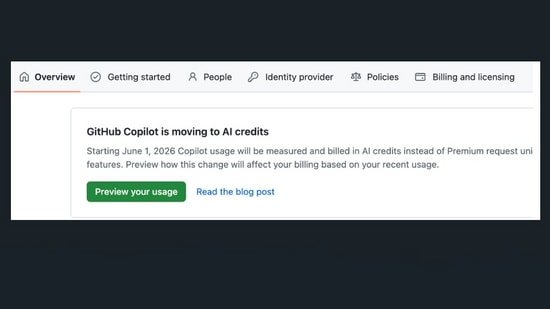
If you logged into GitHub this week and saw a polite green banner saying “GitHub Copilot is moving to AI credits” — that was not a software update. That was a new challenge for your finance team. From June 1, 2026, the price of Copilot at most Indian enterprises is set to multiply by roughly 9x. We tested the alternatives so you don’t have to find out the hard way.
What’s actually changing on June 1
Copilot is ditching the old “premium request” meter and switching to GitHub AI Credits. From June 1, every interaction is billed by tokens — input, output, even the bits cached in memory — at the same API rates Anthropic, OpenAI and Google charge GitHub.
The headline plan prices look unchanged. Copilot Pro+ is still USD 39 a month, Business is USD 19, Enterprise is USD 39. The catch? Each plan only includes that same dollar amount in AI Credits. Burn through your USD 19 by lunch on the 3rd, and the rest of the month is on your credit card.
Why now?
GitHub’s own admission: “Today, a quick chat question and a multi-hour autonomous coding session can cost the user the same amount. GitHub has absorbed much of the escalating inference cost behind that usage, but the current premium request model is no longer sustainable.” The second nudge came from Anthropic — Claude Opus 4.7 (April 16, 2026) ships with a new tokenizer that emits up to 35% more tokens for the same prompt, and from June 15 Claude Code and agent SDKs get their own metered credit pool. Translation: Copilot’s wholesale costs went up, and now so does yours.
At Hindustan Times, our preview bill on the new Github model is projected at roughly 9x our April spend — and we are not a small team.
Want to check your own damage?
Head to GitHub → your org → Billing Overview → Preview your usage.
How the top AI coding models really compare in 2026
We benchmarked five families that matter for Indian dev teams. Quality first, cost second, sanity third.
Coding quality — SWE-bench Verified and LiveCodeBench (May 2026)
Summary: Public leaderboards put GPT-5.5 Codex narrowly ahead, but in our own internal tests across HT’s stack — Java, HTML, MongoDB, Flutter, Swift , Kotlin, React frontends, and ML pipelines— Claude Opus 4.7, whether called directly or via Copilot, beat Codex on the tasks our engineers actually do every day. Codex still leads on long terminal-agent benchmarks; Opus leads on our work.
How did we benchmark costs?
To calculate costs across models, we used the same prompt across all models to create a new customer support microservice with detailed requirements. The results were astonishing in terms of both token usage and overall cost. Opus 4.7 emerged as the winner in terms of quality, while Gemini 3.1 Pro ranked last.
A similar experiment was done to enhance functionality of existing services where thousands of tokens are sent to an AI model with current repos content to implement a feature. Here, Deepseek was the clear winner in cost due to the low cost of cached input.
The catch: DeepSeek is roughly 2x slower than Opus — but you don’t have to use DeepSeek’s own API
We’re not going to pretend it isn’t slow. DeepSeek’s official API thinks before it answers, and on our tasks it took roughly twice as long per response as Opus.
But — and this is the lesson from two weeks of pilot work — the new SDLC isn’t single-task. Engineers run an agent on Service A while debugging Service B and reviewing a PR on Service C. When you parallelise three tasks, a 2x slower agent doesn’t slow the developer down by 2x — it slows the project down by maybe 10–15%. The wall-clock cost is real, but it is a long way from a deal-breaker, and the bill savings dwarf it.
For an engineering org with 400+ developers and a serious appetite for control, DeepSeek V4 Pro is MIT-licensed and the weights are public on Hugging Face. You can fine-tune it, modify it, and deploy it commercially with no restrictions.
Don’t trust the flat-rate plans without doing the math
Claude Code Max (USD 100 / USD 200 a month). The USD 100 tier gives a senior engineer roughly 15–35 hours of Opus per week and 88,000 tokens per 5-hour window. For one heavy user, it’s fine. For a 150-engineer org, you are looking at USD 100,000–150,000 a year just to keep the lights on.
OpenAI Codex (ChatGPT Pro USD 200, Business USD 30/user). Strong quality, but OpenAI can cost a developer “USD 40 or USD 400” depending on what they do with it.
PS: Open AI is giving codex free for 2 months for enterprise. We have already applied. You can Applyhere
Amazon Kiro.Here’s the unsung hero. Kiro routes prompts to Claude Sonnet 4.6 / Opus 4.7, gives you full multimodal (screenshots, diagrams, video), and the Pro tier starts atUSD 20/month with 1000 AI credits. With heavy usage, we have seen its cost is lower than other models/tools but higher than deepseek.
Pro tip: you can run DeepSeek inside Claude Code
DeepSeek ships anAnthropic-compatible API, which means you can point the Claude Code CLI at DeepSeek with a single environment variable swap.
HT Tech Team’s recommendation
After two weeks of POC across ~50 engineers spanning backend, frontend, Android, iOS and ML, here’s the stack we’re moving to — and the simple rule we wrote on the whiteboard:
If you want the best quality with no usage limits, run Claude Code Opus 4.7 on Max. If you are cost-sensitive — which almost every company is nowadays — split the work: Kiro for the frontend, DeepSeek for the backend and ML and Codex/Opus for complex work.
Concretely:
- Front-end, mobile and design-heavy teams → Kiro (Pro USD 20). Screenshot debugging, CLS/LCP work, Figma-to-code, responsive testing, animation — you get Claude Opus/Sonnet under the hood with full multimodal support, and the overage rates are gentle enough that a heavy month can stay in range of USD 50-100 per developer.
- Backend, platform and ML teams → DeepSeek V4 Pro. APIs, services, refactors, test generation, data pipelines, model training code. Roughly 1/20th the cost of Opus at near-identical SWE-bench scores as Opus 4.6, with cached-token re-reads that are practically free.
- Staff engineers and high-stakes work → Claude Code /Codex. Architectural foundation-setting, complex personalisation logic, live incident debugging, anything where waiting two extra seconds for a response costs more than a few dollars in tokens.
- For non-engineering work (PMs, designers, ops, editorial) → the consumer Claude subscription (USD 25/month enterprise tier) is still excellent — drafting specs, summarising calls, light research. Just be aware: Opus 4.7 quota runs out after roughly 3–4 substantial queries in a session, then you wait for the next reset window or fall back to Sonnet. Useful for thinking, not for sustained agentic work.
One migration gotcha worth flagging up front: any custom agents, sub-agents or playbooks you built against Copilot’s orchestration model will not port one-to-one to Kiro or deepseek. The tool definitions, hand-off semantics and context windows are different. Plan for one engineer-week per non-trivial agent to re-author and re-test before cutover. Don’t discover this on June 2.
Disclosure and disclaimer
Hindustan Times runs a multi-cloud engineering stack with active commercial relationships across the major hyperscalers and AI model providers — including AWS, Microsoft (GitHub), Google Cloud and Anthropic. The findings in this article reflect our internal pilot evaluation against HT-specific use cases (newsroom platforms, content APIs, recommendation systems, mobile apps, ML personalisation). They are not vendor endorsements. Other organisations should run their own evaluations against their own stack, scale and requirements before making procurement decisions.
Security has not been evaluated as part of this exercise. This article ranks the listed models on coding quality, cost and speed only. We have not assessed any of these tools against enterprise security, data-residency, IP-protection, model-output-leakage, prompt-injection-resistance, regulatory compliance, or audit-trail requirements. DeepSeek in particular is a China-headquartered provider — your security, legal and compliance teams must independently evaluate whether sending source code, customer data, or proprietary content to any of these endpoints meets your organisation’s policy. Self-hosting is the appropriate path for teams that cannot send code to a third-party API.
HT will publish an updated version of this article in June, after roughly 150 HT engineers complete their migration to the new stack and we have wall-clock data on productivity, cost and incident impact. Bookmark this page if you want the follow-up.


