


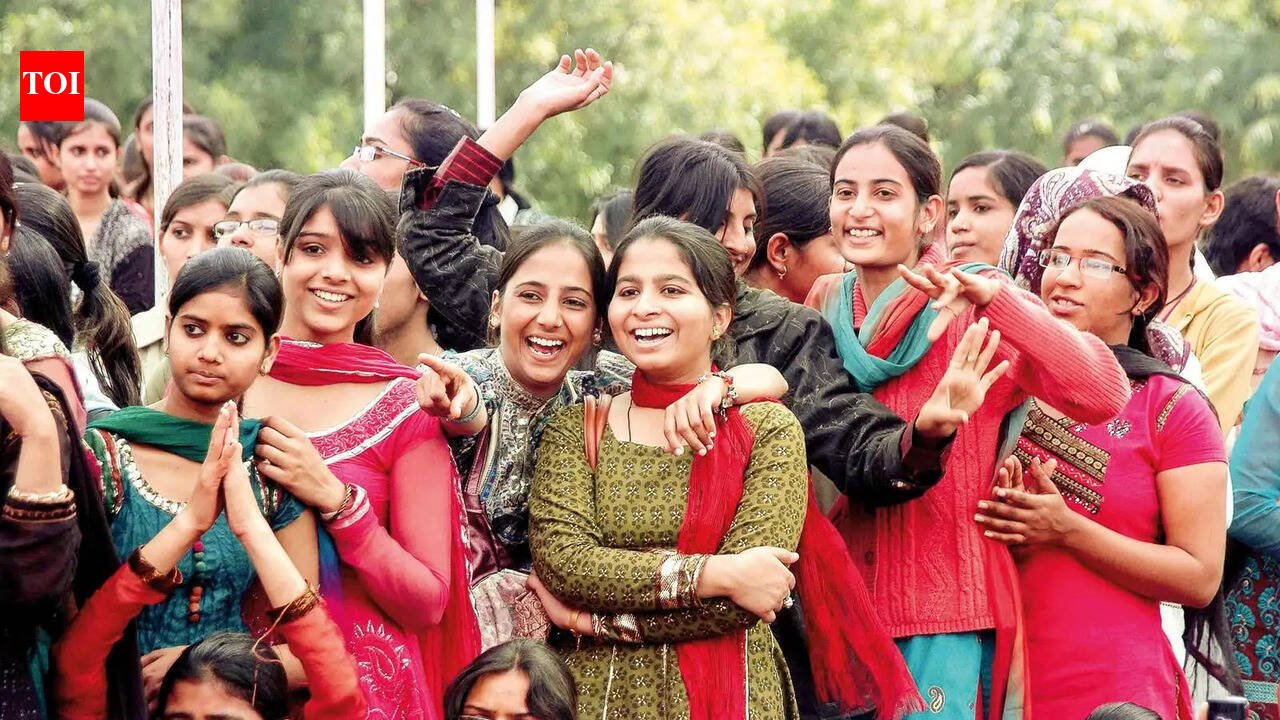
At convocations across Rajasthan, the image has flipped: girls routinely outnumber boys among gold medallists and award winners, sometimes sweeping multiple recognitions. What looks like a moment on stage is, in fact, the most visible marker of an 18-year churn in the state’s education landscape—where policy nudges, new institutions and a slow societal reset have combined to pull more young women into colleges and universities, even as gaps in access, course diversity and last-mile support remain.The numbers capture the scale of the shift. Participation of girls in higher education rose by 77% in nearly two decades, from 1.63 lakh in 2008 to 7.02 lakh in 2026, according to the Annual progress report 2025-26 released by the state higher education department in April this year. Gender parity moved sharply too: where there were 97 female students for every 100 male students in the 2015–16 session, the figure climbed to 127 in the 2025–26 session. Rajasthan’s campuses are no longer merely accommodating women; they are increasingly being shaped by them.Sociologists link this to a broader change in household decision-making. “This is a very welcome change. Earlier, enrolments in school were okay, but the moment a girl reached puberty or completed schooling, we saw that dropouts started. The govt with different schemes and scholarships has definitely worked to ensure that girls complete their education till graduation, but one of the major changes that has come up is that parents have understood the importance of education, not only for boys but girls as well,” said sociologist Rashmi Jain. She points to a shift in aspirations: families now associate education with daughters’ futures, accepting that a girl can be a breadwinner while also being a caregiver.Govt records show the infrastructure for women’s education expanded alongside this attitudinal change. Women’s colleges increased from 466 in 2015–16 to 801 in 2025–26 (including B.Ed. courses). Two deemed-to-be universities and two private universities dedicated to women are currently operational in the state. The growth is not just in brick-and-mortar; it is also in the rules that decide who gets in, who stays, and who can afford to continue.A series of policy interventions over the decade targeted precisely the points where girls historically fell out of the pipeline—distance, cost, and limited subject availability. In June 2016, the state govt introduced a 3% bonus marks benefit for girls seeking admission into co-educational colleges when the subject or faculty they applied for was not available at their local government women’s college. The move coincided with a 26.23% increase in enrolment in the academic year 2016-17 compared to 2015-16, signalling how small admission levers can produce outsized outcomes when they remove a structural barrier.In March 2019, the govt waived fee payable for female students pursuing studies in universities and colleges, directly addressing affordability. In 2024, it ordered that 30% of total sanctioned seats (on a horizontal basis) be reserved for women in govt co-educational colleges for admissions commencing from the academic session 2024-25, formalising women’s presence in mixed campuses. From the upcoming 2026-27 academic session, the state has also made a provision to award 5% bonus marks to female students holding a Black Belt qualification for admission into govt colleges—an unusual incentive that ties admissions advantage to achievement beyond academics.Safety and mobility—often the decisive factors in conservative settings—have also been pushed into the policy frame. From 2023-24, the Transport Voucher Scheme was extended to all female students whose residence is located over 10 kilometres away from their college, providing a transport allowance of Rs 20 per day of attendance. Higher education expert Puneet Sharma argues that such measures, combined with better campus facilities, changed parental confidence.“As facilities like hostels, safe campus environments increased in the state, families were more confident to send their daughters out of hometowns for higher education,” he said.“The situation is such now that we see girls not just opting for humanities subjects, but they are taking up engineering, finances and law too, which were considered as fields for men.”The period also saw Rajasthan’s institutional map widen beyond traditional state colleges, giving students more high-quality options closer to home. IIT Jodhpur was established in August 2008, initially operating from IIT Kanpur’s campus before becoming operational from its Jodhpur campus in 2013. Central University of Rajasthan was set up in Kishangarh in Ajmer district in 2009. AIIMS Jodhpur followed in 2012, expanding the state’s medical education space. Sharma notes that residential campuses mattered as much as reputations: “Rajasthan being a conservative society, security of students was a key concern for parents and these residential institutes helped to address that concern.”Yet, the story is not simply one of rising enrolment; it is also about where women are enrolling—and where they are not. As of 2025-26, 10.67% of total enrolment of girls in higher education is in science courses, the second highest after humanities at 41.8%. The distribution suggests that while doors have opened wider, the flow still concentrates in familiar streams, raising questions about whether counselling, school-level preparation, and local availability of labs and faculty are keeping pace with ambition.Private universities, too, reflect both progress and the next set of challenges. Niti Nipun Sharma, president of Manipal University Jaipur, said 37% of students in the university are girls.“In the past decade we jumped from 26% to 36% of students being girls and this is not restricted to just humanities subjects, but across all streams, including core engineering faculties and law. A safe campus where a student can grow academically along with personality development through extracurricular activities has been a key factor in this shift,” he said. The implication is clear: safety, campus culture and holistic support are not add-ons; they are participation drivers.Rajasthan’s education gains between 2008 and 2026 show what happens when social change meets targeted policy—bonus marks that compensate for subject unavailability, fee waivers that blunt cost shocks, transport support that makes attendance feasible, and seat reservations that institutionalise access. The gaps are equally instructive: course choices remain uneven, and the state’s next leap will depend on whether it can convert enrolment into broader academic diversification, stronger outcomes, and sustained participation across geographies and disciplines. The convocation stage may be the symbol, but the real test is whether every district can produce that moment—at scale, across streams, and without the old barriers returning in new forms.
