






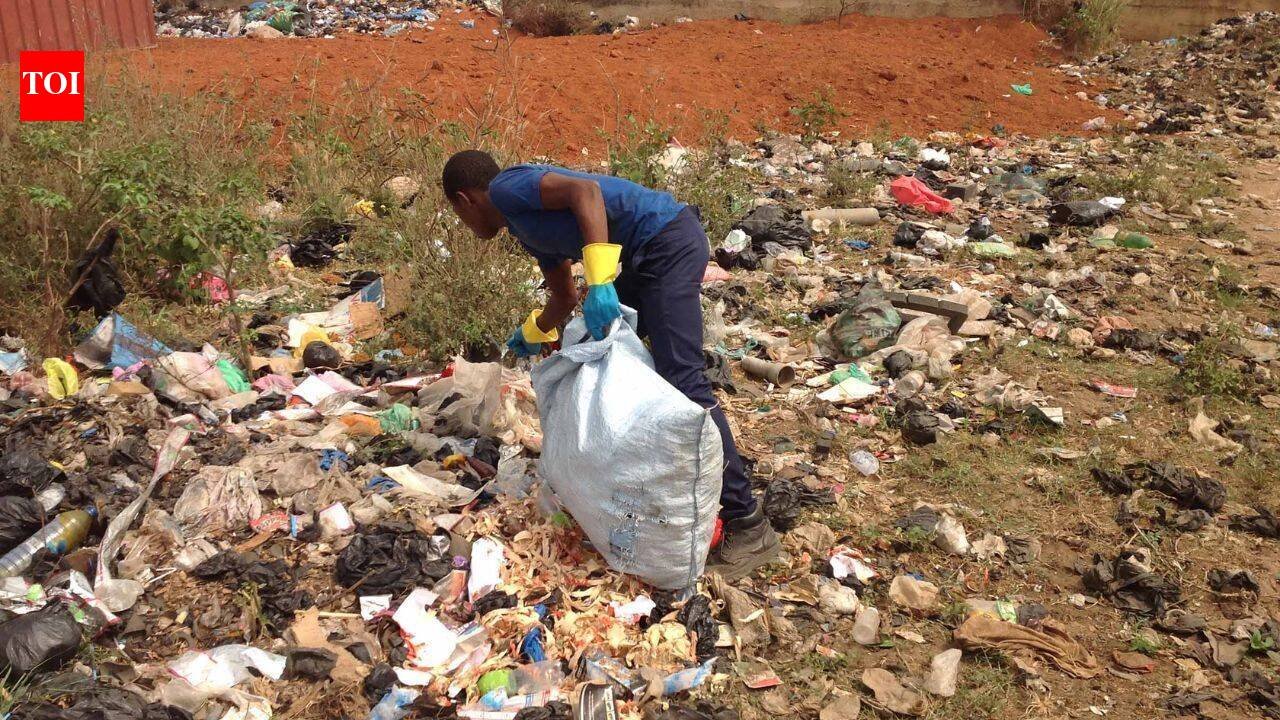
Ghana is transforming its plastic problems into paving blocks for its roads, sold below the price of concrete blocks. Behind this operation is Nelson Boateng, who graduated in computer network engineering, and was already manufacturing plastic bags and began transforming the same material into flooring.
The plastic Ghana cannot contain
Accra, the capital of Ghana produces around 2,800 to 3,000 tons of solid waste per day and the plastic portion of this volume is estimated between 300 and 450 tons, according to data from the International Growth Centre. Academic works cited by Ghanaian researchers reach the same level of 300 tons of plastic per day just in the capital. But the problem isn’t just the volume, it is also the destination.A large part of this material never reaches the recycling conveyor belt. The Yale Environment 360 report noted that only about 5 per cent of the 5,000 tons of plastic discarded daily across the country were sent to recycling facilities, while the rest ended up in landfills, illegal dumps, streets, waterways, or burned in the open air. In total for the year, Ghana generates nearly 1.1 million tons of plastic, a figure that the Ghana Circular Economy Center reiterated in July 2026, when calling for investment in collection after the floods that hit Accra.Heather Troutman, program manager of the Ghana National Plastic Action Partnership explained the deadlock to Yale Environment 360: recycling plastic in the capital is expensive, complicated, technical, and burning is easier. It is this practical calculation that pushes mountains of bags to the backyard bonfire instead of the plant.The solution for this, she pointed out, is giving commercial value to the material. If recycled plastic becomes fishing nets, fuel, or flooring, it ceases to be waste and becomes a priced input. As long as disposal is cheaper and easier than reuse, no awareness campaign will hold back the tons of plastic that flow into the sea. And it is in this economic gap that Nelplast established itself.
Building a revolution
What makes the project and innovation financially viable for the government are the costs.
Boateng’s company Nelplast appeared in February 2021 in a report by Yale Environment 360 about pavements made from plastic waste, alongside projects from India, Scotland and the Netherlands that tackle the same problem through different approaches. He revealed that the recipe for the flooring has no cement or bitumen. The plastic is collected by scavengers and brought to the factory and collectors are paid per kilo. More than 500 collectors sell plastic to Nelplast, and 60 per cent of them are women who depend on this income, according to the survey published by IPS. The kilo is paid at about 10 cents per dollar, which turns the material scattered on the streets into currency.The company also employs people inside the warehouse, with 60 direct employees and about 500 people indirectly linked to the operation, according to Quartz Africa.The material is shredded, washed, dried, and mixed with sand, sometimes pigment. The mixture enters an extruder with three heating zones, built by the company itself, because each type of plastic melts at a different temperature, from about 150 to 220 degrees Celsius, according to his account to Planet Forward. What comes out of the machine is a hot paste, that is pressed into moulds, in a process described by Boateng himself in interviews with the IPS agency and the Planet Forward outlet. The proportion between plastic and sand varies according to the project.What makes the project and innovation financially viable for the government are the costs. In an interview with Quartz Africa, Boateng stated that each Nelplast block costs about 1 dollar, compared to an average of 1.50 dollars for the conventional concrete block. To IPS, he calculated the difference another way, pegging a floor about 30 per cent cheaper than cement. The blocks have high durability, resistance to cracks, absence of green mould on the surface, and colour that does not fade.According to Boateng, the company has already paved residential areas, the courtyard of Action Chapel, the front of the Ministry of Environment, Science, Technology, and Innovation of Ghana, and sidewalks in parts of the country. A pothole-ridden street section in Ashaiman, the densely populated municipality where he grew up, was also redone with the material. The detail is relevant in a country where only 23 per cent of roads were paved at the time of the survey published by Yale Environment 360. There is a lack of paving and an abundance of plastic, and this equation sustains the business.
The bottleneck
Quartz Africa recorded a production of about 200 blocks per day consuming 800 kilos of plastic, a volume too small to meet interested developers.
Raw material is not lacking but production capacity is. Quartz Africa recorded a production of about 200 blocks per day consuming 800 kilos of plastic, a volume too small to meet interested developers. To IPS, Boateng spoke of recycling 2,000 kilos of plastic and mentioned a much larger installed capacity on the approximately 4,000 square meters of land he occupies in Ashaiman.The issue lies with the equipment. Some machine parts are imported and expensive, and the official promise to provide machines to increase production to around 15,000 blocks per day remained unfulfilled, as did the loans anticipated by the government program One District, One Factory, of which Nelplast is a part.
Inspired by India
Absorbing plastic into pavement is not a Ghanaian invention. The technique originated in India about two decades ago, from experiments by R. Vasudevan, a chemistry professor at Thiagarajar College of Engineering in Madurai, who began in 2001 upon realising that plastic and bitumen both come from petroleum and bond well. His method uses low-density polyethene from bags and PET from soda bottles.The country has installed over 96,000 kilometres of roads with plastic, and about 22,500 kilometres of new roads were built after the Ministry of Road Transport made it mandatory in 2016 to add recycled plastic to asphalt, according to Yale Environment 360.The difference is that India incorporates plastic into the asphalt, while the Ashaiman factory dispenses with asphalt altogether. Scotland and the Netherlands followed two other paths, with additives sold to asphalt plants and with hollow modules used in bike paths.


