


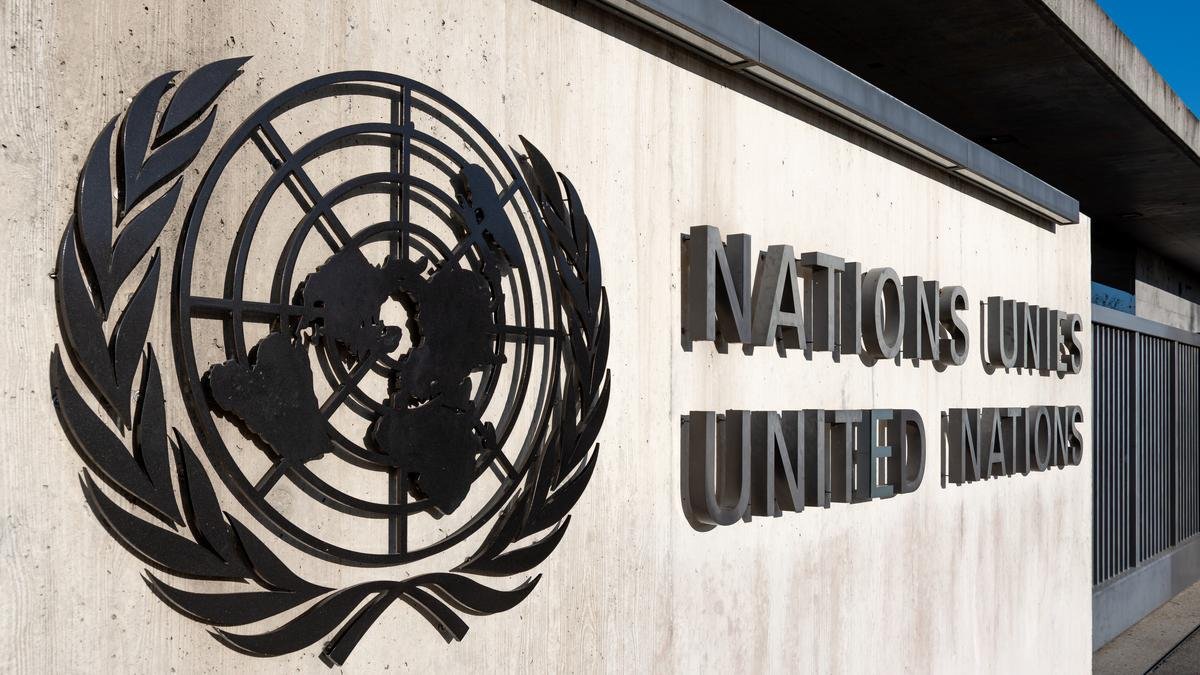
On June 3, for the first time, Germany failed to win a non-permanent seat on the United Nations Security Council (UNSC). The largest economy in the European Union (EU) won just 104 votes, well below the required 127 votes, and lost to the other two contenders in the race, Portugal, which won 134 votes, and Austria, which got 131 votes.
The UNSC has five permanent members and 10 non-permanent members who rotate every two years. Out of these 10 seats, two are reserved for the regional grouping of ‘Western European and other States’, which includes Germany. Members for these 10 seats are elected by the UN General Assembly (UNGA), with a contesting nation needing at least two-thirds of the vote to win a place on the UNSC. Germany has been re-elected six times; whenever it has contested. Up until now.
Steadfast with Ukraine
The loss in the UNSC election is being seen as a major foreign policy defeat for the Christian Democratic Union (CDU)-led federal government of Germany and its head, Chancellor Friedrich Merz, who had, after coming to power last year, stated his desire to restore Germany’s place on the world map. Opposition parties in the Bundestag, including the Greens as well as the far-right AfD party, called it an “embarrassing defeat”.
Foreign Minister Johann Wadephul, who had extensively lobbied for Germany’s candidacy in the UNGA, stated that the loss could have been due to the fact that Germany takes a clear stance on issues that not all member states share. “There is our firm support for Ukraine; the fact that Russia does not want such a voice at the Security Council,” said Mr. Wadephul. He also acknowledged that “the fact that Germany must always assume a special responsibility for Israel in the West Asia conflict may also have cost votes.”
With respect to Ukraine, the EU and Germany specifically have emerged as the war-torn nation’s most steadfast supporters even in the face of the U.S.’ changed attitude towards the country after Donald Trump became President for a second term. Under Mr. Merz, Germany has increased its military assistance for Ukraine. Moreover, in light of Russia’s aggression and the U.S.’ increasingly belligerent rhetoric towards the EU and NATO, Mr. Merz has advocated for increased budget for the domestic military while also calling for stronger European defence capabilities. Mr. Merz also became a part of the ‘coalition of the willing’, along with France and the U.K., in order to facilitate support for Ukraine.
Russia’s “special military operation” in Ukraine has been condemned by almost the entire international order, with the U.S. and the EU invoking sanctions on the country. Portugal and Austria, in line with the EU’s position, have also been strong supporters of Ukraine’s right to sovereignty. Moreover, they have been consistently registering their interest in the UNSC seat for over 10 years.
Austria has also been one of the strongest allies of Israel in Europe but its long-standing policy of military neutrality makes it much less of a player in matters of international conflict. But for Germany, the question of Israel and Palestine has been more complicated.
Ambiguity with Israel
Ever since the breakout of the Israel-Hamas conflict in October 2023, Germany has steadfastly upheld Israel’s right to defend itself. Since October 2023, the UNGA has adopted at least six major resolutions regarding the conflict and Israel’s subsequent genocide in the Gaza Strip. Berlin abstained from three of them, including the most immediate ones in 2023 calling for a ceasefire and for enhanced UN rights for Palestine. Even as international condemnation for Israel increased due to rising casualties in the Gaza Strip, especially of children, Germany has been walking a tightrope with regards to its relation with Israel.
When Mr. Merz was elected Chancellor in early 2025, he spoke to Israel Prime Minister Benjamin Netanyahu over the phone and said that he would “find ways and means for him (Netanyahu) to visit Germany and also to be able to leave again without being arrested in Germany,” in defiance of the arrest warrant issued by the International Criminal Court against Mr. Netanyahu on November 21, 2024, for alleged war crimes and crimes against humanity committed in the Gaza Strip.
While Chancellor Merz has since then criticised Israel for its excessive campaign in the Gaza Strip, even moving to restrict arms sales to the country in August 2025, which he lifted in November 2025 after the signing of a ‘ceasefire’, he visited Israel in December 2025 and held talks with Mr. Netanyahu where he re-affirmed support to Israel. He also refused to join an initiative by western allies to recognise the state of Palestine.
Germany’s relationship with Israel is complicated by, as Mr. Wadephul mentioned, its ‘special responsibility’ — the political doctrine of Germany to back Israel’s security in the light of Nazi Germany’s crimes against Jews during the Holocaust in World War II.
Conflicting stances
Germany’s standing as an upholder of international law has also taken a hit in the context of the ongoing Iran-Israel-U.S. war in West Asia which began on February 28, 2026. Mr. Merz refused to condemn the move as a violation of international law and stated that along with the U.S. and Israel, “we share the goal of ending the terror of these regimes”. However, his initial support soon turned into criticism as the war progressed. The effects of the war have been increasingly hitting the German economy, with oil and gas prices rising sharply. The energy sector in Germany is already stressed as the nation has drastically reduced its dependence on Russia, which was its main source for energy, in light of the Ukraine war. By the end of April, Mr. Merz made scathing remarks against the U.S. and said that Iran’s leadership was “humiliating” Washington.
Germany’s selective application of international law vis-a-vis Ukraine and Iran, and its cautious and often wavering approach towards Israel might have led smaller nations, especially of the Global South, to lose faith in it and regard smaller European states as safer bets. It would be wise for Germany to re-evaluate its standing in the international order if it wishes to regain its position as an upholder of the United Nations and international law.
Published – June 08, 2026 10:18 pm IST
