



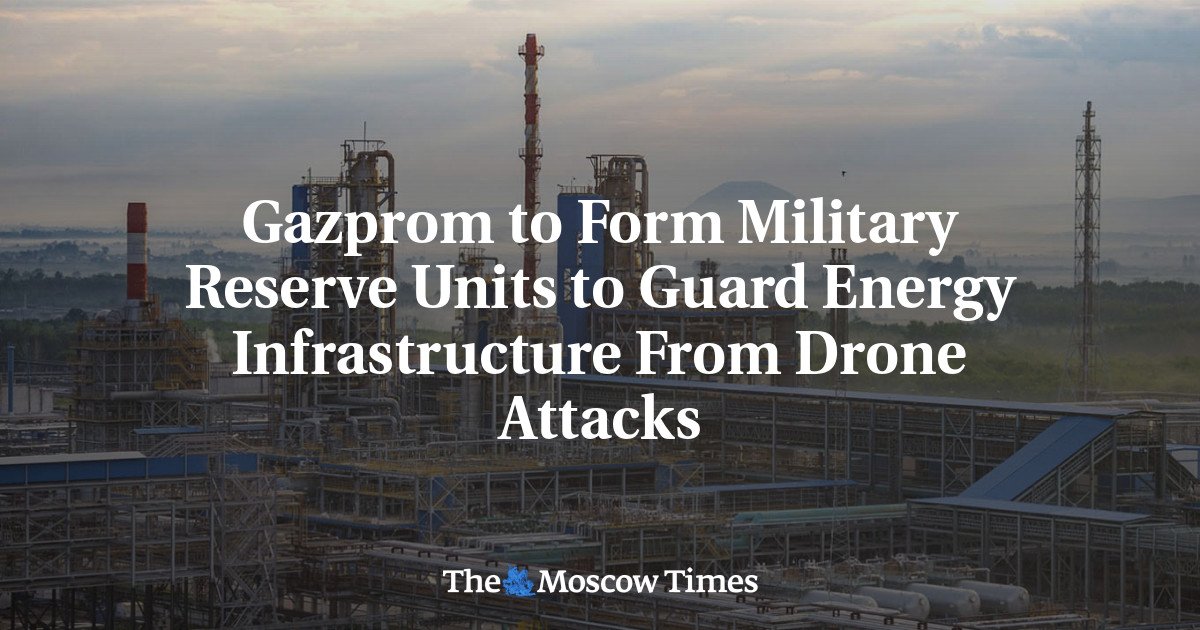
Russian gas giant Gazprom has reached an agreement with the Defense Ministry to create mobile firing groups tasked with protecting the company’s infrastructure, including from Ukrainian drone attacks, independent outlet Ekho reported, citing internal company documents.
The move highlights Moscow’s growing efforts to harden critical energy infrastructure against increasingly frequent long-range drone strikes, which have disrupted oil and gas facilities across Russia since the start of the full-scale war in Ukraine. Rather than relying solely on regular military forces, authorities have increasingly turned to regional volunteer units and reserve formations to bolster air defense around strategic sites.
According to the documents, volunteers would undergo medical examinations, a rigorous selection process and two months of training before signing three-year contracts to join Russia’s mobilization reserve. The arrangement would allow participants to continue their civilian jobs while periodically attending military training.
The primary mission of the mobile firing groups would be to patrol and protect Gazprom’s gas infrastructure, the documents said. During training exercises, reservists could also be assigned to guard other critical infrastructure, but only within the region where their contract was signed.
Participants would retain their average salary and receive a monthly payment of 200,000 rubles (about $2,560) from Gazprom while attending training, in addition to payments from the Defense Ministry, according to the documents.
The company also plans to provide three meals a day, uniforms, medical treatment, life insurance and free transportation to and from training sites. Although members would serve under contracts with the mobilization reserve, they would not be considered active-duty military personnel.
The initial contracts would last three years and could later be extended by another three years, five years or for shorter periods, depending on the participant’s age. The upper age limit is 52 for enlisted personnel and warrant officers, 57 for junior officers and 62 for senior officers, the documents said.
Gazprom has repeatedly reported Ukrainian drone strikes on its facilities since the start of 2026, including compressor stations that support gas exports through the TurkStream and Blue Stream pipelines.
In May, drones struck the company’s Astrakhan Gas Processing Plant, one of Russia’s largest gas processing facilities. Drones also targeted Gazprom’s gas processing and helium plants in the Orenburg region in late June.
The reported initiative follows similar measures adopted elsewhere in Russia. Earlier this year, authorities in the Leningrad region announced recruitment for volunteer mobile firing groups to defend against drone attacks.
Volunteers signing contracts through the regional military enlistment office were promised a one-time payment of 250,000 rubles (about $3,200), a monthly salary starting at 200,000 rubles (about $2,560) and a bonus of 100,000 rubles (about $1,280) for each drone they shoot down.
Read this article in Russian at The Moscow Times’ Russian service.


