



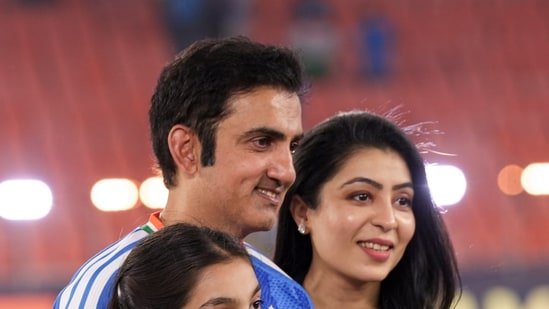
The signature scowl was nowhere in evidence, the trademark snarl put away. For now. Gautam Gambhir was all smiles at the post-match press conference, laughing at himself and with the others, revelling in Suryakumar Yadav’s company, relishing casting an occasional eye on the T20 World Cup, standing proudly to the captain’s left on the head table.
Were Gambhir that sort, he would view Sunday’s events at the Narendra Modi Stadium as vindication of his methodology. As the ultimate proof that, while his tactics might not have been easily understandable, they were well thought out and based on sound logic. As evidence, while he might still be a work in progress as a Test coach, he is a phenomenal white-ball boss who has now picked up three important pieces of silverware in the last 12 months.
But Gambhir isn’t that sort. He is driven and fiercely committed, combative and feisty, unwilling to take a backward step, yet not so invested in the past, however recent, that he loses sight of the future.
In his 20 months in charge, Gambhir has overseen debilitating home Test series to New Zealand (0-3, November 2024) and South Africa (0-2, November 2025). That said, Sunday’s 96-run victory over New Zealand in the final of the T20 World Cup means he has now won two ICC trophies, which no Indian coach has managed thus far. The trophy run began at the 50-over Champions Trophy in Dubai last March, split over to the T20 Asia Cup, also in the UAE, in September and has now culminated in the T20 World Cup, which India won for an unprecedented third time while being the first to repeat a title run and the first side to go all the way on home turf.
Two words that Gambhir used often during a 30-minute media interaction alongside Suryakumar, long after Sunday had given way to Monday, were ‘brave’ and ‘courageous’. As a player, Gambhir was nothing if not these; he was pugnacious and uncompromising, sometimes giving the impression that he enjoyed playing and making runs less than proving a point to others, but he was mighty effective and maximised his abilities, which weren’t insignificant but definitely not in the Sehwag-Tendulkar-Laxman league.
It was grand of Gambhir to, unprovoked, dedicate this title win to ‘Laxman bhai’, among others. The others included Rahul bhai, Ajit Agarkar and Jay Shah.
Rahul bhai, of course, is Rahul Dravid, not just Gambhir’s role model as a batter but also his predecessor as the head coach. “What Rahul bhai has done to keep Indian cricket in such a good shape, I have to thank him for everything that he’s done during his tenure,” Gambhir explained. “And then VVS Laxman (the Centre of Excellence boss) for unconditionally doing so much for Indian cricket, especially behind the doors, because COE remains the pipeline for Indian cricket.
“Third is obviously (chairman of selectors) Ajit Agarkar, because he does take a lot of flak and the amount of honesty he’s worked with. And last but not the least, I have to thank Jay Shah (the independent chairman of the International Cricket Council), because not many people have actually called me when I’ve gone through the lowest moments in my tenure, whether it was after New Zealand, whether it was after South Africa. I had to thank him for trusting me with this job (when Shah was the president of the Board of Control for Cricket in India), because when I was given this job, I had no experience of being the head coach of any franchise or any team. Till these guys are there, Indian cricket is in very, very safe hands.”
Gambhir has his set of staunch supporters, but inevitably, he has also had his fair share of detractors who have found fault with him for everything he does. Or doesn’t. Gambhir doesn’t claim to be a saint, but no one in their right mind will question his integrity, commitment, and passion for Indian cricket. His heart is in the right place, even if his tongue can let him down, and he can sometimes appear confused in his thinking. He has no time for social media warriors who, hiding behind the anonymity of keyboards and sanitised screens, spew venom.
He is firm in his belief that he isn’t accountable to the keyboard warriors but to the 30-odd others who populate the Indian dressing room. Clearly, watching and listening to him and Suryakumar, it was obvious that they share a great chemistry, a legacy of their days together with Kolkata Knight Riders, when a young Suryakumar played under Gambhir’s captaincy for 4 years. The coach and the captain are mutually dependent and need to be on the same page if they aren’t already. Fortunately for India, Gambhir and Suryakumar have shared a similar vision since they were thrown together in July 2024, immediately after the successful Rohit Sharma-Dravid partnership ended.
For Gambhir, this win will be particularly sweet, given the circumstances leading into the World Cup, which came less than three months after a dispiriting hammering at the hands of South Africa in the two-Test series. Around the Test series setbacks, including a 1-3 rout in Australia, India were unstoppable in 20-over cricket, not losing a bilateral series between the two World Cups and adding the Asia Cup to their kitty. Anything less than a title win for the No. 1 team in the world would have been seen as a failure, never mind the format’s fickleness and the reality that no team had won the title on home soil.
India showed nous and tactical acumen to shake up their batting order midway through the World Cup, splitting the Abhishek Sharma-Ishan Kishan opening combine to inject Sanju Samson as the former’s opening partner while dropping Kishan to No. 3, asking Tilak Varma to bat at No. 5 or 6 and leaving out Rinku Singh. It was a seismic shift – Gambhir said that because of the personnel at his disposal, India could have put out four or five different combinations without losing the aura of intimidation – that would have attracted great condemnation if it hadn’t come off. The outcome dictates the efficacy of any decision; in this case, everything fell neatly into place. Samson uncorked successive knocks of 97 not out, 89 and 89 in the last three must-win games, including Sunday’s final against the Kiwis. Kishan was perfectly at home at one-drop, and Tilak relished the freedom down the order.
Abhishek, meanwhile, repaid the faith for his horror tournament not attracting the axe with an 18-ball half-century in the final. Clearly, when he was out of sorts and when Samson was warming the bench, Gambhir kept the faith, marrying technical inputs with his unheralded man-management skills that make him such a hit as a white-ball coach. Gambhir didn’t need this trophy to keep his job because, despite unfounded whispers, he was never in any danger of being replaced. But this win will firm up his resolve and convince him – if he needed any convincing, that is – that the master tactician in him is alive and kicking, and that all he needs to replicate limited-overs success to the red-ball format is a bit of luck, more than a tectonic change in personnel, approach, mindset or attitude.
Later in the year, when India resume their World Test Championship challenge in August, the World Cup triumph will be put on the backburner. India have two demanding away assignments – in Sri Lanka, the land of spin, where they haven’t lost a series since 2015, and in New Zealand, where seam is the king and where they haven’t won a series since 2009. To reignite their WTC final hopes, India need as many points as they can get from these four Tests before the five-match showdown at home early next year against Australia. Gambhir will again be under the microscope, his tactical and selection calls dissected with a fine-tooth comb. But under the microscope is familiar territory for the tempestuous 44-year-old from Delhi, who will not writhe or cower but will come out all guns blazing.


