






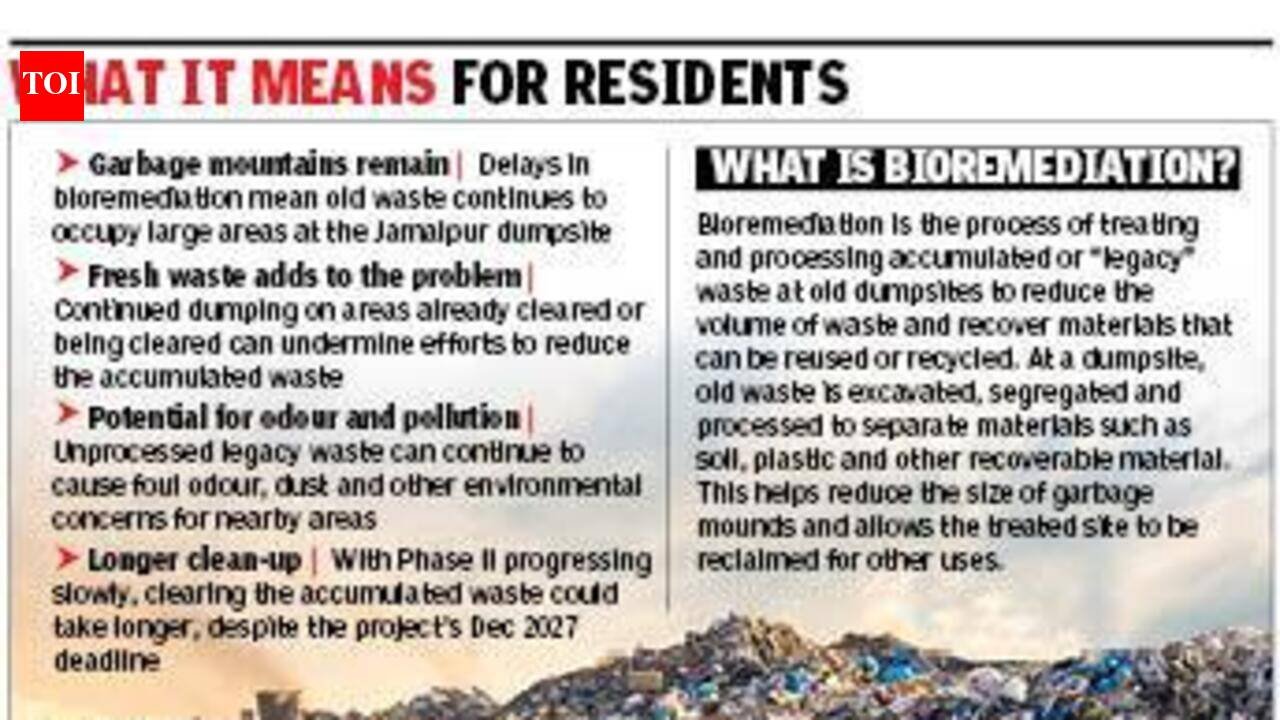
Ludhiana: Work on bioremediation of legacy waste at the main garbage dump in Jamalpur has been disrupted for the past one month. Machines meant for use in the project, aimed at eliminating “garbage mountains”, are lying idle at the dumpsite. Officials said the project was stalled after a transformer caught fire.The work is part of Phase II of the project. Phase I, which entailed bioremediation of 5 lakh metric tonnes of legacy waste, has not been fully completed either. The second phase was launched to clear the remaining waste.The same firm had cleared legacy waste in the first phase. It was to undertake bioremediation at a fresh site for the second phase, but fresh waste was again dumped on the previous site, negating efforts to clear it.Officials said 7.5 lakh metric tonnes of legacy waste has been bioremediated so far and that they have another year to treat the remaining waste. The project deadline is Dec 2027.Officials attributed the slow pace of the project to the rainy season, lack of proper infrastructure and theft.A representative of the private firm handling the project said, “At first we were not given a proper electricity connection. This transformer was installed with great difficulty but it got burnt a month ago. Another transformer has arrived at the site and wiring is being installed. We expect work to begin in a day or so.”He also flagged the theft of machine parts from the dumpsite. According to him, work could not proceed without the stolen machine parts. He added that the firm had made considerable investment in the project but the MC had not made any payment to it so far.Meanwhile, MC superintending engineer Sham Lal Gupta said, “The transformer will be installed and work will start shortly. We will ask the contractor to increase the pace of the project and meet the deadlines.”As part of Phase II of the project, the MC allotted the work of bioremediation of 20 lakh tonnes of waste to a private firm in March 2024. However, work on the ground started in Feb-March this year because requirements such as an electricity connection had not been fulfilled.Even when work started, the contractor could process only 4,000 tonnes per day against a requirement of 10,000 tonnes per day.The first phase of the legacy waste bioremediation project started in 2022 to process 5 lakh metric tonnes of legacy waste. The work took more than three years.Box: Numbers behind Jamalpur dump– 20 lakh tonnes — waste covered under Phase II– 7.5 lakh tonnes — legacy waste bioremediated so far– 10,000 tonnes/day — required processing capacity– 4,000 tonnes/day — actual capacity achieved by contractor– Dec 2027 — project deadline– 1 month — work disrupted after transformer fireBox: Why work is moving slowly– Electricity connection not provided initially– Transformer caught fire a month ago– Machine parts allegedly stolen– Lack of proper infrastructure– Rainy season– Processing capacity much below requirement– Fresh waste dumped on the earlier cleared siteBox: What it means for residents–Garbage mountains remain: Delays in bioremediation mean old waste continues to occupy large areas at the Jamalpur dumpsite–Fresh waste adds to the problem: Continued dumping on areas already cleared or being cleared can undermine efforts to reduce the accumulated waste–Potential for odour and pollution: Unprocessed legacy waste can continue to cause foul odour, dust and other environmental concerns for nearby areas–Longer clean-up: With Phase II progressing slowly, clearing the accumulated waste could take longer, despite the project’s Dec 2027 deadlineBox: What is bioremediation?Bioremediation is the process of treating and processing accumulated or “legacy” waste at old dumpsites to reduce the volume of waste and recover materials that can be reused or recycled. At a dumpsite, old waste is excavated, segregated and processed to separate materials such as soil, plastic and other recoverable material. This helps reduce the size of garbage mounds and allows the treated site to be reclaimed for other uses.


