



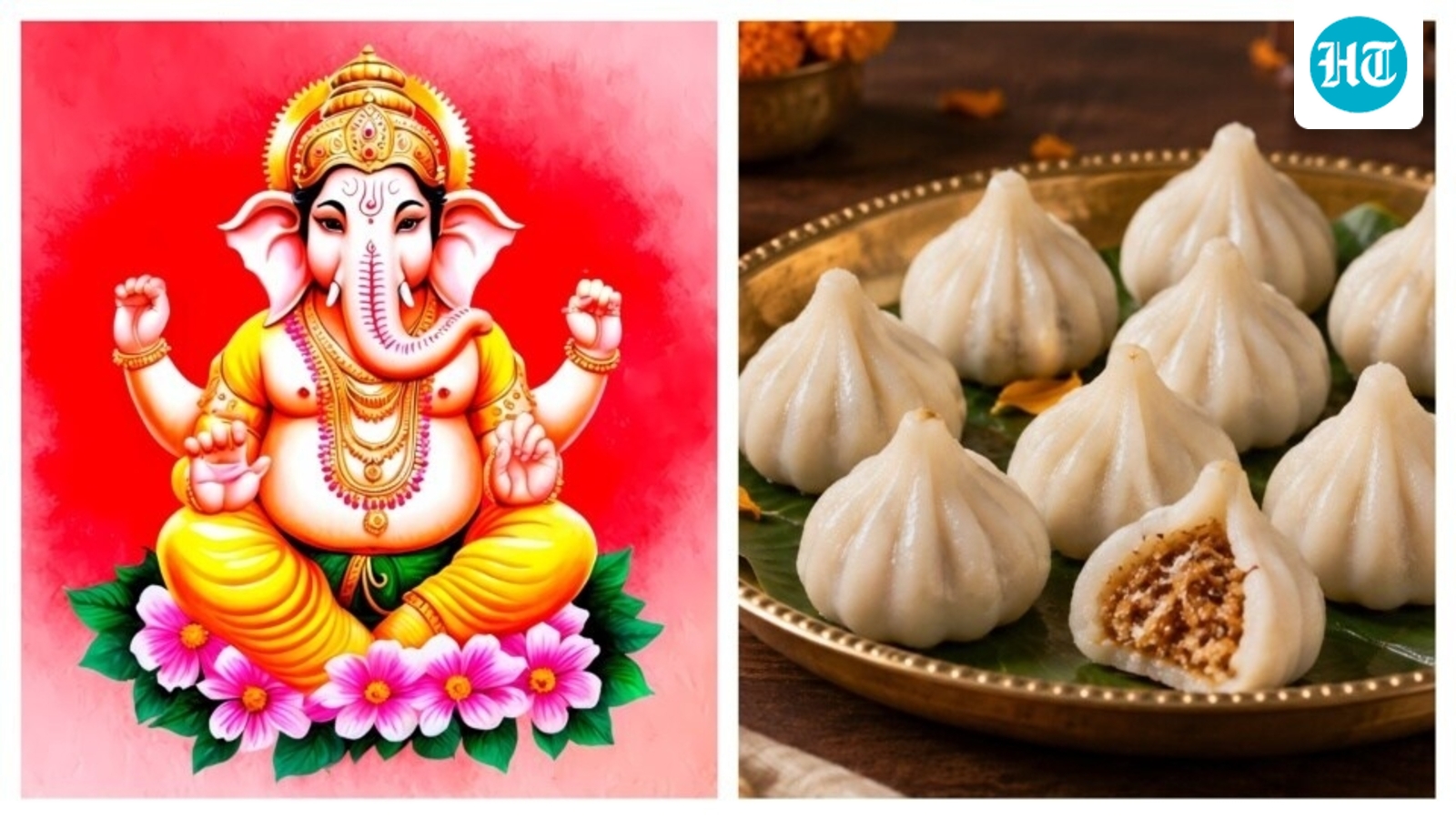
Ganesh Chaturthi 2026: Celebrations honouring Lord Ganesha call for the preparation of delicious sweets, especially the much-beloved modak. These treats are offered to the deity as bhog, served as part of celebratory feasts at home, and distributed among loved ones.
The sweets range from different varieties of modaks, which are also Lord Ganesha’s favourite treat, to pedas; sweets are an integral part of the auspicious festive menu.
Here are some recipes for sweets, different types of modaks and peda:
1. Ukadiche Modak
Recipe by Chaman Singh, chef de partie, Deltin Suites, Goa
Ingredients
For the outer covering
- Rice flour – 1 cup
- Water – 1¼ cups
- Ghee – 1 tsp
- Salt – 1 pinch
For the filling
- Freshly grated coconut – 1 cup
- Jaggery – ¾ cup
- Cardamom powder – ½ tsp
- Poppy seeds – 1 tsp (optional)
- Ghee – 1 tsp
Method:
Prepare the filling
- Heat 1 tsp ghee in a pan.
- Add the grated coconut and jaggery.
- Cook on low flame until the jaggery melts and the mixture becomes slightly thick.
- Add cardamom powder and poppy seeds.
- Mix well and allow the filling to cool completely
Prepare the dough
- Bring the water to a boil with salt and ghee.
- Lower the flame and gradually add the rice flour.
- Mix quickly, cover, and let it rest for 5 minutes.
- Transfer the mixture to a plate and knead while warm, using slightly wet hands.
- Knead until you have a smooth and soft dough.
Shape the modaks
- Take a small portion of the dough and roll it into a ball.
- Flatten it into a thin disc.
- Create pleats around the edges.
- Place 1–1½ tbsp of the filling in the centre.
- Bring the pleats together and seal the top.
Steam
- Grease the steamer tray lightly with ghee.
- Place the modaks on the tray, leaving some space between each.
- Steam for 10–12 minutes on medium heat.
- The modaks are ready when the outer layer appears slightly translucent and firm.
Chef’s tip: Keep the dough soft and warm while shaping. If it becomes dry, the pleats may crack. Avoid overcooking the coconut-jaggery filling, as it can become hard once cooled.
2. Nutty peda
Recipe by Shilpa Kumar, in-house chef, Akshayakalpa Organic
Ingredients:
- Nuts & Seeds (lightly roasted) –
- Cashews – 50 g
- Almonds – 50 g
- Pistachios – 50 g
- Walnuts – 50 g
- Pumpkin seeds – 50 g
- Sunflower seeds – 50 g
- Melon seeds – 50 g
- Sesame (til) seeds – 50 g
2. Desiccated coconut – 2 tbsp
3. Makhana/ Fox Nuts (roasted and powdered) – 2 tbsp
4. Soft seedless dates – 200g
5. Pure ghee – 1 tbsp
Method:
- Lightly roast all the nuts and seeds (except the sesame seeds). Allow them to cool and coarsely grind them.
- Blend or mash the soft, deseeded dates into a smooth paste.
- Combine the coarsely ground nuts, seeds, desiccated coconut, powdered makhana, date paste, and ghee. Knead well until the mixture forms a smooth, firm dough.
- Place the dough on parchment paper and gently roll it into a cylindrical log, applying a little ghee if required to achieve a smooth, glossy, and non-sticky finish.
- Spread the roasted sesame seeds evenly on another sheet of parchment paper or a flat plate. Roll the prepared dough log over the sesame seeds until it is evenly coated.
- Cut the log into equal portions and shape each portion into a smooth spherical peda.
3. Filter coffee and Mysore pak modak
Recipe by Chef Vijesh Modi, executive chef, The Deltin, Daman
Yield: Approximately 20–22 modaks
Size: 30–35 g each
Mysore Pak Filling
Ingredients:
- Besan – 200 g
- Ghee – 220 g
- Sugar – 250 g
- Water – 90 ml
- Cardamom powder – 1 g
- Milk powder – 20 g
Method:
- Sieve the besan thoroughly.
- Lightly roast the besan over low heat until the raw smell disappears. Do not brown it.
- Warm the ghee separately.
- Prepare a one-string sugar syrup using the sugar and water.
- Gradually add the besan to the syrup, whisking continuously.
- Add the warm ghee in batches while stirring continuously.
- Add the milk powder and cardamom powder.
- Cook until the mixture becomes glossy, leaves the sides of the pan and starts forming a soft mass.
- Spread the mixture in a greased tray to approximately 1–1.5 cm thickness.
- Allow it to cool completely and cut into small 8–10 g cubes
Filter coffee modak mixture
Ingredients:
- White chocolate – 300 g
- Mawa/khoya – 200 g
- Milk powder – 80 g
- Powdered sugar – 60 g
- Fresh cream – 80 g
- Strong filter coffee decoction – 35–40 ml
- Ghee – 20 g
- Cardamom powder – 1 g
- Instant espresso powder – 3–4 g
Method:
- Reduce the filter coffee decoction to approximately 20–25 ml for a concentrated flavour.
- Heat the cream and add the coffee reduction.
- Melt the white chocolate separately.
- Cook the mawa, milk powder and powdered sugar over low heat.
- Add the coffee-cream mixture and cook until thick.
- Add the melted white chocolate, ghee, cardamom powder, and espresso powder.
- Cook until the mixture reaches a soft, mouldable consistency.
- Allow it to cool slightly
Assembly
- Lightly grease your hands with ghee.
- Take approximately 25 g of the coffee modak mixture and flatten it into a disc.
- Place an 8–10 g cube of Mysore Pak in the centre.
- Bring the mixture around the filling and seal completely.
- Place the filled mixture into a modak mould and press gently.
- Carefully demould the modak.
- Refrigerate for 20–30 minutes to allow the modaks to stabilise.
Luxury garnish
Keep the garnish minimal:
- Tiny Mysore Pak crumble at the base
- 1 roasted coffee bean
- Small pistachio sliver
- Very small touch of edible gold leaf
Chef’s tip: Do not make the coffee flavour too sweet. The Mysore Pak already provides richness and sweetness, so the outer layer should have a slightly bitter, roasted coffee finish. This contrast creates a more balanced and premium flavour profile.
4. Fried modak
Recipe by Swapnil Chowgule, Chef Commi 3, Deltin Suites, Goa
Makes: 10–12 modaks
Ingredients:
For the filling
- Grated coconut – 1 cup
- Jaggery – ¾ cup
- Cardamom powder – ½ tsp
- Poppy seeds – 1 tsp
- Ghee – 1 tsp
For the outer covering
- Maida – 1 cup
- Fine semolina (suji) – 2 tbsp
- Salt – 1 pinch
- Ghee – 1 tbsp
- Water – as required
For Frying
Method
Prepare the filling
- Heat ghee in a pan and add the grated coconut and jaggery.
- Cook on low flame until the mixture thickens.
- Add cardamom powder and poppy seeds, and mix well.
- Allow the filling to cool completely.
Prepare the dough
- In a bowl, mix the maida, semolina, salt and ghee.
- Rub the ghee into the flour until the mixture resembles breadcrumbs.
- Gradually add water and knead into a firm yet smooth dough.
- Cover and rest the dough for 15–20 minutes.
Shape the modaks
- Divide the dough into small portions and roll each into a ball.
- Roll each ball into a thin disc.
- Place 1–1½ tbsp of the filling in the centre.
- Make pleats around the edges, bring them together and seal the top properly.
Deep fry
- Heat oil to approximately 160–170°C.
- Fry the modaks over medium-low heat until golden brown and crisp.
- Remove and drain on a wire rack or tissue-lined plate.
Chef’s tip: Avoid frying the modaks on very high heat, as the outside may brown quickly while the covering remains undercooked. Medium-low heat ensures a crisp and evenly cooked outer shell.
Each recipe has its own culinary appeal. Whether it is the traditional softness of ukadiche modak, the crispiness of fried modak, the wholesome crunch of nutty peda, or the contemporary flavours of filter coffee and Mysore Pak modak, there is something for every palate. Prepare these treats at home to offer as bhog, serve during Ganesh Chaturthi celebrations, or share with loved ones.
