






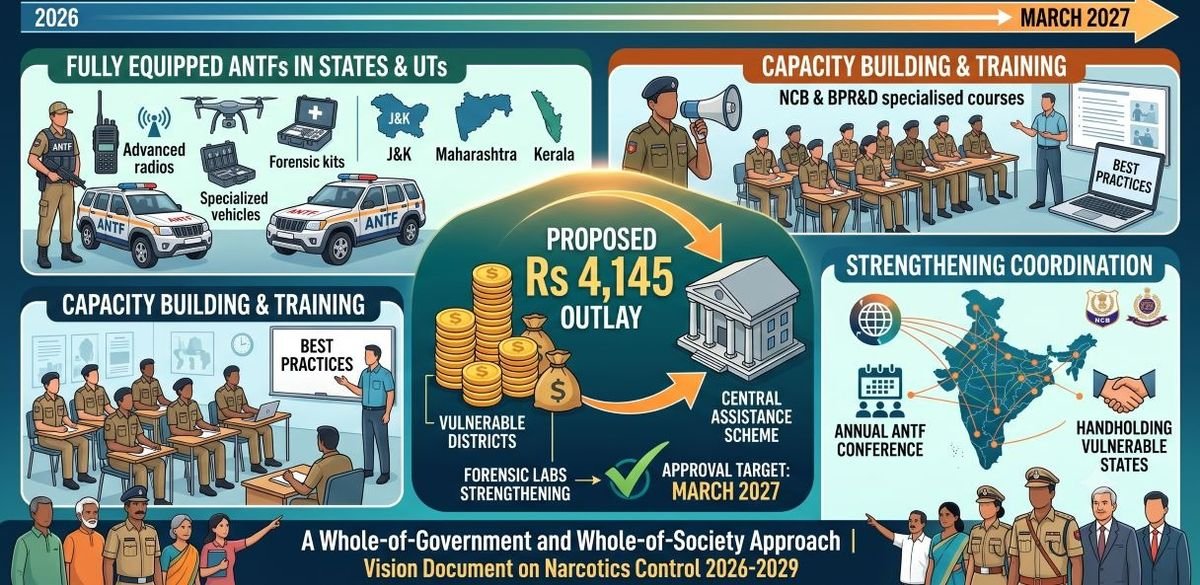
Srinagar, Sep 18: The Union government has set a target of establishing fully equipped Anti-Narcotics Task Forces (ANTFs) across States and Union Territories by March 2027, as part of a three-year roadmap outlined in the Vision Document on Narcotics Control 2026-2029.
According to the document, accessed by Rising Kashmir, the plan comes under Capacity Building & Coordination, which identifies strengthening the institutional and operational capacity of State enforcement agencies as a key requirement for implementing the government’s narcotics-control roadmap.
The Vision Document was released on June 26, 2026 and lays down time-bound targets for stakeholders through 2029.
Nearly 99 per cent of enforcement-related actions under the Narcotic Drugs and Psychotropic Substances (NDPS) Act are carried out by State Enforcement Agencies, according to the document. It therefore calls for strengthening the Anti-Narcotics Task Forces, local police and forensic infrastructure with adequate human and material resources.
The roadmap envisages ANTFs as the nodal agency for anti-narcotics efforts in each State and Union Territory. As the first step towards strengthening them, the document proposes uniformity in their structure and responsibilities across States, aimed at ensuring smoother coordination.
The Narcotics Control Bureau (NCB) has prepared a model template for ANTFs and shared it with States and UTs.
The government has set the specific target of establishing fully-equipped Anti-Narcotics Task Forces by March 2027.
The document also proposes strengthening the skills and capabilities of ANTF personnel.
The NCB, in collaboration with the Bureau of Police Research and Development (BPR&D), will organise 20 specialised courses over the next year for ANTF officers. These courses are intended to update officers on emerging challenges in narcotics and enable them to share best practices.
To further strengthen coordination, the document proposes that an annual ANTF conference be institutionalised by the NCB.
The NCB will also identify vulnerable States and handhold them in establishing an ideal ANTF based on the model template, while taking into account their specific challenges.
The roadmap also proposes a new assistance mechanism for States and UTs.
At present, assistance towards anti-narcotics efforts is provided through a scheme with a provision of Rs 50 crore, according to the document.
A new scheme is envisaged as 100 per cent centrally funded, with a financial outlay of about Rs 4,145 crore. The proposed scheme will have a special focus on vulnerable districts and capacity building of State/UT ANTFs.
Additionally, the Ministry of Home Affairs (MHA) will consider providing operational funds to vulnerable districts that have a clear district roadmap for their enforcement activities.
The target specified in the document is approval of the central assistance scheme for States and UTs by March 2027.
The document identifies capacity building of States, courts and forensic laboratories, along with empowering the NCB as the apex agency to monitor achievement of the targets identified in the roadmap.
The government already operates a four-tier NCORD mechanism to improve coordination between Central and State drug-law enforcement agencies and other stakeholders.
The government has described the Vision Document on Narcotics Control 2026-2029 as a three-year roadmap with clear priorities and time-bound targets, based on a whole-of-government and whole-of-society approach to narcotics control.


