



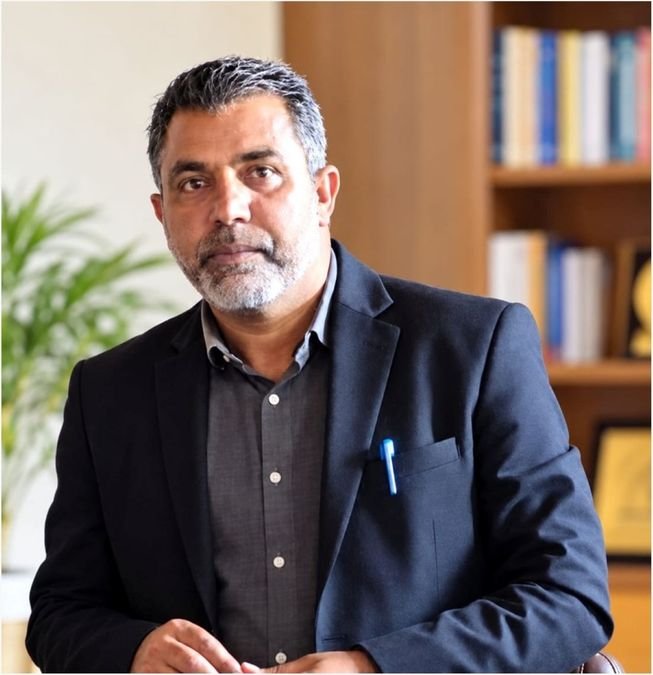
RK Correspondent: Your recent work has included art education, vocational education, project-based learning and contextualisation of Kaushal Bodh. Why should schools move beyond textbook-centred learning?
Sheikh Gulzar Ahmad:Because life is not organised according to textbook chapters.
Children learn by doing, making, observing, questioning, creating and solving real problems.
Art provides avenues for expression. Vocational education connects learning with work and dignity of labour. Project-based learning brings different areas of knowledge together.
The larger idea is that learning should connect the head, hand and heart. This is also consistent with the broader direction of NEP 2020 and NCF-SE 2023.
RK Correspondent: You have worked extensively with teachers across Jammu and Kashmir and also facilitated programmes beyond the UT. What have teachers taught you?
Sheikh Gulzar Ahmad:Teachers have taught me that educational reform eventually acquires a human face.They have also taught me to listen.When a teacher questions a new initiative, it should not automatically be interpreted as resistance. Sometimes the question reveals a genuine implementation challenge.
Three decades of interaction with teachers have convinced me that teachers are not merely implementers of educational policy. They are professionals whose experience should inform policy, curriculum, assessment and teacher education.
RK Correspondent: With AI and digital technology changing education, what should teachers prepare for?
Sheikh Gulzar Ahmad:Teachers need to learn how to use technology without surrendering professional judgement to it.
AI can assist with lesson planning, differentiation, resource development, language support and feedback. But it cannot replace the teacher’s understanding of the individual learner, classroom context and ethical considerations.
Technology should therefore extend teacher capacity, not diminish teacher agency.The future teacher will need stronger digital, pedagogical, assessment and critical-thinking capabilities.
RK Correspondent: Finally, after beginning as a primary-school teacher in 1996 and reaching a system-level academic role, what do you hope remains after the programmes, workshops, modules and documents are forgotten?
Sheikh Gulzar Ahmad:I hope the work leaves behind people who continue to think.
A programme ends, a workshop ends, a handbook eventually becomes old and policies change. But if a teacher begins asking better questions, if a Head of Institution listens more carefully, if a classroom becomes more inclusive, or if a child finds learning more meaningful, something lasting has happened.
Looking back, I don’t see my journey as a movement away from the classroom. I see it as an attempt to understand the classroom from different perspectives—as a teacher, teacher educator, curriculum developer, assessment professional, researcher and academic coordinator.
If there is one lesson I would carry forward, it is this:
Educational reform finally succeeds only when an idea travels from the policy document to the teacher, from the teacher to the classroom, and from the classroom into the life of the child.
That is the journey I have tried to be part of.
