



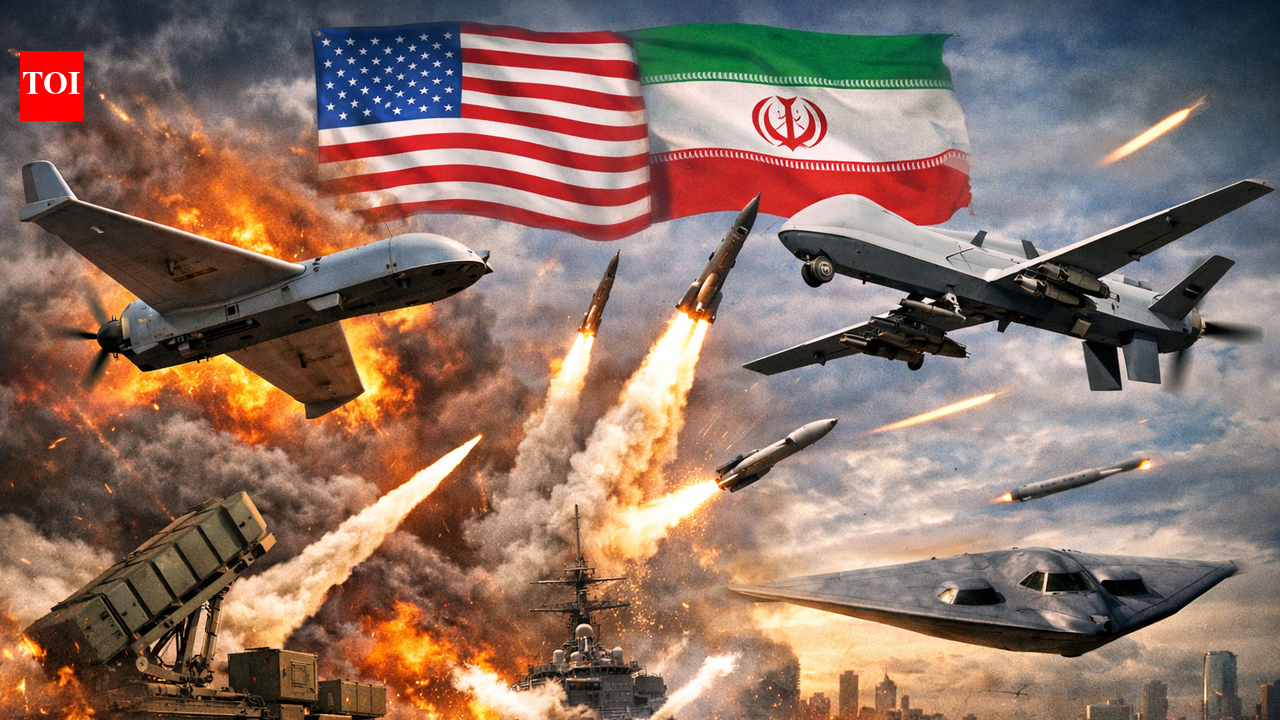
The ongoing war involving the United States, Israel and Iran has rapidly evolved into one of the most technologically complex missile and drone battles in modern military history. Ever since the start of hostilities on February 28, Iran has launched more than 500 ballistic missiles and over 1,000 drones across the Middle East, according to US military officials and independent tallies. These attacks have targeted US bases, oil infrastructure and urban areas across the Gulf, while American and Israeli forces have responded with air strikes, cruise missile attacks and layered missile defence systems.The conflict has revealed a striking contrast in military strategies. Iran has relied heavily on relatively cheap drones and ballistic missiles designed to overwhelm air defence systems through sheer volume. The United States and its allies, meanwhile, depend on technologically advanced platforms such as stealth bombers, precision-guided cruise missiles and expensive interception systems like Patriot and THAAD to blunt those attacks.
This clash between low-cost mass attack systems and high-end defensive technology has turned the war into a battle not only of military capability but also of economics and endurance. In several cases, a drone costing tens of thousands of dollars has forced defenders to fire interceptor missiles costing millions.From the Shahed drone swarms launched across the Gulf to B-2 stealth bombers striking hardened nuclear facilities deep inside Iran, a small set of weapons systems is shaping the trajectory of the conflict. These platforms are not simply tools of war; they are determining how the war is fought, how long it can be sustained and which side gains the strategic advantage.
Shahed-136: The drone that turned the war into an attrition battle
Few weapons have shaped the current war as dramatically as Iran’s Shahed-136 loitering munition. The drone has become the defining symbol of Tehran’s military strategy and the most widely used weapon in its arsenal during the conflict.The Shahed-136 is a relatively simple aircraft. Roughly three metres long with a distinctive delta-wing design, it is powered by a small propeller engine mounted at the rear. The drone carries an explosive payload weighing roughly 40 to 60 kilograms and is programmed to strike predetermined coordinates before detonating on impact.
.
What makes the system influential is not its sophistication but its cost and scale. Estimates place the price of a Shahed-136 drone between about $20,000 and $50,000. For that relatively modest investment, Iran gains a weapon capable of travelling distances estimated at up to 2,000 kilometres.The drone flies slowly and at low altitude, making it difficult to detect on radar compared with ballistic missiles that follow high-altitude trajectories. Its small radar signature and quiet engine allow it to approach targets with relatively little warning.
.
Iran has used these drones in coordinated swarms across the Gulf region, launching dozens simultaneously against military bases, oil facilities and urban infrastructure. Even when many are intercepted, a portion can still penetrate defences and strike targets.The most significant impact of the Shahed-136, however, lies in its economic effect on the war. Destroying a drone worth tens of thousands of dollars often requires firing a Patriot interceptor costing several million dollars. This imbalance means that even successful defences impose a heavy financial burden on the defending side.
.
The result is a war of attrition in which Iran attempts to exhaust the missile stockpiles of the United States and its allies by forcing them to expend expensive interceptors at unsustainable rates.
Shahed-131: The swarm multiplier
Alongside the Shahed-136, Iran has also deployed the smaller Shahed-131 loitering munition. While less powerful than its larger counterpart, the drone plays an important operational role.The Shahed-131 carries a smaller warhead and has a shorter range, typically estimated at several hundred kilometres. Yet it is particularly useful when deployed in large numbers.In many attacks, the Shahed-131 functions as part of a layered drone swarm. These drones can be launched simultaneously with larger strike drones or ballistic missiles. Their role is often to saturate radar systems and complicate interception decisions for air defence operators.When dozens of targets appear simultaneously on radar screens, defenders must decide which threats to engage first. Smaller drones can therefore act as decoys, increasing the likelihood that larger or more destructive weapons reach their targets.The presence of these drones has forced US and allied forces to adapt their defensive strategies, including deploying fighter aircraft and helicopters armed with cheaper weapons to intercept low-flying targets.
Shahab-3: Iran’s long-range missile backbone
While drones dominate headlines, ballistic missiles remain the backbone of Iran’s long-range strike capability. Among these, the Shahab-3 stands out as one of the most important weapons in Tehran’s arsenal.The Shahab-3 is a medium-range ballistic missile capable of travelling roughly 2,000 kilometres. It carries a warhead weighing about 1,700 pounds and can strike targets across much of the Middle East.From launch sites within Iran, the missile can reach Israel and many US military installations across the Gulf region. This range has made it a key component of Iran’s deterrence strategy for more than two decades.
.
During the current war, Shahab-family missiles have often been fired in coordinated waves alongside drone swarms. The combination creates a complex attack profile that challenges air defence systems.Ballistic missiles travel at extremely high speeds and follow steep trajectories, while drones approach at low altitude. Defending against both simultaneously requires multiple types of interception systems working together.Iran has also reportedly developed more accurate derivatives of the Shahab-3, extending its strike range and improving targeting precision.
Fattah hypersonic missile: Iran’s contested next-generation weapon
Iran has claimed that its Fattah missile represents a breakthrough in missile technology. According to Iranian officials, the weapon can travel at speeds up to fifteen times the speed of sound and has a range of about 870 miles.Tehran describes the Fattah as a hypersonic missile capable of manoeuvring during flight. If true, such manoeuvrability would make interception extremely difficult.
.
Traditional ballistic missiles follow predictable trajectories, allowing missile defence systems to calculate interception points. Hypersonic glide vehicles, however, can alter their flight paths and fly at lower altitudes, drastically reducing the time defenders have to react.Despite these claims, US and Israeli officials have not confirmed whether the Fattah meets the technical definition of a true hypersonic weapon. Independent verification of its performance remains limited.Even so, the missile has already had strategic effects. The mere possibility that Iran could field manoeuvrable hypersonic weapons forces planners to reconsider the effectiveness of existing missile defence systems.
B-2 Spirit and the GBU-57 bunker-buster
On the American side of the conflict, few weapons carry as much strategic weight as the B-2 Spirit stealth bomber and the GBU-57 Massive Ordnance Penetrator it can deliver.The B-2 is one of the most advanced aircraft ever built. Its flying-wing design and specialised materials drastically reduce its radar signature, allowing it to penetrate heavily defended airspace.
.
This capability makes the aircraft uniquely suited for striking hardened underground facilities. In fact, the B-2 is currently the only aircraft capable of carrying the GBU-57 bunker-buster bomb.The GBU-57 weighs about 30,000 pounds and is designed to penetrate deep underground before detonating. The bomb was developed specifically to destroy hardened nuclear facilities and deeply buried command centres.
.
In Operation Midnight Hammer last June, seven B-2 bombers reportedly dropped fourteen of these weapons on Iranian nuclear facilities at Fordo, Natanz and Isfahan. The strike marked the first operational use of the weapon.These strikes demonstrated the United States’ ability to destroy hardened infrastructure even when it is buried beneath mountains or reinforced bunkers.
Tomahawk cruise missile: The naval strike workhorse
Another key weapon shaping the war is the Tomahawk land-attack cruise missile, a staple of US naval warfare for decades.Tomahawks are launched from US Navy destroyers and submarines and can travel distances exceeding 1,500 kilometres. The missile flies at low altitude and can follow complex routes programmed before launch.This ability allows the weapon to avoid radar systems and approach targets from unexpected directions. Its precision guidance enables it to strike specific buildings, bunkers or radar installations.
.
During the opening stages of the conflict, US naval forces fired Tomahawk missiles from warships in the region as part of Operation Epic Fury. Footage released by US Central Command showed missiles being launched from the destroyer USS Thomas Hudner.Submarines also played a role. During earlier strikes, more than two dozen Tomahawks were launched from a submarine against an Iranian nuclear site, demonstrating the ability to strike from beneath the sea.The missile’s long range allows the United States to hit targets inside Iran without placing aircraft in immediate danger.
LUCAS drone: America’s answer to Shahed swarms
The widespread use of Shahed drones has forced the United States to adopt a similar approach. One response is the Low-cost Unmanned Combat Attack System, or LUCAS.The LUCAS drone is essentially a low-cost one-way attack drone modelled on the Shahed-136. Designed to be inexpensive and easy to produce, it allows the United States to conduct precision strikes without relying exclusively on expensive cruise missiles.
.
US Central Command has confirmed the use of such low-cost drones in operations targeting Iranian facilities. These drones allow commanders to strike radar stations, launch sites or ammunition depots without expending higher-value munitions.By adopting similar technology, the United States is attempting to neutralise Iran’s economic advantage in drone warfare.
Patriot missile defence system
The Patriot air defence system has become one of the most heavily used defensive weapons in the war. Developed by the United States and deployed across much of the Middle East, Patriot batteries are responsible for intercepting incoming missiles and drones.The system uses advanced radar to track incoming threats and launch interceptor missiles designed to collide with or explode near the target.Patriot systems have achieved interception rates exceeding ninety percent in some engagements. This high success rate has helped protect military bases and urban areas across the region.
.
However, the cost of these interceptions has raised concerns. Each PAC-3 interceptor missile can cost roughly four million dollars. Using such weapons against inexpensive drones creates a severe economic imbalance.As Iranian drone attacks continue, military planners are increasingly concerned about the sustainability of relying solely on high-cost interceptors.
THAAD: High-altitude missile defence
The Terminal High Altitude Area Defense system, known as THAAD, forms another crucial layer of the US missile defence network.THAAD is designed specifically to intercept ballistic missiles during the final phase of their flight, when they are descending toward their targets at extremely high speeds.
.
Unlike the Patriot system, which operates at lower altitudes, THAAD interceptors engage threats higher in the atmosphere. This layered defence increases the probability of destroying incoming missiles before they reach their targets.
.
However, THAAD interceptors are extremely expensive. Each missile is estimated to cost around twelve million dollars.During previous confrontations in the region, the United States reportedly expended a significant portion of its THAAD interceptor inventory in just days of intense combat.
.
This raises serious questions about how long such systems can sustain high-volume missile attacks.
APKWS: The cheaper solution to drone swarms
As the cost imbalance between drones and interceptors becomes more apparent, the United States has begun relying on alternative weapons to counter drone attacks.One of the most notable is the Advanced Precision Kill Weapon System, or APKWS.The system converts a standard Hydra rocket into a laser-guided weapon by attaching a guidance kit costing roughly $3,000. The total cost of the weapon is around $25,000.Fired from fighter aircraft or Apache helicopters, the rocket provides a much cheaper method for destroying slow-moving drones compared with using a Patriot interceptor.Although the operating costs of aircraft remain high, the system allows commanders to engage multiple drones without exhausting expensive missile stockpiles.
The real battlefield: Endurance and economics
The weapons shaping the US-Iran war illustrate a broader shift in modern warfare. The conflict is not simply a contest of military power but also a test of economic endurance.Iran’s strategy relies on deploying large numbers of inexpensive drones and missiles to overwhelm defences and force opponents to expend costly interceptors. The United States, meanwhile, relies on advanced platforms capable of precision strikes and layered missile defence.The outcome may depend less on which side possesses the most advanced technology and more on which side can sustain its weapons supply for the longest period.If interceptor stocks run low or production cannot keep pace with attacks, even the most sophisticated defence systems may struggle to keep up with mass drone and missile assaults.In that sense, the defining weapons of the war are not just tools of destruction. They are instruments shaping the pace, cost and sustainability of one of the most complex military confrontations in the modern Middle East.


