



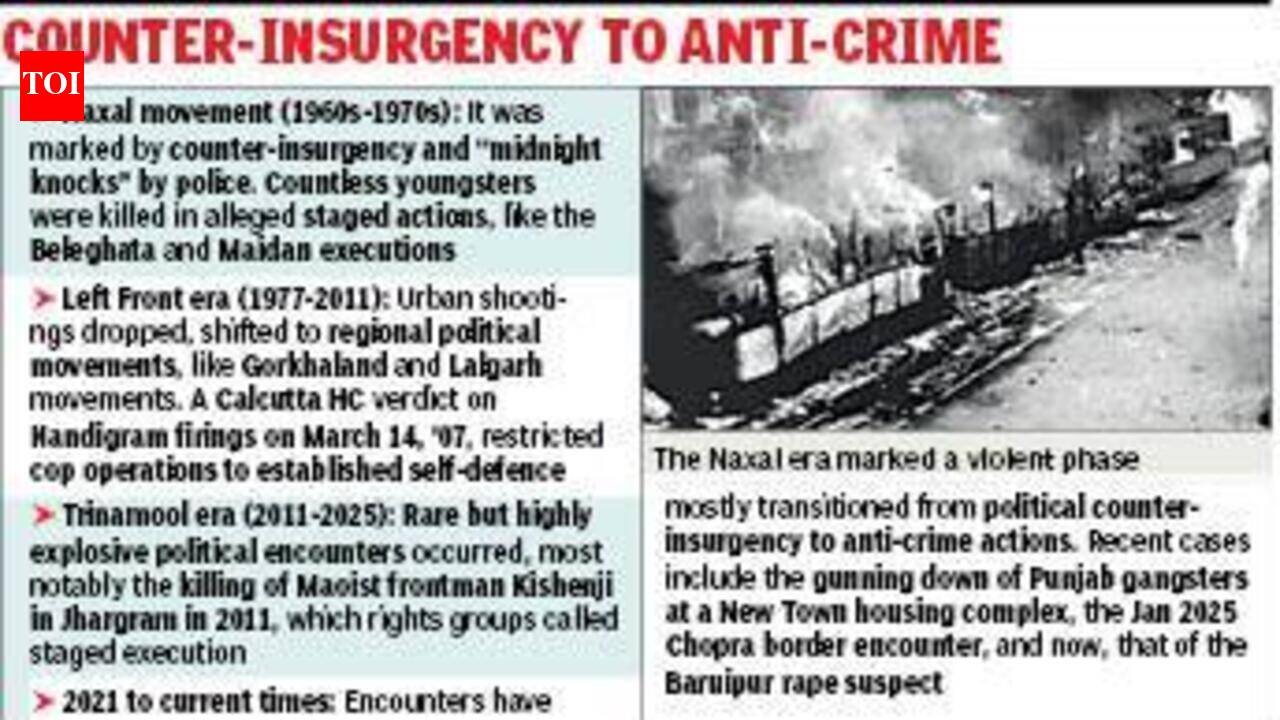
Kolkata: The recent history of encounter deaths in Bengal stretches back almost six decades but several factors have made these episodes stand out from each other across the different regimes that have governed Bengal since the 1960s. During the Naxal movement, encounters became a prominent fixture in Bengal with many young, brilliant students—several of them from Presidency College, Jadavpur University and BE College—being killed in police encounters. Neighbourhoods of Kolkata still recall police’s “midnight knocks” to pick up those, allegedly associated with the movement.A retired public servant, Sunish Deb, who was an active Naxal movement member, recalled, “It was Nov 1970 when cops picked up four youths from the Beleghata CIT quarters at night, including Ashok Basu, a meritorious engineering student from JU, lined them up against a wall of the complex, and shot them dead. At that time, Beleghata Police Station OC was Anil Ghosh Dastidar, who himself narrated the incident to me at DD Lalbazar on July 20-24, 1972,” Deb said. “On Aug 4, 1971, Saroj Dutta was arrested by the Special Branch from Raja Basanta Roy Road in the dead of night. Early on Aug 5, he was taken to the Maidan and shot dead. Umpteen such incidents crowded newspapers those days. Most times, police claimed the youths either tried to run away or snatch their revolvers and they had to fire in self defence.”In the Left Front regime, the frequency of encounters dropped. APDR vice-president Ranjit Sur said, “In Left times, Asim Mondal, a Janajuddha (People War group) activist, was killed in a police encounter in West Midnapore. The Lalgarh movement saw a massive surge in encounters, with numerous activists and tribal residents being killed by security forces in West Midnapore and surrounding areas. Such killings were also reported during the Gorkhaland movement under Subhash Ghising.”The Calcutta High Court verdict by Chief Justice Surendra Singh Nijjar and Justice Pinaki Chandra Ghose, holding the Nandigram firings on March 14, 2007, as “totally unconstitutional” led to the halt of police firings. It was decided that cops could fire only when the “right to self defence” could be established.But such killings were reported even after that. After the Trinamool came into office, the govt faced intense scrutiny with the encounter of Maoist frontman Kishenji. Recalling the incident, Sur said, “One of the most high-profile encounters of the Trinamool times was Kishenji’s killing. Other Maoist figures, such as Yudhisthir Mahato, were also killed in operations that we, human rights activists believe, were staged executions. The renewed agitations for a separate Gorkhaland state during the Trinamool govt also witnessed encounter deaths.”In recent years though, encounters in Bengal also marked targeted anti-crime operations. Gangsters, fleeing a gang war in Punjab, took shelter in the Sukhobrishti housing complex in New Town, where they were eventually tracked down and killed in a gunfight by the police. In Jan 2025, a 25-year-old murder accused, Sajjak Alam, who had been on the run after shooting cop escorts in a prison van, was gunned down just 800m from the international border in Chopra before he could escape into Bangladesh. Sur said APDR’s fact-finding committee found it to be a fake encounter.


