



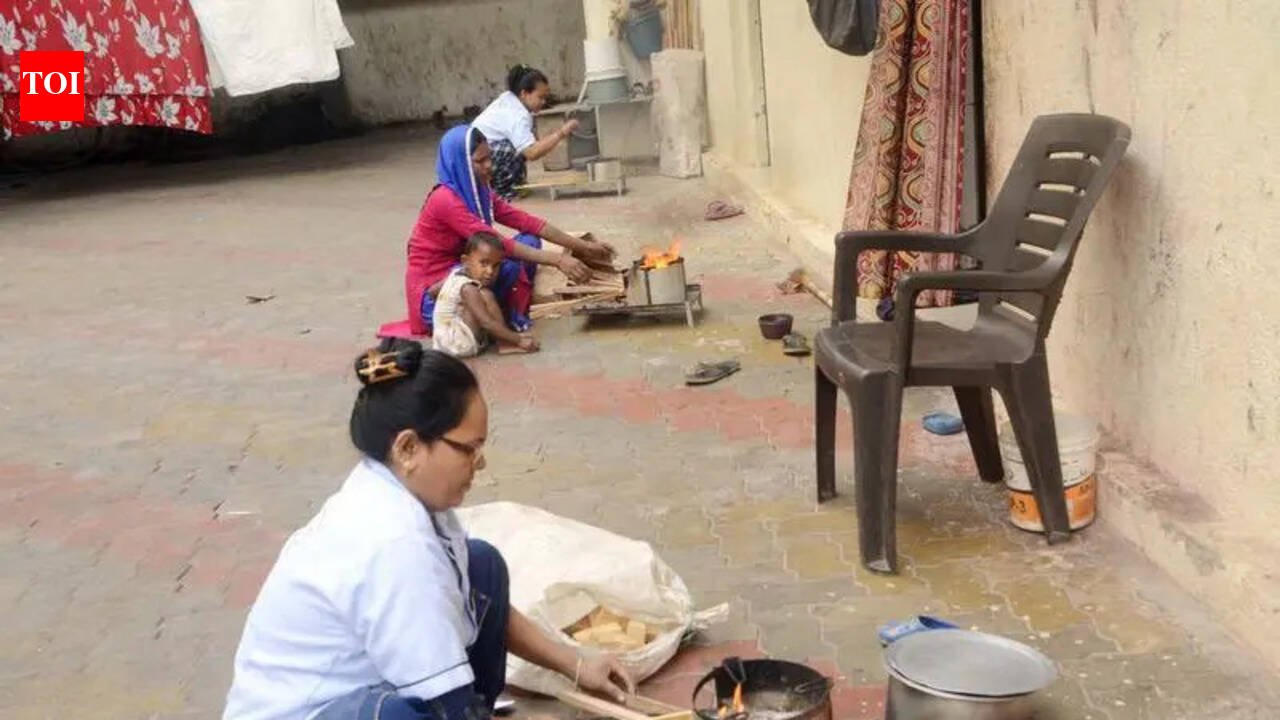
Rajkot/Ahmedabad: For the last fortnight, industrialist Parth Ganatra spends considerable time to oversee arranging bundles of cooking wood for his 50 workers so that they can prepare their meals in the labour colony attached to his unit in Metoda GIDC. Every evening, smoke now rises from makeshift chulhas outside the workers’ quarters, a desperate stop-gap arrangement to keep his workforce from leaving.“I can’t afford to lose my worker. It’s difficult to even procure this wood, but I had to manage,” said GanatraThe unusual sight reflects a growing crisis in Gujarat’s manufacturing clusters, where industries are struggling to retain migrant labourers amid an acute shortage of cooking gas cylinders. Industrialists fear that if the supply disruption continues, it could trigger a large-scale exodus of migrant workers to states such as Bihar, Uttar Pradesh and Odisha.Major clusters such as Shapar-Veraval and Metoda in Rajkot and the ceramic hub of Morbi depend heavily on migrant labour. Most workers live in labour colonies set up by factories, where they rely almost entirely on commercial LPG cylinders for cooking.Unlike domestic cylinders, commercial LPG does not carry government subsidy and was earlier readily available. However, supply chain disruptions following the war in West Asia have led to severe shortages.The Rajkot Chamber of Commerce and Industry (RCCI) has written to the district collector highlighting the gravity of the situation.“In MSME units where workers are residing, we are facing an acute LPG cylinder shortage. As a result, units are struggling to retain workers, many of whom have begun rushing back to their native places,” RCCI said in its representation.Industrial associations estimate that around one lakh migrant workers are employed in casting and forging units in Rajkot’s industrial areas, while Morbi’s ceramic industry alone employs nearly four lakh workers — most of whom depend on commercially supplied LPG cylinders for daily cooking.Collector Om Prakash said, “We don’t want migrant workers to face any trouble and we are doing everything to ensure they get cooking gas. We have made it clear that the gas supply for cooking purposes must remain the same as it was before the war.”Bharuch: Despite being one of Gujarat’s most heavily industrialised cluster, Dahej does not have a single dedicated labour colony, forcing thousands of migrant workers to live in makeshift accommodation arranged by contractors — often in nearby villages or even farmhouses.This has been the situation for three decades.Dahej, home to over 400 industrial units across chemicals, petrochemicals, agrochemicals, pharmaceuticals, paints, tyre, dyes and pigments sectors, depends on a large migrant workforce for activities such as civil construction, fabrication, sanitation, loading and unloading, security, packaging and shop-floor operations. However, in the absence of any government-supported labour housing facility, workers have little option but to stay in rented makeshift rooms in nearby villages. With demand for accommodation high, even a small single-room unit commands a rent of Rs 3,000 to Rs 5,000 per month.Around 10,000 workers reside in around 15 villages near Dahej.Harish Joshi, president of the Vilayat Industries Association, “Migrants are backbone of manufacturing units. But it’s increasing difficult to stop them from leaving.”Many of these rooms are rented by labour contractors who supply manpower to industries. Contractors also typically arrange transport and canteen facilities for workers. But the current shortage of LPG cylinders has disrupted this system, forcing several canteen services to scale down operations.The shortage has also led to a rise in tiffin services run by families in nearby villages, though the cost of meals has increased sharply due to the crisis.OMCs sold 74,622 5-KG cylinders in 12 daysAhmedabad: Oil Marketing Companies (OMCs) have begun organising special camps across industrial clusters to supply 5-kg LPG cylinders to workers. According to sources, Gujarat typically witnesses a demand of around two lakh 5-kg cylinders.Sanjib Kumar Behera, executive director and state head (Gujarat) of IOC said, “Between March 23 and April 4, the three government OMCs together sold 74,622 cylinders of 5 kg each across the state. “On average, more than 5,700 small cylinders are being sold every day,” Behera said, who is also the State-Level Coordinator of OMCs.During this period, 22,553 cylinders were issued under new connections, while 57,503 cylinders were sold under the Free Trade LPG category. “In Surat alone, around 21,000 cylinders were sold. OMCs have organised camps in various industrial areas to ensure workers can access these cylinders,” he added.QUOTES“Workers prefer commercial gas connections due to the minimal paperwork involved. Many units are providing, but supplies are short, and there’s a major struggle to retain the workforce.Amrut Gadhiya, President, Shapar-Veraval Assn“Due to uncertainty over fuel availability, some workers have already returned to their hometowns. Many companies have now started arranging electric cooking equipment to ensure workers can prepare meals.”Nirmal Shah, Labour Contractor, Dahej


