



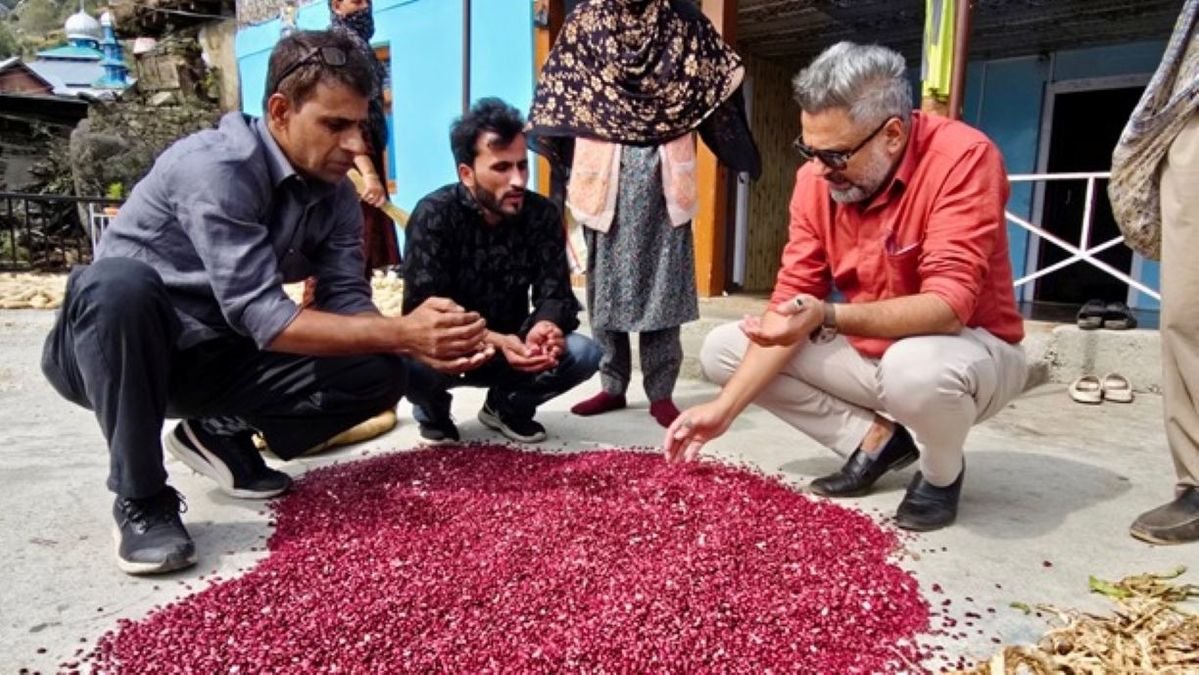
Doda, Oct 10: Rajmash (Rajma) farming has turned into a significant source of livelihood in the hilly belts of Doda district. Remunerative market prices have driven a sharp rise in enthusiasm among growers this season.
In the region, the crop is more commonly known as Rajmash rather than Rajma, the term used across most of the country. This local usage has stuck and now appears in the GI tag itself, registered as “Bhaderwah Rajmash.”
In higher-altitude areas such as Dhandal and Gurmul, the crop has become an important economic lifeline. A government push to expand its acreage has helped drive this shift.
Under the Holistic Agriculture Development Programme (HADP), the Department of Agriculture distributed seeds of the GI-tagged Bhaderwahi Rajmash across these areas. The aim was to ensure the variety, long associated almost exclusively with Bhaderwah town, takes root in suitable hilly pockets across the wider district.
The Bhaderwahi Rajmash was granted a Geographical Indication (GI) tag by the Chennai-based GI Registry in August 2023. It was recognised as a product specific to the region, known for its distinct taste and texture.
The crop’s reputation extends well beyond Doda district. Travellers on the Jammu-Srinagar National Highway have long stopped at Peerah, a small roadside halt in neighbouring Ramban district, for its Rajma Chawal, a dish so well known that even Chief Minister Omar Abdullah has publicly praised it. The Rajma served at Peerah’s dhabas traces back to the same Doda-Kishtwar-Ramban hill belt, with the Bhaderwahi variety from the Chinta Valley long regarded as among the finest grown anywhere in the region.
As a result of the department’s efforts, farmers in Dhandal, Gurmul and adjoining areas have harvested a bumper crop this season. The departmental farm-gate procurement price for raw produce has been fixed on a per-kilogram basis, while cleaned, graded and packaged Rajmash fetches a significantly higher rate in the open market.
Farmers in the region typically dibble Rajmash seeds alongside maize stalks. The maize provides natural support for the vines to climb, making intercultural operations easier. With favourable weather and just one or two rounds of weeding, yields have multiplied this season, with several growers harvesting produce in quintals.
Local farmer Sheikh Shabir said the Agriculture Department distributed seeds across Dhandal, Gurmul and the surrounding block this season, resulting in a massive harvest across the area. He said the crop requires minimal effort and can be easily managed by farming families.
The GI-tagged seeds, brought in from Bhaderwah, have adapted well to the local soil and climate, he said. They are conveniently intercropped with maize. After dibbling the seeds alongside maize, only one or two hoeings are needed, and with good weather, the crop turns out well. He said some farmers in the area have harvested multiple quintals on a commercial scale this season.
Another farmer, Amir Hussain, said the local climate is highly conducive for growing high-quality Rajmash. Cultivation had previously remained limited to a small scale, he said, due to a lack of awareness about modern techniques and yield-enhancement practices, with most of the produce earlier going toward self-consumption.
He said that changed once the Agriculture Department stepped in under HADP, providing free quality seed and technical guidance, along with periodic field inspections and timely plant protection advice. Every farmer is now harvesting substantial yields, he said, of markedly better quality than in previous years.
Aamir Rafiqi, Sub-Divisional Agricultural Officer, Pranoo, Doda, said area expansion and promotion of Bhaderwahi Rajmash has been a key focus under HADP. He said around 28 to 29 quintals of seed stock were procured last year.
The total area under Rajmash cultivation across the sub-division now stands at nearly 3,000 hectares, involving roughly 15,000 farmers, Rafiqi said. Several Farmer Producer Organisations are actively working with growers on aggregation and marketing.
Rafiqi said that across every zone where seeds were distributed under the area expansion drive, reports of a bumper crop have come in from field visits conducted by departmental teams. This drive covered nearly 2,500 kanals, or around 1,263 hectares, and benefited over 850 registered farmers.
He said the government has fixed competitive base rates. FPO-led direct marketing has allowed growers to secure better prices without exploitation by middlemen, while also meaningfully engaging unemployed rural youth in agribusiness.
The department has also targeted area expansion under the JKCIP programme, Rafiqi said, with similarly promising results expected. He credited the Agriculture Department, the district administration and field functionaries for the success of the drive.
Addition reporting by Parvaiz Bhat from Doda
