



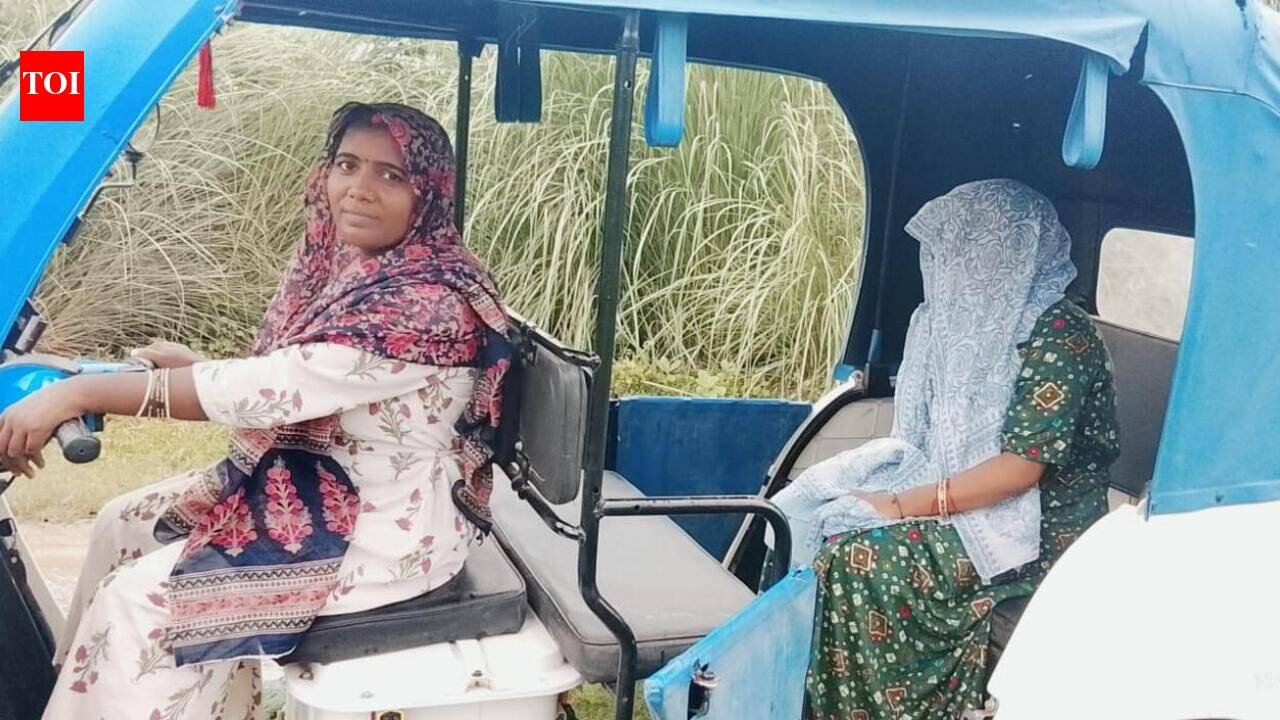
Prayagraj: From struggling to make ends meet to becoming the “e-rickshaw didi” of her village, Sarita Devi of Kaushambi is carving out a distinct identity in a profession traditionally dominated by men.After completing her household chores, she drives her e-rickshaw to ferry passengers between towns, earning Rs 900-1,000 a day. Her initiative has inspired other women, with nine rural women in the district having applied to operate e-rickshaws and three already receiving them.Sarita, a resident of Mirzapur Javai village in Sirathu block of Kaushambi district, is now known locally as the “e-rickshaw didi”. When she returns home in the evening, her face wears a smile born of self-reliance and a newfound identity.Sarita recalls that when she first took her e-rickshaw out in the village, neighbours would make snide remarks and taunt her, insisting that a village daughter-in-law ought to remain within the confines of the ‘ghoonghat’ (veil). However, their perspective has since changed.Sarita explains that in the remote area where she lives, women previously had no income-generating options beyond domestic chores. After completing their household duties, women would remain idle for the rest of the day. She faced a similar situation, and her family’s financial condition was dire. With four children to support and a husband who worked as a labourer, there were days when the family had to make do with just one meal.Amid these struggles, she joined the “Jai Mata Di Self-Help Group” in 2021. It was during group meetings that she first realised how women could collectively generate a livelihood through small-scale savings initiatives. Eventually, she began working as a ‘Samuh Sakhi’ (group facilitator), earning between Rs 1,000 and Rs 1,500 per month. However, Sarita’s journey did not end there; she continued to seek out new opportunities.A turning point in Sarita Devi’s life came in October 2024 when she participated in the “Safe Mobility Programme” organised by Development Alternatives. Here, she learnt about women-led e-rickshaw businesses. Sarita felt that this could be more than just a source of employment and could become a means for women to gain independence and forge a new identity.In Dec 2024, she took part in an “E-rickshaw Driver Training Programme”. The organisation provided her with technical knowledge about driving, road safety rules and vehicle maintenance, along with hands-on training. During the training, she also received comprehensive support in obtaining a driving licence, preparing loan applications and understanding the fundamentals of the business.Usha Pal, deputy commissioner (NRLM-Kaushambi), said Sarita Devi applied for an e-rickshaw under the Chief Minister’s Youth Entrepreneurship Campaign scheme. She secured financial assistance from a bank through the District Village Industries Officer’s office and purchased an e-rickshaw costing approximately Rs 2.25 lakh. The funding comprised a bank loan of Rs 2.25 lakh and an investment of Rs 28,500 from her own capital. Now, Sarita Devi earns between Rs 900 and Rs 1,000 daily through her e-rickshaw business.Sarita Devi’s initiative sparked awareness among other women in the village. She showed them the way forward, explaining how society had confined women within the four walls of their homes. Women often limit their aspirations to activities like making papads and pickles or running beauty parlours, yet there are opportunities far beyond these confines. They can find prospects in new sectors and increase their income.Usha said there are currently 10,360 self-help groups in Kaushambi district, involving 108,711 women. Inspired by Sarita’s example, nine rural women in the district have applied to operate e-rickshaws so far, and three have already been provided with them. Sarita Devi has become a source of inspiration for these women.
