



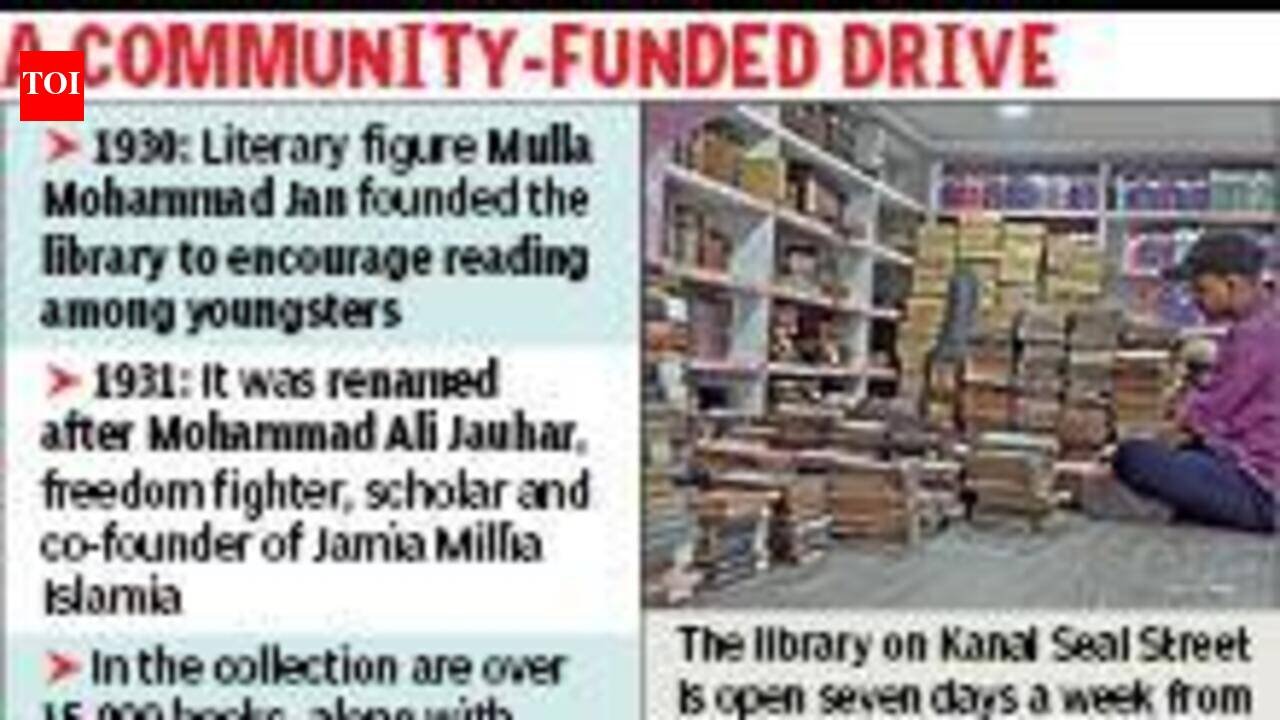
Kolkata: Ninety-six-year-old Mohammed Ali Library on Kanai Seal Street in central Kolkata, one of the oldest public reading institutions in Kolkata, has reopened its doors after three years of restoration and archival conservation, aimed at protecting a collection of rare books and periodicals from further deterioration.Located on the ground floor of Barry House, close to the bustling Zakaria Street, the library resumed operations on Teachers’ Day, following extensive structural repairs and a community-funded drive to revive the institution, which had steadily fallen into disrepair over the years. The restoration included structural repairs, improved lighting and the renovation and reinforcement of its wooden shelves. The work extended beyond the physical space. An extensive archival programme, involving indexing, cataloguing and digitisation is underway, with around 50% of the library’s rarest books and century-old journals already digitised. The remaining collection is expected to be digitised soon, giving the library an additional layer of protection against the effects of age, humidity and repeated handling.Founded in 1930 by Mulla Mohammad Jan to encourage reading among youngsters from the neighbourhood, the library was in 1931 renamed after Mohammad Ali Jauhar, freedom fighter, scholar and co-founder of Jamia Millia Islamia. Mohammad Ali Park is also named after him.Over the decades, the library evolved into more than a repository of books. It became a neighbourhood institution, where generations of readers, students and researchers found a place to study. “I am thankful to the committee members and the friends of the library. Whatever we are seeing today is the fruit of their labour, patience and perseverance,” said Mohammad Khalil of Mohammad Ali Library.Its collection today stands at more than 15,000 books, along with periodicals dating back a century, the most significant of them being an Urdu translation of the Ramayana, published in 1901, and an Urdu translation of the Mahabharata. The library also preserves issues of Tahzeeb-e-Niswaan, one of the pioneering Urdu women’s journals of the early 20th century, and original copies of Awadh Punch, the Urdu satirical weekly.As the library started to fall on bad times, damp took a toll on the collection. Pages started to come loose, wooden shelves began to decay and some racks turned unstable. With inadequate labelling and cataloguing, even accessing parts of the collection turned difficult even as furniture needed repairs and the reading room brighter lights. “The books were decaying, the shelves were falling off, and the library needed renovation,” said Anwarul Haque, librarian of Mohammed Ali Library. “The intervention became critical to safeguard a unique literary heritage.”The reopening has brought some of the oldest members, several of them in their 80s, back to their favourite reading space.The library is open to readers, students and researchers seven days a week, from 2 pm to 10 pm.
