






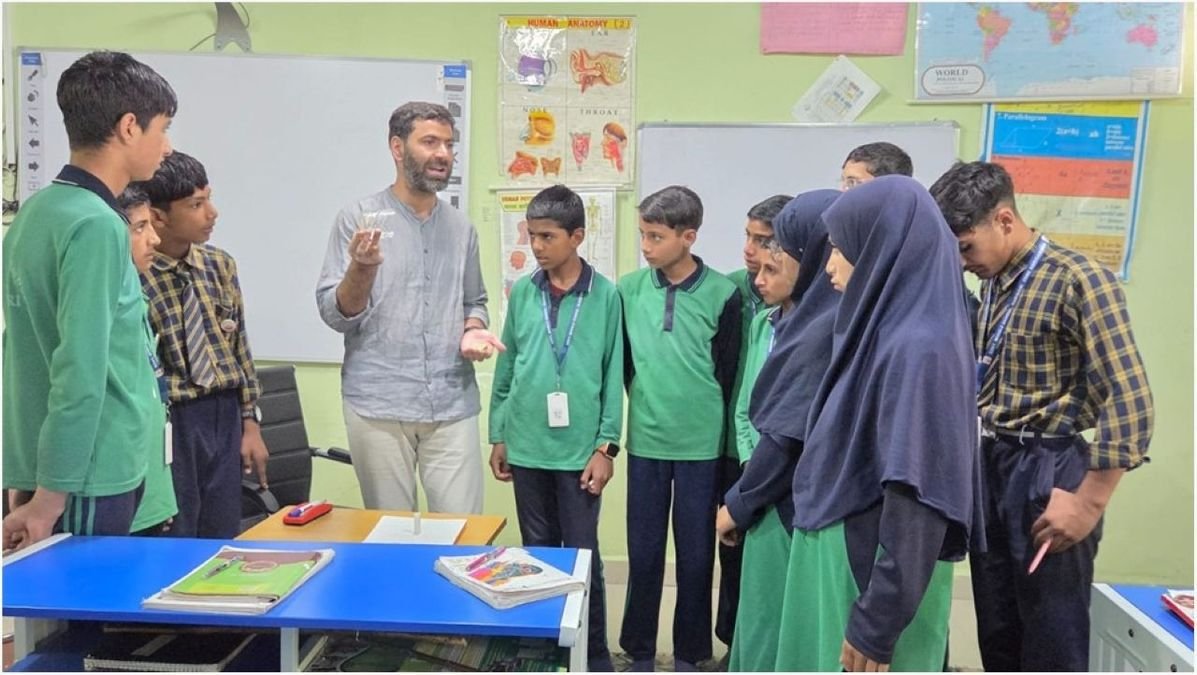
In the hills and villages of Gund tehsil in central Kashmir’s Ganderbal district, a government school is quietly attempting to change the way children learn moving beyond textbooks and classrooms to encourage experimentation, creativity and solutions to problems they encounter in everyday life.
Pradhan Mantri Schools for Rising India (PM SHRI) Government Middle School Ramwari has been working towards creating a learning environment where academic education goes hand in hand with practical exposure, digital learning and community participation.
The school serves children from Ramwari and surrounding areas and, under the leadership of Head of Institution and science teacher Imran Raina, has placed greater emphasis on hands-on learning and student participation.
The approach is visible not only in the school’s infrastructure but also in the projects taken up by its students.
One of the school’s recent projects is a student-developed model titled “Smart Reward-Based Toilet.”
Guided by Imran Raina, the students worked on the concept of using a simple technology-enabled reward mechanism to encourage children to adopt hygienic toilet habits.
The model was subsequently presented at the divisional level, where it received appreciation from the Education Minister and officials of SCERT Srinagar.
For the students, however, the project represents something larger than a model displayed at an exhibition.
It demonstrates an attempt to connect classroom learning with an issue that affects everyday life—cleanliness and hygiene.
The project also reflects the kind of learning the school is trying to promote: identify a problem, understand it, think of a solution, build a model and present the idea.
For a middle-school student, that process can turn a science lesson into an exercise in observation, problem-solving and confidence.
Inside the school, technology has become an important part of the learning process.
The institution has a functional ICT laboratory, while smart boards have been installed in classrooms to support digital and blended learning.
Instead of limiting learning to printed material, teachers can use digital resources to explain concepts visually and provide students with exposure to technology at an early stage.
The classrooms themselves are spacious and ventilated, providing an environment intended to facilitate interaction between teachers and students.
The school also has a library and dedicated reading spaces, encouraging children to develop habits of independent reading and exploration beyond the prescribed syllabus.
Science occupies a particularly important place in the school’s learning approach.
A dedicated practical area provides students with opportunities to conduct curriculum-linked experiments and understand scientific concepts through observation and demonstration.
The emphasis is on making students active participants in the learning process rather than simply recipients of information.
Project-based learning is also encouraged across subjects, including science, mathematics and social studies.
Through such projects, students get opportunities to work collectively, solve problems, prepare presentations and explain their ideas before others.
Science fairs and exhibitions provide another platform for students to display experiments, working models and innovative ideas.
The school’s approach to education extends beyond academics.
Sports and activity spaces provide opportunities for physical education and co-curricular activities, while the library and reading corners support children’s intellectual development.
The institution has also placed emphasis on basic facilities that directly affect students’ wellbeing, including maintained sanitation facilities and safe drinking water.
The idea is to create a school environment where learning is supported by hygiene, physical activity, reading and social interaction.
The school’s focus on innovation is not restricted to students.
In-house professional development and training sessions are conducted to help teachers adopt newer teaching methodologies, digital tools and assessment practices.
Digital systems are also being used for maintaining student records, tracking learning outcomes and communicating students’ progress with parents.
Such measures are intended to make the learning process more structured while allowing teachers to identify areas where individual students may require additional support. Another area receiving attention is inclusive education.
Students who require additional academic support are encouraged through remedial coaching and peer tutoring, while accessible learning materials are used to help children learn according to their individual needs.
The approach recognises that students do not learn at the same pace and that classroom teaching sometimes needs to be supplemented with additional assistance.
Parents and members of the local community are also involved through meetings, awareness programmes and participatory activities.
The engagement allows the school to maintain a connection between the classroom and the community in which its students live.
Environmental awareness has also become part of school activities.
Tree-planting drives, cleanliness campaigns and student clubs provide children with opportunities to understand environmental responsibility through participation rather than classroom instruction alone.
For students, such activities can turn abstract lessons about sustainability into something visible in their own surroundings.
Much of the school’s emphasis on practical learning is linked to the approach adopted by its head of institution, Imran Raina, who also teaches science.
His background in the subject has encouraged greater use of experiments, models and hands-on activities, while students are being encouraged to look at everyday problems through a scientific lens.
The “Smart Reward-Based Toilet” project has emerged as one of the clearest examples of this approach.
Its recognition at the divisional level has also provided students with an opportunity to see their work being appreciated outside the school.
For children studying in a government middle school, such exposure can be significant—not simply because of recognition, but because it gives them confidence that their ideas can have relevance beyond the classroom.
PM SHRI schools are intended to provide modern and quality learning environments while demonstrating improved educational practices.
At Ramwari, that vision is being reflected through a combination of infrastructure, technology, practical education and student participation.
The school has an ICT laboratory and smart boards, but its focus is not limited to providing equipment.
The larger effort is to use these resources alongside classroom teaching, practical experiments, projects, exhibitions and community activities.
The result is a learning environment in which students are encouraged not only to remember what they are taught, but also to ask questions, experiment with ideas and find applications for their knowledge.
The significance of a school is ultimately measured not only by its buildings or facilities but by what students carry with them when they leave its classrooms.
At PM SHRI Government Middle School Ramwari, the effort is to give children academic knowledge while developing digital awareness, problem-solving abilities, creativity and civic responsibility.
The “Smart Reward-Based Toilet” is one example of what can emerge when students are given the space and encouragement to experiment.
In a remote or semi-rural community, a school can become more than a place where children attend classes. It can become a space where young minds learn to identify problems around them and imagine ways of solving them.
That is perhaps the larger story emerging from Ramwari—a government school attempting to make learning more practical, more participatory and more connected to real life.
And for the children walking into its classrooms each day, the lesson may extend well beyond the pages of a textbook: learning is not only about knowing the answer, but also about having the confidence to ask a question and try to find a solution.


