


Bengaluru: Tiny enough to escape the naked eye but destructive enough to devastate an entire crop, black thrips have emerged as one of the gravest threats confronting Karnataka’s chilli farmers. From the vast chilli fields of Raichur to cultivation belts across North and Kalyana Karnataka, the invasive pest has left a trail of damaged crops, escalating cultivation costs and shrinking yields, raising concerns over whether existing government interventions are sufficient to contain the outbreak.Ironically, Bengaluru is believed to have been the epicentre of the pest’s spread in the state. Scientists first detected Thrips parvispinus, commonly known as black thrips, on papaya leaves in Bengaluru in 2015. By 2021, surveys conducted by the Indian Council of Agricultural Research-Indian Institute of Horticultural Research (ICAR-IIHR), Bengaluru, found that the insect had rapidly spread into Karnataka’s chilli-growing regions, particularly Raichur, where it came to dominate the pest population.According to ICAR-IIHR, Thrips parvispinus accounted for 94-96% of the thrips population recorded in Raichur during the 2021 survey, far outnumbering other species such as Thrips hawaiiensis, T. florum and T. palmi. The institute subsequently recommended a comprehensive Integrated Pest Management (IPM) schedule along with climate-resilient cultivation practices to curb infestations.
Clockwise from left: A chilli leaf severely infested by black thrips; an adult Thrips parvispinus under magnification; and multiple black thrips feeding on a chilli flower, causing extensive damage to the crop.
A 2024 roving survey published in the International Journal of Entomology Research, covering eight major chilli-producing districts in Karnataka, found that Raichur recorded the state’s highest black thrips infestation, averaging 14.73 thrips per plant—an indication of severe crop damage.The growing menace came under the spotlight in Parliament on Tuesday after Raichur MP G Kumar Naik sought details on crop losses, compensation and measures to protect chilli farmers. Replying to the question, Union Minister of State for Agriculture Ramnath Thakur acknowledged that black thrips have emerged as the predominant pest affecting chilli cultivation in Raichur. While outlining measures such as Integrated Pest Management, climate-resilient varieties, crop insurance and market support schemes, the Centre admitted it does not maintain district-wise data on crop losses, yield reduction or farmer indebtedness linked to the pest. It also did not provide details on the adoption or effectiveness of IPM measures in severely affected regions.The Centre further informed Parliament that Karnataka has increased the Scale of Finance for chilli cultivation by nearly 24%, from ₹55,884 to ₹69,189 per acre for 2026-27, to offset rising cultivation costs. Chilli has also been notified under the Pradhan Mantri Fasal Bima Yojana and the Restructured Weather Based Crop Insurance Scheme, while financial assistance for IPM and post-harvest infrastructure is available under the Mission for Integrated Development of Horticulture.However, Kumar Naik argued that the current response falls short of what farmers need. “The current approach appears to place the burden of managing an invasive pest largely on farmers, when they deserve stronger scientific support, timely extension services and coordinated institutional intervention. Farmers in Raichur and other parts of Karnataka deserve better,” he said.
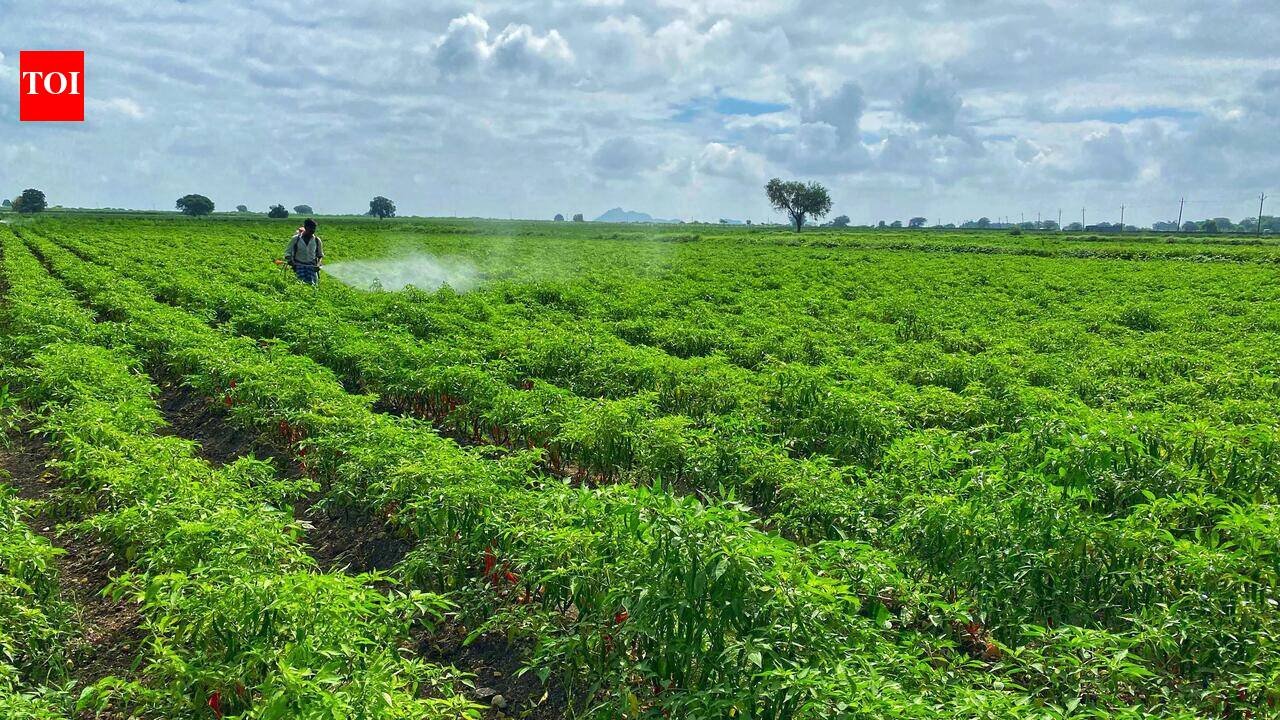
A healthy chilli plant at a farm in Kurugodu, Ballari district, where timely Integrated Pest Management (IPM) practices helped protect the crop from black thrips infestation.
Inset Box: Timely transplanting key to containing pest: IIHRMeanwhile, entomologists at ICAR-IIHR, Hesaraghatta, said the situation is now largely under control owing to sustained scientific intervention and greater farmer awareness. “In 2021, we were recording 100 to 120 thrips per plant. That number has now come down to fewer than 15 per plant,” said Dr V. Sridhar, entomologist at IIHR. “The key to preventing outbreaks is timely transplanting. The pest population peaks during November and December. If farmers transplant seedlings in July or August, the crop reaches the fruiting stage before the pest population explodes, significantly reducing damage.”
