


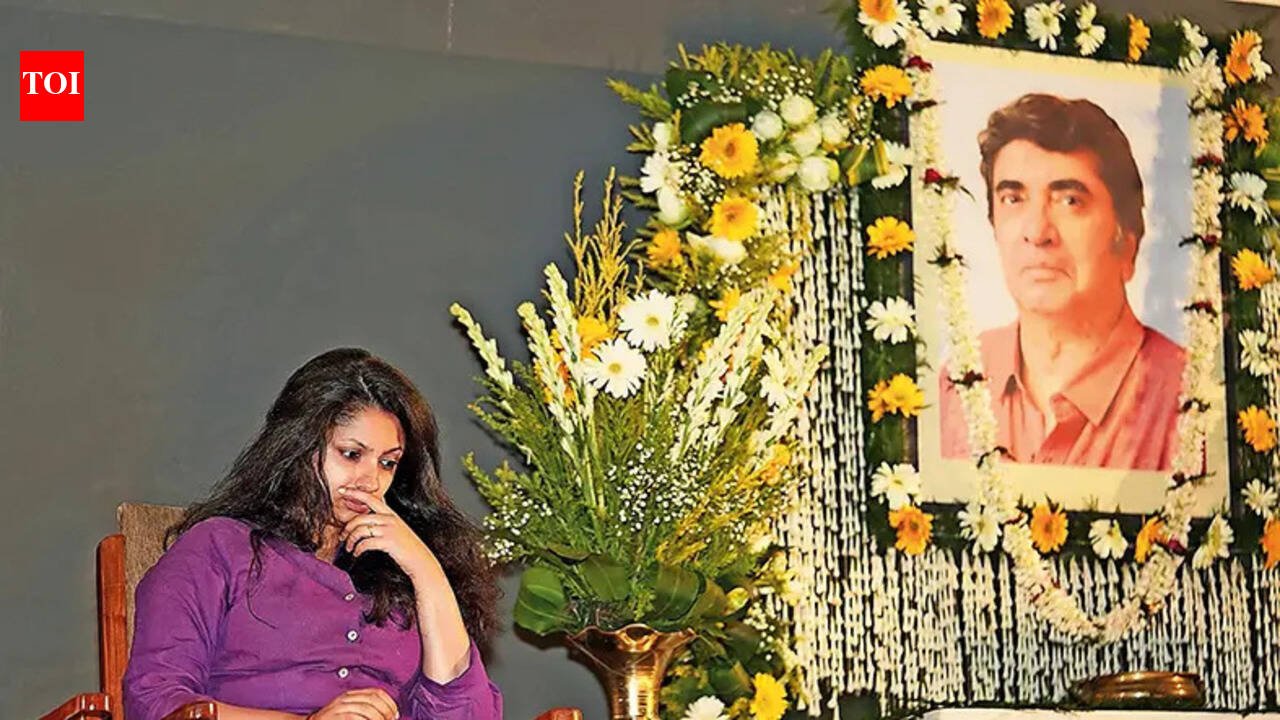
There was a quiet sense of grief at Nandan on June 6 as a retrospective of filmmaker Anik Dutta opened with a screening of Aparajito—the film that brought him widespread acclaim, numerous awards, and renewed recognition as one of Bengal’s most distinctive cinematic voices.The evening was more than a film screening. It felt like a gathering of memories, friendships, unfinished conversations, and a collective acknowledgment of a filmmaker whose relationship with Bengal’s cultural establishment had long been marked by both admiration and resistance.
Roopa Ganguly and Rudranil Ghosh at the event
Among those present were producer Firdausal Hasan, actor Jitu Kamal, music director Debajyoti Mishra, actors Anjana Basu and Anusha Vishwanathan, along with Swapan Dasgupta, Rudranil Ghosh and Roopa Ganguly. Their presence reflected the breadth of Dutta’s influence across Bengal’s artistic and cultural landscape.Perhaps the most poignant observation came from Firdausal Hasan, who described the retrospective as the filmmaker’s “ultimate redemption”. He also credited Rudranil Ghosh for helping make the retrospective possible. The screenings will continue with Bhobishyoter Bhoot, the film that was withdrawn from theatres shortly after its release during the previous government’s tenure.“On the 27th, when this accident happened, Rudranil was there from 2 pm till late at night. Then he came to Nandan and arranged a meeting to ensure that Anik da’s films would finally be screened here—a venue that had consistently denied him screens during his lifetime. We hope that films will be judged on merit rather than political considerations, so that no filmmaker has to endure what he did,” Hasan said.The irony was impossible to miss. The same Nandan that had once declined to screen some of Dutta’s acclaimed works had now opened its doors to celebrate his cinematic journey. History, it seemed, had come full circle.
Jeetu Kamal at the event
For Jitu Kamal, who portrayed Satyajit Ray in Aparajito, the occasion carried a deep sense of gratitude and loss. Rudranil Ghosh remembered Dutta not only as a filmmaker but also as a keen observer of society whose sharp wit and intelligence found expression through cinema.“I don’t think any director has been honoured in the very space that denied him entry during his lifetime,” said an emotional Kamal, struggling to hold back tears. “I hope those responsible for selecting films at Nandan are held accountable for denying deserving works a platform, so that no actor, producer or director has to face this in the future.”One of the evening’s most moving moments came when Roopa Ganguly invited singer Lagnajita Chakraborty to the stage. Accompanied by Debajyoti Mishra, she performed the iconic theme associated with Satyajit Ray’s Pather Panchali—a fitting tribute to Aparajito, which lovingly chronicled the making of that landmark film.As the familiar melody filled the auditorium, it seemed to bridge generations of Bengali cinema: Ray’s legacy, Dutta’s tribute to that legacy, and the audience gathered to honour the filmmaker who brought that story to the screen.Retrospectives are often exercises in looking back. Yet this one felt different. It was not merely about revisiting films, but about revisiting a life devoted to storytelling. Anik Dutta was absent from the stage, but present in every frame, every recollection and every note of music that evening.Perhaps that is the true measure of an artist’s legacy—not simply that they are remembered after they are gone, but that their work continues to bring people together long after the final credits have rolled.
