



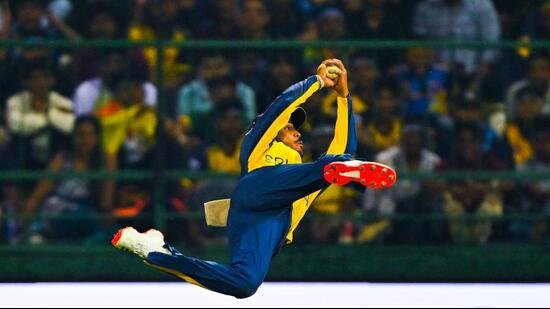
New Delhi: There is a peculiar cruelty to cricket. It can ask you to wait an entire day for a moment that lasts less than a second. For photographers stationed along the boundary ropes, the challenge is even tougher. You must power through hours in the heat and thousands of uneventful frames. And then, without warning, you have your money shot.
At the ICC Men’s T20 World Cup, when Pathum Nissanka flung himself sideways to intercept Glenn Maxwell’s reverse sweep, time slowed. The ball hovered, his body stretched and somewhere near gully, Ishara S. Kodikara pressed his shutter six times to capture one unforgettable still.
Within hours, the image travelled far beyond the boundary ropes, across timelines and screens built for motion. In a digital age dominated by Instagram reels and YouTube Shorts, a still photograph forced the world to pause.
“I have always safeguarded journalistic integrity throughout my career,” Kodikara, a senior photojournalist at Agence France-Presse told HT. “Never in my wildest dreams did I imagine that this moment would go viral. For me, it was simply another day at work.”
With images like this, it’s rarely about just luck. You would think sports photography has a lot to do with reflex but instinct and observing patterns trump that. After more than 24 years behind the lens, Ishara’s anticipation has shifted from conscious effort to instinct.
“I was standing towards the gully area when the incident happened,” he said. “The batter had already attempted the same shot twice earlier, which immediately caught my attention. I moved towards gully. From that point onward, I felt something was building.”
“You cannot afford to take your eyes off the game even for a second. Every movement matters and anticipation becomes your greatest asset. When you know the patterns, the tactics and the intent of players, you begin to sense when something special might unfold.”
When Maxwell risked again, Nissanka and Kodikara, it seems, were both ready. “In sports photography, patience and preparation often meet opportunity in a split second,” he said. He pressed the shutter six times. “Within those six frames, the story was captured.”
“A photograph must carry emotion, context and strong geometry. These elements together create the rarity and power of an image. It is all about a constant anticipation of the moment.”
For Ryan Pierse, chief photographer of Getty Images, the challenge of modern photojournalism is not only capturing the decisive moment but ensuring it survives the scroll.
“Our job as photographers and content creators these days is to make sure that the power of a single still image will stop people scrolling,” he told HT. “Even if it’s just for a second longer than they normally would. If a picture makes you look twice, we’ve done our job.”
When Pierse began his career, storytelling through stills was unquestioned. “It was solely about the power of an image and telling a story,” he explained. “As social media became more prevalent, the way you shoot, edit and even format images has changed.”
Now, video content has exploded and attention spans have thinned. Along with his team at Getty, they are exploring athletic performances with unique and experimental photographic technologies.
For instance, at the recent Milano Cortina 2026 Winter Olympic Games, he worked with vintage Graflex cameras, similar to the type used when Cortina first hosted the Games in 1958, to blend nostalgia with innovation. His team produced a series of seven creative initiatives for Milano Cortina 2026 wherein each project explored athletic performance with a different visual idea and experimental photographic techniques.
In one of the images, Pierse captured the field in the Women’s 12.5km Biathlon Mass Start shot with a large pole from a bird’s-eye-view.
Pierse insists that the fundamentals remain intact: position yourself well, understand the sport and never lose focus. That is what links his philosophy with Kodikara’s as they deem anticipation crucial.
“Not just focusing the lens but mental focus,” he said. “You might be on a cricket field for seven or eight hours in the heat. The moment you switch off, something big will happen. There can be one ball in that entire day that matters. You can’t switch off for a second.”
There is probably nothing that Ryan hasn’t covered in his 30 years of experience – whether it’s the Olympics, World Cups, the Ashes, Grand Slams or Formula 1. When asked about his favourite photograph, Pierse does not choose spectacle, but memory.
“The Australian team has a tradition of singing their team song in the middle of the ground hours after the game finishes. I captured Nathan Lyon leading the song at the Sydney Cricket Ground as the clock struck midnight in the background,” he recalled.
“For many years, that team song was never captured in stills or video. It was behind closed doors. Growing up in Australia, being a Test cricketer was the ultimate dream. I was never going to be that, but to be in that moment, to record it and feel the energy and emotion that stayed with me.”
The image is quieter than Nissanka’s catch. There are no airborne bodies, no split-second athleticism. Instead, it’s a circle of players under dimmed lights, midnight marked in the background, victory encapsulated by ritual. It marks two vastly different kinds of stillness.
Beyond the challenge of navigating the video boom, the rise of AI-generated imagery hovers over their craft now. These are pictures that never passed through a camera and moments that most likely, never existed.
“There will be more AI-generated material out there,” Pierse said. “But we focus on what we do best: producing real, organic content. What you see is what you get.”
A lot of content, Pierse notes, is fleeting. “We scroll past it for a reason. It’s the content that stops us in our tracks and makes us look twice that matters.”
In an ecosystem that rewards immediacy and volume, both photographers return to the same principles of anticipation and authenticity. The Ashes photo at SCG did exactly that back in 2013. Twelve years later, the image of Nissanka’s catch did exactly that. In an age that moves forward relentlessly, still images still make the world stop.


