



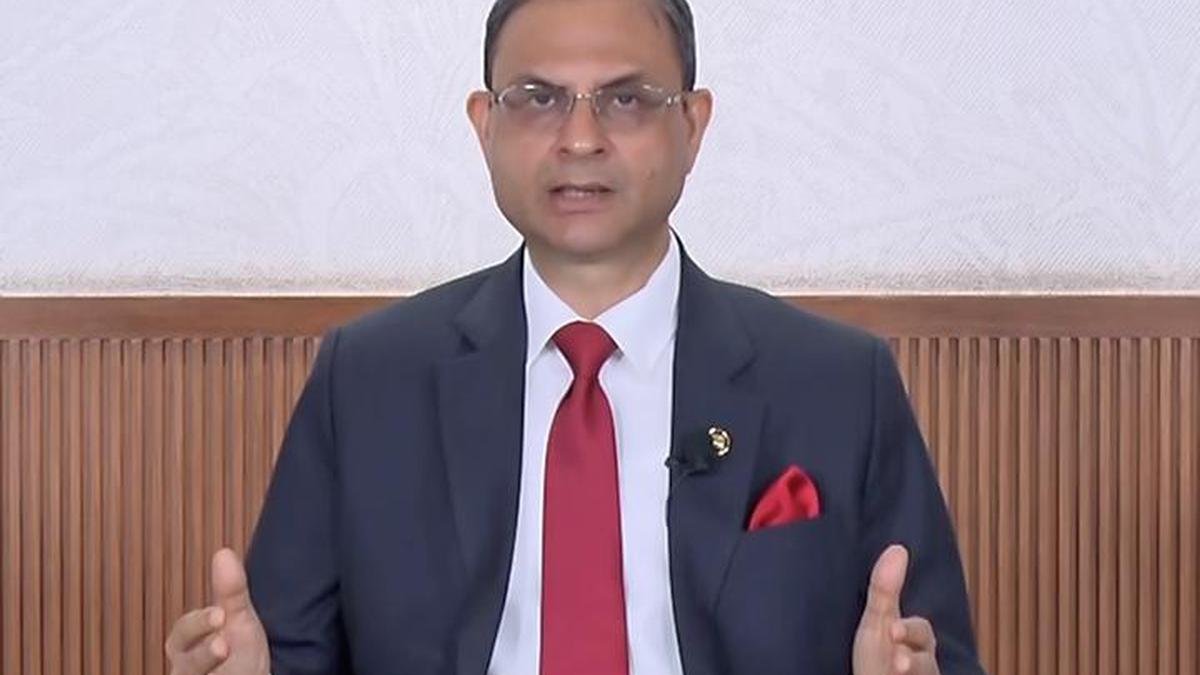
Reserve Bank of India (RBI) Governor Sanjay Malhotra. File.
| Photo Credit: ANI
Reserve Bank Governor Sanjay Malhotra on Friday (June 5, 2026) said the forex reserve stood at a healthy $682.3 billion, adequate to provide import cover for about 11 months.
Various policy initiatives are expected to strengthen the balance of payments, he said while announcing the second bi-monthly monetary policy for the current fiscal.
The initiatives include the recent agreements with major trading partners, allowing 100% FDI in the insurance sector, ethanol blending programme, push for energy transition, easing FDI restrictions for land-bordering countries, liberalisation of the ECB framework, and several others, he said.
“As of May 29, 2026, India’s foreign exchange reserves stood at a healthy $682.3 billion, adequate in terms of the standard metrics of reserve adequacy, including import cover (for about 11 months) and external debt (89.1%),” he said.
“While our foreign exchange reserves provide a strong buffer against external shocks, we have a broad range of regulatory and market-based instruments to respond effectively as may be required. In this regard, we remain vigilant and are fully prepared to do whatever it takes to preserve orderly market conditions,” he said.
India’s forex reserves dropped $7.511 billion to $681.384 billion during the week ended May 22.
The kitty had expanded to an all-time high of $728.494 billion during the week ended February 27 this year, before the onset of the West Asia conflict, which led to several weeks of decline as the rupee came under pressure and the RBI had to intervene in the forex market by selling dollars.
India’s forex reserve stood at $686.801 billion in the week to January 2, 2026.
Mr. Malhotra further said the Reserve Bank will ensure appropriate liquidity in the banking system to meet the productive requirements of the economy and facilitate monetary policy transmission.
Observing that India successfully navigated the challenges of elevated tariffs and trade-related uncertainties in 2025-26 amid a turbulent global economic environment, he said the surge in energy prices and persistent trade policy uncertainties continue to pose upside risks to India’s current account deficit in 2026-27.
Services trade surplus and inward remittances are expected to provide some comfort, he pointed out.
Published – June 05, 2026 01:23 pm IST


