



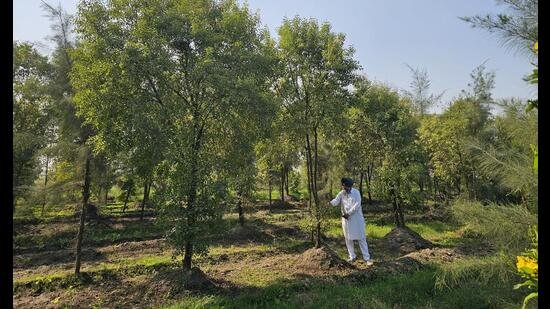
The Punjab forest department is all set for sample testing of the pilot project of home-grown sandalwood trees to scientifically validate oil content and promote future commercial plantations.


Started in 2013, enterprising farmers from different parts of Punjab ventured into this novel project. Supported by the state forest department and with technical assistance from the Bengaluru-based Institute of Wood Science and Technology (IWST), a central institute, this initiative is a long-term agroforestry diversification project aimed at helping farmers increase their earnings.
Experts said that sandalwood farming is ideal for areas in Punjab marred by degraded soil and scarce water.
Data shows nearly 7,000 sandalwood saplings were bought by 116 farmers from a government nursery in Hoshiarpur in 2025-26.
Anjan Singh, district forest officer (DFO) at Hoshiarpur’s Dasuya and nodal officer of the project, said sandalwood grown in the non-native region of Punjab can produce grade 3 oil, which also has a market demand.
“Sandalwood is mainly cultivated in Karnataka, Andhra Pradesh and Tamil Nadu. The tree’s hardwood yields oil after it reaches 15 years of age in the south Indian states, where the average annual climate is hotter than in Punjab. A team from the Forest Research Institute, Dehradun, is expected to visit soon to audit the plantation and the potential for oil extraction from the early-grown trees,” the DFO said on Thursday.
The DFO said the lab testing report may take some time, but the department is hopeful of encouraging results.
He cautioned farmers against inflated claims regarding exorbitant rates associated with sandalwood.
“It certainly has commercial value for the cosmetics, perfumes, and pharmaceuticals sectors, but the exact value will be ascertained after experts audit the quality of the wood emerging after 12-14 years. Experts opine that sandalwood grown in Punjab may be best utilised for commercial usage after 20 years of its plantation,” the official added.
“Various batches of saplings have borne flowers and multiplied through natural pollination also. Sandalwood was introduced in the Kandi area for experimentation in 2013, but gradually farmers from rugged areas are showing interest in it,” he added.
A resident of Singhwala village in Moga, Jagdeep Singh, started planting sandalwood saplings in 2017.
“I learnt about sandalwood farming from social media, and we approached the state forest department’s nursery at Bhatoli in Hoshiarpur district. Trees have a fair survival rate, and we have been advised to wait for another three years before evaluating their market rate,” he said.
Surjit Singh, another enterprising farmer in Ludhiana district, said that sandalwood cultivation has specific requirements as it is a parasitic species, meaning it derives its nutrients from other plants.
He has been planting sandalwood since 2019 and bought 200 plants last year.
“Farmers must grow a host plant like neem, ‘saru’ (casuarina) or other trees alongside sandalwood to ensure its proper growth. After five years, my first batch of trees has grown 10 feet tall, and experts said it could grow up to 35-40 feet. These saplings require almost no cost other than general cleaning. I am putting small quantities of neem-based fertiliser twice a year,” he said.


