






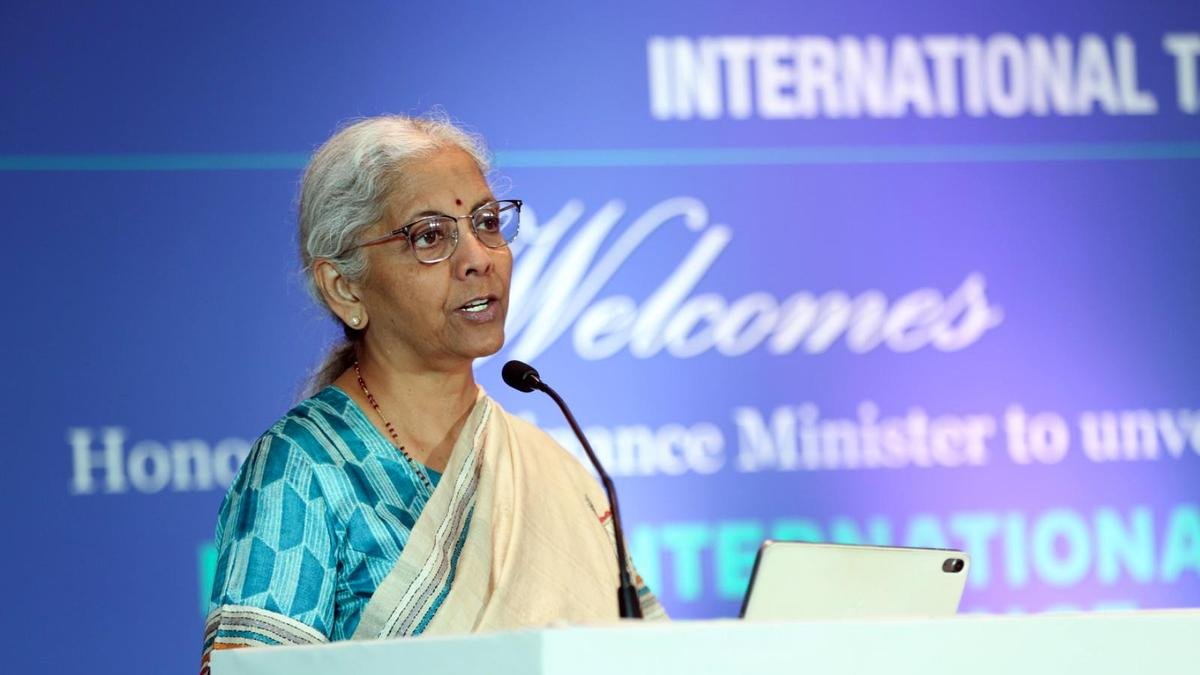
Union Finance and Corporate Affairs Minister Nirmala Sitharaman addresses the 8th International Tax Conference on ‘New Age Taxation’, organised by International Tax Research and Analysis Foundation (ITRAF), in Bengaluru
| Photo Credit: ANI
Finance Minister Nirmala Sitharaman urged industry stakeholders to ensure that tax policy recommendations submitted to the government address broader issues, including compliance costs, revenue implications and potential unintended consequences, rather than focusing merely on demands for rate cuts, exemptions or concessions. She made the remarks while speaking at the 8th International Tax Conference on “New Age Taxation”, organised by the International Tax Research and Analysis Foundation (ITRAF) here on Wednesday.
Addressing the conference, Ms. Sitharaman said tax consultations should be a genuine exercise involving “evidence, experience and ideas’’ rather than merely providing stakeholders an opportunity to place representations on record. She also urged academics, researchers, and think tanks to produce independent tax policy studies that help improve public discourse on taxation.
Asking what kind of tax system India should have over the next two decades as the country moves towards Viksit Bharat by 2047; she said “such an approach requires better tax policy research, look at a proposal from all sides, measures its effects, recognises the trade-offs and wherever possible offers a workable alternative.”
Year after year most industry representations have three requests: reduce a rate, provide an exemption, or grant a concession, and that wasn’t enough, she said, adding that a mature tax policy debate must go beyond sectoral interests and examine whether existing provisions continued to serve their purpose.
`India requires stronger independent tax policy research’
The Finance Minister also called for stronger independent tax policy research in India and urged ITRAF to play a larger role in shaping policy. She said India had economists, tax lawyers and chartered accountants of the highest calibre but lacked an institution that brought their expertise together and gave their work greater standing in the policy process.
Drawing comparisons with institutions such as the Institute for Fiscal Studies in the UK and the International Bureau of Fiscal Documentation in Amsterdam, Ms. Sitharaman said India needed more visible and rigorous independent tax research. ITRAF should emerge as India’s leading independent institution for tax policy research and analysis, she added.
“Tax policy, therefore, is not and should not be a one-sided exercise for the government,” she added.
The Minister also highlighted India’s advance pricing agreement programme and measures relating to global funds, virtual digital assets and global capability centres (GCCs). The tax system would have to respond to emerging issues including artificial intelligence, robotics, the gig economy, global mobility, virtual digital assets and GCCs, she said.
The government has been focusing on structural tax reforms on fundamentally lowering tax litigation rather than just clearing dispute backlogs, she said, adding TDS and TCS (Tax Collected at Source) rules have been rationalised to simplify compliance for taxpayers.
On international taxation, Ms. Sitharaman highlighted India’s renegotiation of treaties with Mauritius, Singapore and Cyprus, adoption of the multilateral instrument, country-by-country reporting, automatic exchange of information and measures targeting undisclosed foreign income
On India’s growth, she said the 7.8% first quarter GDP expansion belonged to the hardworking citizens, industries, and MSMEs and herself or the government was not taking any credit for it.
Published – September 16, 2026 08:02 pm IST


