



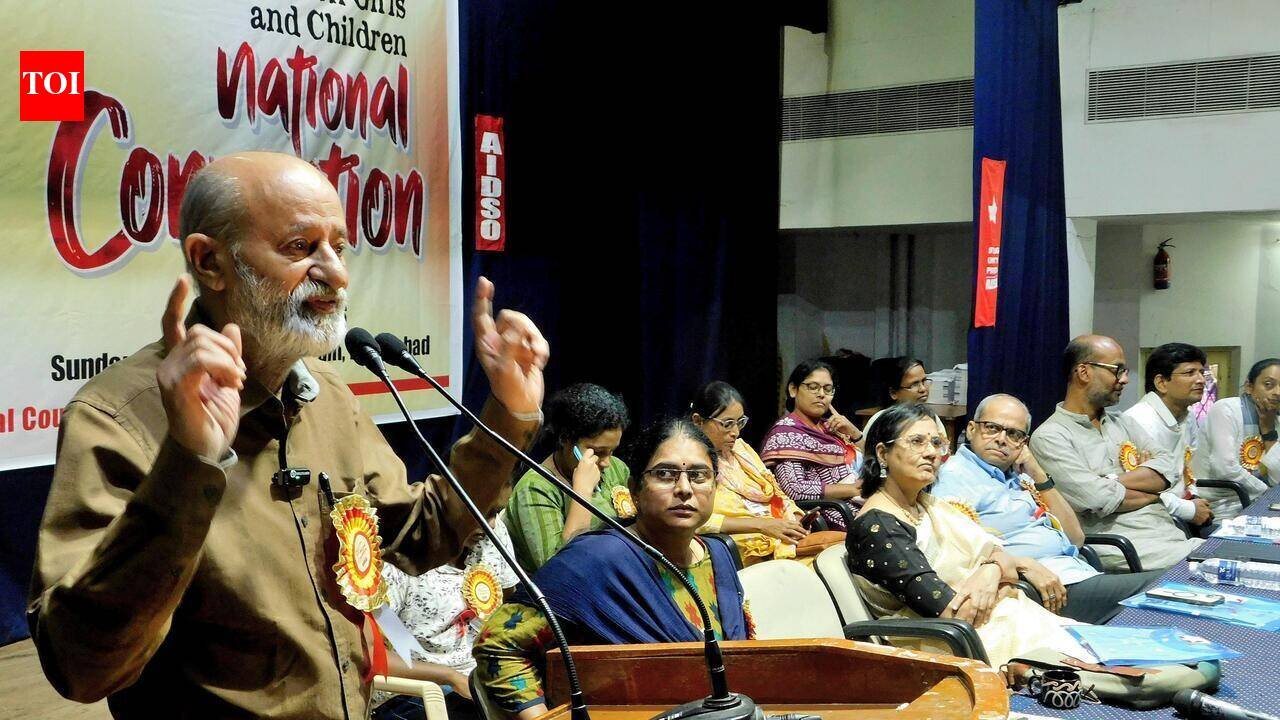
Hyderabad: Urging young people to fight the growing political and social inequalities, economist and political commentator Parakala Prabhakar said, “If at all there is any hope kindled today, it is only because of the youth of the nation.”Speaking at a national convention against atrocities on girls and children organised by All India Democratic Students’ Organisation (AIDSO) on Friday, Prabhakar criticised what he described as contradictions in the Centre’s approach, saying those in power spoke of “Vasudhaiva Kutumbakam” while branding students protesting at Jantar Mantar as terrorists. Lamenting that his generation had failed to bring about the desired change, he said the only hope now lay with the youth.“It is the youngsters, especially girls, who have to be conscious and make everybody else conscious… see that even the smallest seeds of inequality are completely out of our system,” he said.The 67-year-old said that along with globalisation, liberalisation and privatisation, there was a need to “fight normalisation”, arguing that discrimination could not be challenged unless it was recognised.“Society focuses on visible crimes like rape and dowry harassment but ignores everyday discrimination. Women continue to receive lower wages for equal work. It has become normalised. We are not asking you to worship women. We are asking you to respect them. Pay them equally,” he said. He added that women spend nearly six hours a day on unpaid household work, whereas men spend around 50 minutes.Claiming that it is already becoming difficult to hold meetings like these in many parts of the country, Prabhakar said, “Such gatherings could become impossible in the future if the present trend continues,” he said.Sharing his views on the Special Intensive Revision (SIR), the former communications adviser to the Andhra Pradesh govt alleged that the Union govt was trying to change the political society of the country through the exercise. “It would create two classes of Indians — those with voting rights and those without franchise, who would continue living as second-class citizens,” he said.Prabhakar said India has around 14 years left to benefit from its demographic dividend, after which it would no longer remain a young nation.“If the country fails to create employment and improve education, healthcare and living standards during this period, it will miss the opportunity to become prosperous,” he added.Change begins at home, says Gauhar RazaFormer chief scientist at CSIR-NISCAIR, Gauhar Raza, who attended the convention, said the attitude of looking down upon women both at home and in society is deeply embedded in the country’s social fabric.“Even at home, boys and girls are not treated equally. If we can’t change our homes, we can’t change society. Until we raise our voice, change will not come,” he said.Calling on young people to continue speaking up against injustice, Raza said those in power are “afraid of your pen and your thoughts.”


