



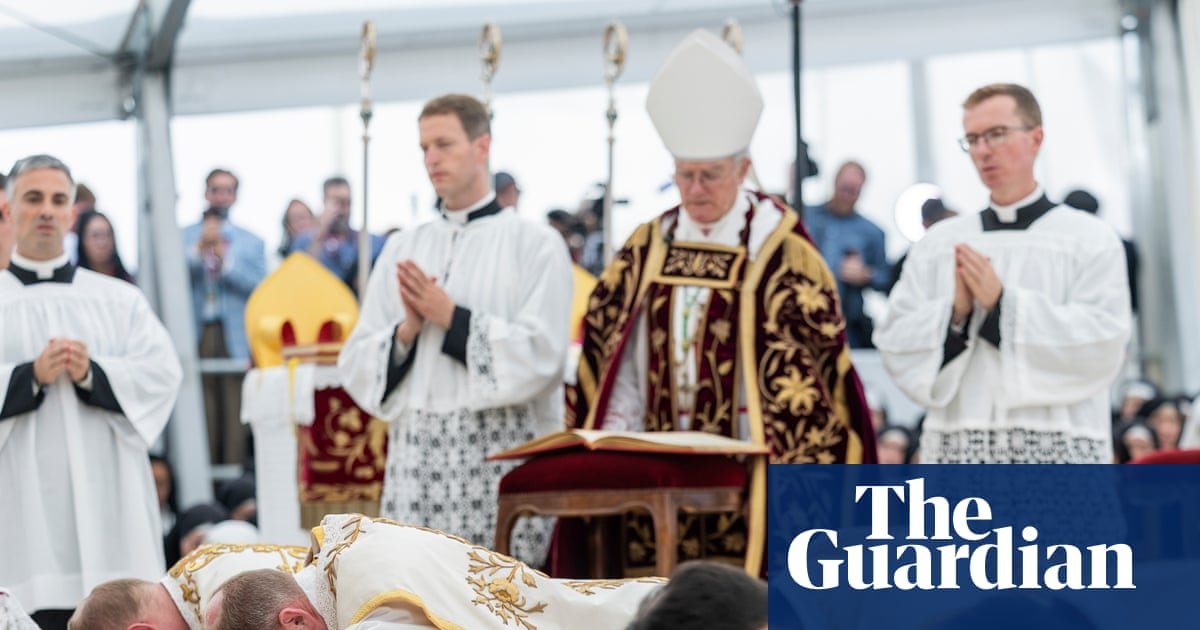
A rebel group of ultra-conservative Catholics has defied Pope Leo by ordaining bishops without his consent, which they declared a “sacred duty” despite it causing their automatic excommunication.
In a ritual-filled ceremony on Wednesday, streamed live from the Swiss village of Ecône, the Society of Saint Pius X (SSPX) went ahead with the consecrations of four bishops, one from Switzerland, one from France and two from the US.
Bishop Alfonso de Galarreta, who himself was consecrated without papal consent in 1988, placed his hands on the head of the four new bishops, a ritual laying of the hands that Catholics believe confers the Holy Spirit from one bishop to another.
Under Catholic church law, all five now face automatic excommunication. The SSPX, founded in 1970 in Ecône to oppose liberalising changes in the Catholic church, is a considered a threat to Pope Leo’s leadership since it represents a parallel, ultra-Catholic church.
The pontiff had made a last-ditch effort to persuade the society to halt the ordinations, calling them a “schismatic act” and a “sin of extreme gravity”.
But, as the mass began on Wednesday, a priest read aloud a statement defending the consecrations while lamenting the Catholic church’s deviation from tradition.
“Therefore before God we consider it a sacred duty toward holy church and toward souls to proceed with the consecration of bishops who are entirely faithful to her holy tradition and to her constant magisterium,” the priest said. “We consider every punishment and censure brought to bear against this step will have no validity.”
Organ music played and a large crowd gathered to watch as hundreds of priests processed through the mountain village towards the society’s seminary, where the ordinations were carried out.
Among those in the crowd were members of the Italian neofascist party Forza Nuova, and Futuro Nazionale, a new far-right force threatening the Italian prime minister Giorgia Meloni’s chances of winning a second mandate in general elections next year.
Despite being a splinter group, the SSPX has a wide reach, gaining a significant following in the US, where it has a large operations base in Kansas, as well as in France, Argentina and other countries. The order has nearly 1,500 priests, seminarians and other vocational members.
The society rejects central changes that emerged from the Second Vatican Council – a landmark Vatican gathering of cardinals, patriarchs, bishops, theological experts and others between 1962 and 1965 – including allowing mass to be celebrated in local languages. Until then it had been said only in Latin.
However, the live stream of Wednesday’s ceremony, carried out in French, was translated into English, German, Italian and Polish. During the offertory, a QR code appeared on the screen so that those following remotely could make donations.
The ordinations could prove to be the first significant crisis for Pope Leo because they provoke a schism – an intentional rupture of the church’s unity. Since Leo was elected in May last year, the first North American pope, he has made church unity a priority and has worked especially hard to heal rifts with traditionalists, which had deepened during the papacy of his predecessor, Francis.
The clash is the first between the Vatican and the SSPX since 1988, when Archbishop Marcel Lefebvre, the society’s founder, and four bishops he had ordained without the permission of the then pope, John Paul II, were excommunicated, including a British bishop, Richard Williamson. In 2009, the conservative Pope Benedict lifted the excommunications. Shortly before, Williamson had caused uproar by denying the Holocaust.


