


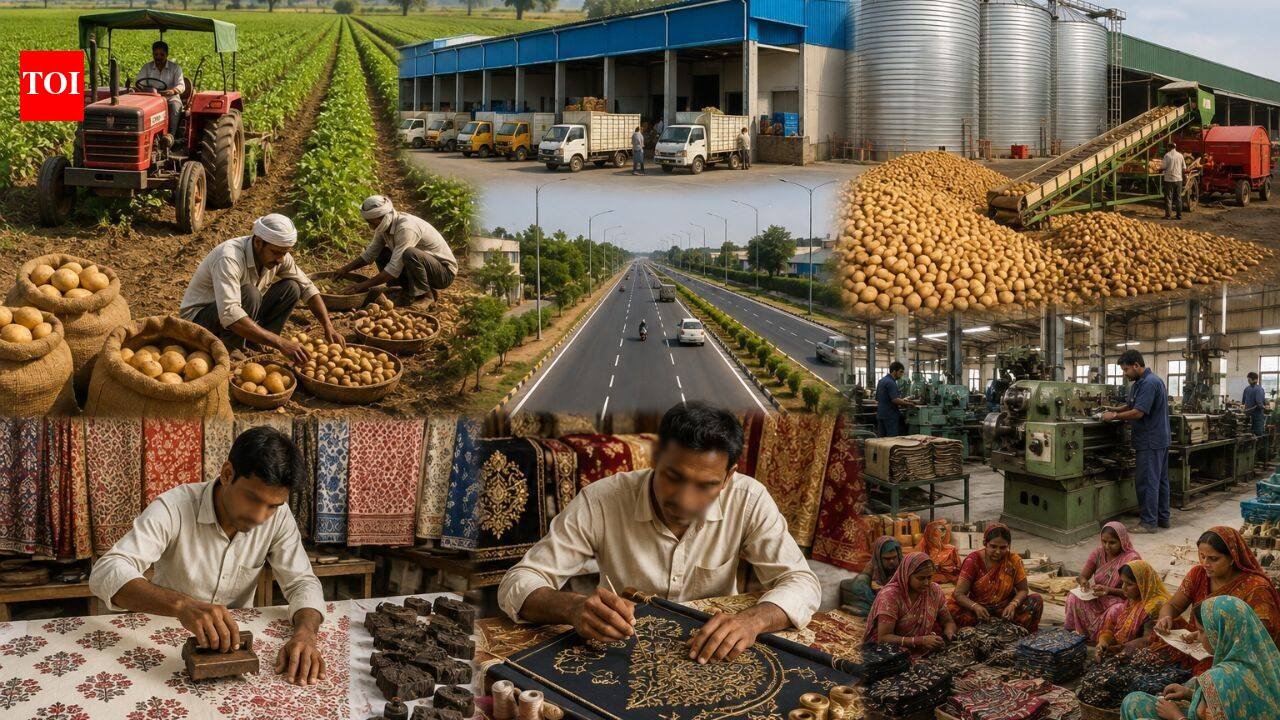
Farrukhabad, one of Uttar Pradesh’s historically important districts, has been undergoing a gradual but significant economic transformation over the past nine years. Between 2017 and 2026, the district has benefited from the wider development and infrastructure push undertaken by the Uttar Pradesh government while building upon its traditional strengths in agriculture, textile printing, handicrafts and agro-based activities.Although Farrukhabad remains a relatively modest contributor to Uttar Pradesh’s overall economy compared with major economic centres such as Gautam Buddha Nagar, Lucknow and Kanpur, the direction of change is increasingly visible. The district is moving beyond an economy dependent predominantly on agriculture towards a more diversified model in which farming, agro-processing, handicrafts, small industries, infrastructure, finance and market access are becoming increasingly interconnected.Agriculture continues to be the principal foundation of Farrukhabad’s economy and livelihoods. The district is particularly well known for potato cultivation and has developed an extensive ecosystem of cold storages, agricultural trading and agro-based businesses around this strength. For thousands of farmers and rural households, agriculture remains the primary source of income. However, the economic strategy of recent years has increasingly focused on ensuring that rural incomes do not depend exclusively on primary agricultural production. Greater value addition, food processing, storage, packaging and improved access to markets can enable farmers to participate in a larger share of the agricultural value chain. This diversification is especially important in a district where small and marginal farmers, artisans and micro-enterprises constitute a substantial part of the economic base.The scale of Farrukhabad’s economy can be understood from its District Domestic Product. Recent economic snapshot data place the district’s GSDP/DDP at around Rs 7,583–7,584 crore, keeping its contribution to Uttar Pradesh’s economy below one per cent. Yet the district’s development needs to be viewed against the much larger expansion of the state economy. Uttar Pradesh’s GSDP has increased from roughly Rs 13.3 lakh crore in 2016–17 to around Rs 30.25 lakh crore according to 2024–25 estimates.Farrukhabad has consequently been part of this broader expansion, even though its growth has been more gradual than that of the state’s major industrial and urban centres.One of the most significant instruments supporting Farrukhabad’s economic diversification has been the One District One Product (ODOP) programme, launched by the Uttar Pradesh government in January 2018. The initiative was particularly relevant to Farrukhabad because of its traditional textile printing and Zari-Zardozi crafts. The district’s textile-printing tradition, locally associated with block printing (textile printing) ,has deep historical roots with GI tag. Artisans use traditional wood and brass blocks to create distinctive patterns on sarees, suits, scarves, stoles, shawls, blanket covers and other textile products. ODOP has provided this traditional occupation with a stronger institutional identity and a platform for connecting local craftsmanship with modern markets.The importance of ODOP lies in its attempt to address several constraints simultaneously. Artisans and micro-enterprises can benefit from financial assistance, subsidised credit, skill development, modern toolkits, exhibitions, branding and market-promotion activities. Market Development Assistance can provide opportunities for participation in trade fairs and promotional events, while Common Facility Centres can potentially offer shared infrastructure for design, processing, packaging, testing and other requirements. Such interventions are important because traditional crafts often possess strong cultural value but face difficulties in accessing modern finance, technology and organised markets.Farrukhabad’s textile-printing cluster demonstrates the potential of this traditional industry. Earlier assessments have identified around 150–200 or more printing units in major clusters, providing employment to more than 1,500 people, while some estimates have placed annual turnover or export-related business at around Rs 150 crore. Farrukhabad’s printed textiles have reached markets within India as well as destinations in the United States, Brazil, Europe, the Gulf and parts of Asia.Products and printing blocks from the district also feed larger textile and printing markets, including those centred around Jaipur and Delhi. ODOP has therefore helped transform textile printing from a traditional local occupation into a more visible component of Farrukhabad’s formal economic development narrative.Zari-Zardozi provides another important avenue for employment and diversification. Its intricate embroidery tradition connects the district with India’s expanding fashion, ethnic-wear, handicraft and lifestyle markets. At the same time, the sector illustrates the challenges that traditional artisans face in adapting to changing consumer preferences. Better access to contemporary designs, modern technology, organised buyers, working capital and digital marketplaces will be necessary if Farrukhabad’s artisans are to move from small-scale production towards higher-value markets. E-commerce and digital branding could be particularly important in taking locally produced handicrafts directly to consumers across India and abroad.Industrial development represents another emerging dimension of Farrukhabad’s transformation. The Uttar Pradesh government’s broader objective of making every district an investment and employment centre has encouraged greater attention to private investment and industrial development. Ground Breaking Ceremonies have generated investment proposals for Farrukhabad, with ambitions rising from earlier levels of around Rs 1,400 crore to approximately Rs 3,000 crore in subsequent phases. Industrial activity around areas such as Khimsepur, along with significant investments including a reported beer-manufacturing project in the range of Rs 500 crore, indicates the possibility of developing a stronger manufacturing and processing base.For Farrukhabad, the greatest opportunity lies in integrating industrialisation with its agricultural strengths. A strong agricultural base can support food-processing units, cold chains, warehouses, packaging facilities, logistics and other value-added activities. Potato cultivation, in particular, provides opportunities beyond conventional farming through processing and organised storage. Similarly, textile and handicraft clusters can create non-farm employment and provide additional income opportunities for rural households. Such linkages can gradually shift the district from simply producing commodities to producing higher-value goods.Infrastructure and basic services have also become important components of Farrukhabad’s development story. The expansion of rural household tap-water connections under the Jal Jeevan Mission is a notable achievement. Recent figures indicate Functional Household Tap Connection coverage of around 98.5 per cent. Improved access to drinking water represents not only an important welfare gain but also a broader improvement in rural living standards. Reliable household water supply can reduce the time spent collecting water and particularly benefit women and children, while contributing to healthier and more productive communities.Road connectivity and civic infrastructure are equally important for Farrukhabad’s economic future. Agricultural produce, textiles, handicrafts and manufactured goods must reach markets efficiently if local producers are to expand. Better roads and improved logistics can reduce transportation costs and connect production centres with larger consumption markets.Farrukhabad’s long-term growth will therefore depend not merely on creating local production capacity but also on strengthening its links with major urban centres, trade hubs and emerging logistics networks.Governance reforms have added another dimension to the development process. Monitoring through mechanisms such as the Chief Minister’s Dashboard has placed greater emphasis on measurable outcomes in the implementation of government schemes. Farrukhabad has recorded strong rankings during particular periods, including sixth position in one monthly development review. While performance has varied across departments and programmes, such monitoring mechanisms encourage district-level administration to focus on delivery, implementation and measurable results.Farrukhabad’s transformation, therefore, should not be described as a sudden industrial revolution. It is better understood as a gradual restructuring of an agriculture-centred economy. The district is retaining its traditional strengths while creating new opportunities through ODOP, investment promotion, infrastructure development, water supply, skill development and market integration. Its textile printing and Zari-Zardozi sectors are particularly important because they represent a bridge between cultural heritage and modern enterprise.The next phase of development will require the district to move from promotion to scale. Better connectivity, modern common facilities, stronger food-processing and cold-chain infrastructure, wider e-commerce access, professional branding, skill upgrading and sustained private investment can help local enterprises move beyond traditional markets. If these elements converge effectively, Farrukhabad can generate more employment, raise incomes and increase the value generated locally.After nine years of change, Farrukhabad stands at an important transition point. Agriculture will remain central to its economy, but the emerging combination of agro-processing, traditional manufacturing, handicrafts, infrastructure and investment can provide the district with a broader economic base. Its transformation may be gradual rather than spectacular, but it reflects a larger shift taking place across Uttar Pradesh: the effort to make economic growth more district-centred, locally rooted and capable of converting traditional strengths into modern and sustainable economic opportunities.
