



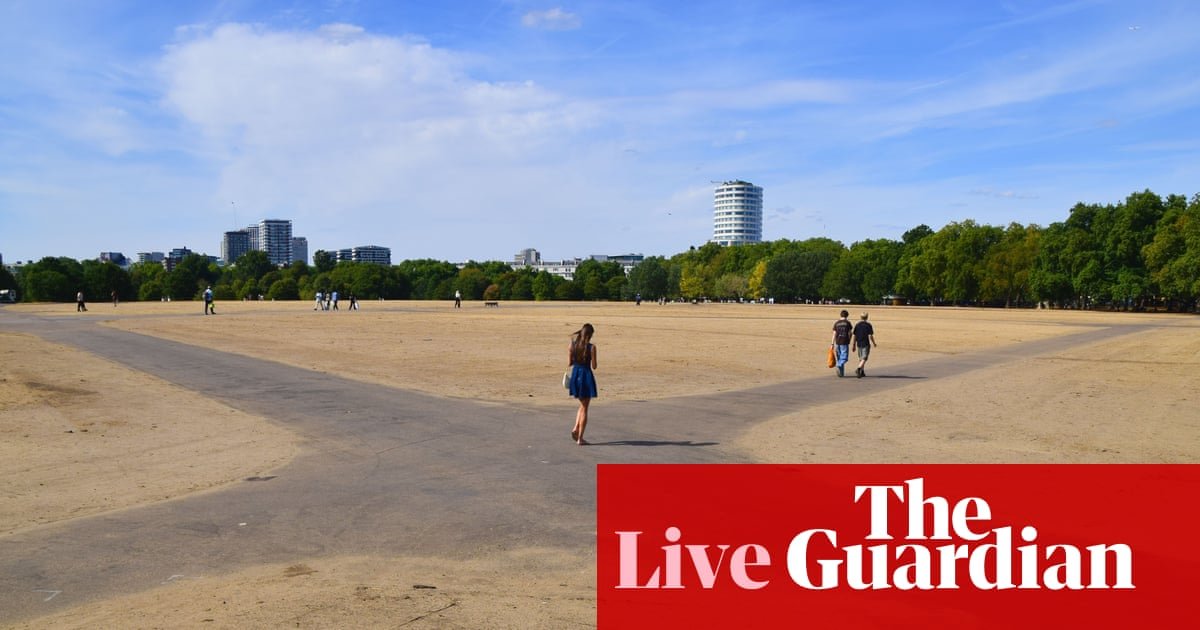
‘Extreme heat’ warning issued for parts of England on Thursday
The Met Office has issued an amber heat warning for large parts of England on Thursday, covering areas including London, St Albans, Cambridge, Oxford, Milton Keynes, Peterborough, Leicester, Birmingham, Nottingham, Lincoln and Sheffield. It will be in place from 9am to midnight on Thursday.
The Met Office warned that the “extreme heat” warning will likely cause “adverse” health effects to people vulnerable to extreme heat, adding that there could be delays to travel and that some “heat sensitive systems and equipment may fail”, leading to potential power cuts at some homes and businesses.
“Following a warm night, a spell of very hot weather will affect England on Thursday,” the Met Office said.
“The highest temperatures will be in parts of the east, southeast and the Midlands, where 37 or even 38 celsius could be reached. This may lead to impacts on transport, infrastructure and health.”
The advice is to stay hydrated, keep out of the sun if possible, wear sunscreen if you are outside, avoid any exercise between 11am-3pm when the sun is strongest and close curtains in rooms that face the sun.
Key events
National Highways has said that junctions 21A to 22 of the M25 have been reopened after the carriageways were closed following a fire.
“The M25 has reopened in both directions with 40 mph speed restrictions, following instructions from fire crews. Due to the volume of traffic, it may take time for congestion to clear,” National Highways wrote in a brief statement posted on social media.
Hertfordshire Fire and Rescue was called to a fire in Ventura Park, Old Parkbury Lane, Colney Street, in St Albans this morning in response to reports of a fire at a large industrial unit.
Both carriageways of the M25 between junctions 22 and 21A were subsequently closed due to what National Highways described as a risk of a “secondary explosion, along with smoke and debris affecting the carriageway”.
There were no immediate reports of any casualties or injuries, and the extent of the damage remains unclear. It is also unclear how exactly the blaze started.
We are seeing reports that thousands of homes have been affected by a disruption to water supplies in areas of London and Essex.
Sky News reports that about 10,000 homes are without water or experiencing low pressure in the Chigwell area, with issues first occurring on Saturday evening. A second water main reportedly burst on Chigwell Road in South Woodford on Sunday morning.
In an update this morning, Thames Water apologised to customers whose water supply had been affected, adding that its teams are “working tirelessly” to fix the broken pipes, citing progress with repairs on Chigwell Road and Daisy Road.
It said:
We’re sorry to customers who’s water supply is still affected this morning. Our teams are working tirelessly in extremely difficult circumstances to fix the broken pipes in the area. Unfortunately they are proving to be more difficult to repair than at first thought.
Pipe damage affected properties across E4, E10, E11, E17, E18, IG2, IG4, IG5, IG6, IG7, IG8, IG9, IG10 and RM4, with many experiencing low water pressure or no running water. Thames Water said it will be providing another update by 1pm this afternoon.
The Guardian’s environment editor, Fiona Harvey, has written a useful explainer about the UK public services that are struggling in the extreme weather. You can read it in full here:
Damian Carrington
There’s only one solution in the end to the drought now declared across most of England and that’s rain, says Hannah Cloke, professor of hydrology at the University of Reading.
“While water companies and regulators have a range of measures available to manage demand, like restrictions and hosepipe bans, these are aimed at slowing the rate at which water resources are depleted,” she said.
“It will not end the drought itself. Meaningful recovery in the months and even years ahead will require sustained rainfall over many weeks or months.” But she warned of potential flash flooding when rain falls on baked ground. She said:
An important consequence of drought is that very dry soils can become less able to absorb rainfall when it does arrive. This can increase surface runoff and can even contribute to localised flash flooding, particularly if rain falls intensely over a short period.
The current situation highlights the need to improve long-term resilience to both drought and flood risk as climate variability increases, and shows one more damaging impact of the burning of fossil fuels.
The climate crisis is increasing both summer heatwaves and winter rainfall in the UK, meaning new reservoirs to store water between seasons should be a priority.
Last year, the government ordered the building of two major reservoirs, the first to be built in England for more than 30 years. However, the reservoirs in East Anglia and Lincolnshire will not be ready until 2036 and 2040 respectively.
Another seven new large reservoirs are planned to be built by 2050, in Oxfordshire, Suffolk, Kent, East Sussex, the West Midlands and two in Somerset. Work is already under way at a further site in Hampshire.
‘Extreme heat’ warning issued for parts of England on Thursday
The Met Office has issued an amber heat warning for large parts of England on Thursday, covering areas including London, St Albans, Cambridge, Oxford, Milton Keynes, Peterborough, Leicester, Birmingham, Nottingham, Lincoln and Sheffield. It will be in place from 9am to midnight on Thursday.
The Met Office warned that the “extreme heat” warning will likely cause “adverse” health effects to people vulnerable to extreme heat, adding that there could be delays to travel and that some “heat sensitive systems and equipment may fail”, leading to potential power cuts at some homes and businesses.
“Following a warm night, a spell of very hot weather will affect England on Thursday,” the Met Office said.
“The highest temperatures will be in parts of the east, southeast and the Midlands, where 37 or even 38 celsius could be reached. This may lead to impacts on transport, infrastructure and health.”
The advice is to stay hydrated, keep out of the sun if possible, wear sunscreen if you are outside, avoid any exercise between 11am-3pm when the sun is strongest and close curtains in rooms that face the sun.
The climate breakdown has been linked to the increasing frequency of wildfires, burning larger areas, across many parts of the world, as my colleagues note in this story.
The so-called “fire wave” under way in the UK is the most widespread the country has ever seen, with the combination of wet winters and prolonged heatwaves exacerbating the risk.
Several wildfires have broken out in the UK over recent weeks amid the hot and dry weather.
These include large blazes at Holme Fen, a peatland nature reserve near Peterborough, Dunwich Heath in Suffolk, Headon Warren on the Isle of Wight, Llanwonno in the Rhondda Valleys, south Wales and the Cairngorms national park in Scotland.
Firefighters work to contain New Forest fire for third day
Firefighters are beginning a third day of tackling a fire in the New Forest in Hampshire. Forestry England says the fire is under control but efforts to contain it could last for several days.
Hampshire Fire and Rescue Service, assisted by neighbouring services, initially scrambled 26 fire engines alongside water carriers to the eastbound A31 after receiving reports that a van had caught fire on Sunday evening.
The fire service said the fire spread from the vehicle to the central reservation before progressing into nearby heathland. In a statement, it said:
Crews have worked tirelessly throughout the night, a change in wind direction provided a challenge to the firefighting operations but thanks to the efforts of firefighters we are managing to contain the fire.
We have been using a mix of fire engines and off-road vehicles to damp down and cool the edges of the area involved in the fire to prevent spread and escalation …
Overnight we had a slightly reduced presence with seven fire engines on site plus water carriers, off road vehicles and support vehicles but are planning to increase this for a larger scale attack today.
The A31 remains closed – and National Highways described “significant” damage to the road surface, road safety barrier and boundary fencing that will require repairs once it is safe to do so.
Pippa Neill
Farmers have reported their earliest harvests in 20 years, with reduced yields, while reservoir levels have fallen to 69% – 11.6% lower than expected for this time of year.
Paul Tompkins, the deputy president of the National Farmers’ Union, said that with no meaningful rain forecast in the coming weeks, the situation for farmers was increasingly concerning. He said:
Many farmers have completed the earliest harvest on record, with poor yields in key crops reported in some areas of the country.
Livestock and dairy farmers are already using winter feed because grass has stopped growing, while growers are working hard to keep fruit and vegetables watered, but many are struggling to access the water they need.
The government said it was considering ways to give more support to the farming sector. The water minister, Emma Hardy, said this would include making it easier to build on-farm reservoirs.
The Met Office has shared two images taken from space that reveal the stark contrast in much of the UK’s landscape between 23 May and yesterday. They capture how an exceptionally dry and hot period turned lots of once green land brown.
Allow content provided by a third party?
This article includes content hosted on platform.x.com. We ask for your permission before anything is loaded, as the provider may be using cookies and other technologies. To view this content, click ‘Allow and continue’.
Heat health alerts now in place across whole of England
Amber heat health alerts are now in effect across all regions of England, aside from the north east, which has been given a yellow alert, up until Friday evening. You can keep up to date with the latest weather health alerts here.
As we mentioned in the opening post, amber heat health alerts come into force across most of England from 9am today and will last until 9pm on Friday.
As well as a rise in deaths and likely “significant” impacts across health and social care services, here are some of the other risks associated with the amber category, as outlined by the UK Health Security Agency:
-
internal temperatures in hospitals and care homes may exceed the recommended threshold for clinical risk assessment
-
the heat affecting the ability of the workforce to deliver services
-
indoor environments overheating increasing the risk to some vulnerable people
-
issues managing medicines
-
increased demand for power exceeding capacity
-
possible travel delays
-
water‑related incidents may increase, including risks from cold‑water shock and drowning
Amber heat health alerts to kick in across England as parts of UK brace for fifth heatwave
Health alerts are set to come into force across England this morning as parts of the UK brace for fifth climate crisis-driven heatwave this summer.
Amber heat health alerts have been issued for all regions in England, except the north-east, which mean significant impacts are likely across health and social care services due to the high temperatures, according to the UK’s Health Security Agency (UKHSA). The alerts stretch from 9am on Tuesday until 9pm on Friday.
The north-east will be under a yellow health alert, which is less intense than the amber category but is still linked to a rise in deaths, particularly among those aged 65 and over or with health conditions, and a likely increase in demand for health services.
The alerts come a day after four more regions of England were officially declared to be in drought: the East Midlands, Lincolnshire and Northamptonshire, Kent and East Sussex, and Solent and the South Downs.
They joined seven English regions, alongside the whole of Wales, already under drought status since last month: East Anglia, Hertfordshire and London, Thames Valley, Hampshire and the Isle of Wight, Devon and Cornwall, the West Midlands, and Wessex (covering Dorset, Somerset, Wiltshire and south Gloucestershire).
The Environment Agency said 71.3% of England is experiencing “flash drought”, as a dry start to August followed the country’s driest July on record.
On Tuesday, highs of 29C in Cardiff, 28C in Manchester and 25C in London are forecast before temperatures soar to the mid-30s in some areas on Thursday, according to the Met Office, with temperatures possibly exceeding 36C in some places.


