



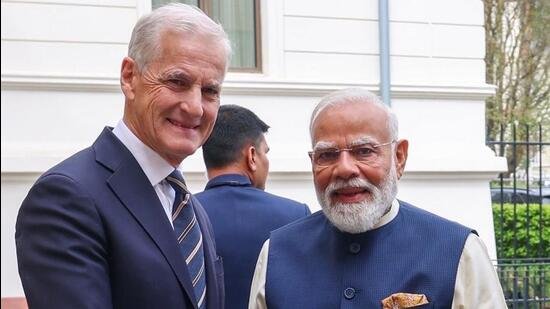
Norway hopes India’s leadership will use its contacts with Russian counterparts to press for a truce in Ukraine since Oslo and New Delhi have the shared objective of ending the conflict, Norwegian Prime Minister Jonas Gahr Støre has said.


At the same time, Støre said that while he respects India’s “historical relations” with Russia and its energy needs as a growing economy, there is also a need to put “more pressure” on Russia to come to the negotiating table to end the war in Ukraine.
Støre, who spoke to a small group of Indian reporters on Monday after the conclusion of his bilateral engagements with Prime Minister Narendra Modi in Oslo, said diplomatic efforts to end the wars in Ukraine and West Asia figured in the discussions. In public remarks at two separate events on Monday, Støre referred to the differences between the two sides but made it clear these hadn’t come in the way of closer India-Norway cooperation in key areas such as clean energy, trade and investment.
Also Read:‘Go to court’: MEA’s tense exchange with Norwegian press over PM Modi ‘skipping questions’ | Watch
“We have to understand that question based on history, there are historical relations [between India and Russia] and I have respect for that. India is a huge country, it has needs for its energy supplies,” he said. “At the same time, it’s always been viewed that in order to end this horrendous war in Ukraine, which is killing people, destroying so much, creating so much instability, there has to be more pressure on Russia to come to the table and make a real effort to end this war.”
He added, “I know that the Indian Prime Minister and Indian leadership, they have channels with the Russian leadership that I hope to see that they can use in order to get a ceasefire going. I think, on ending this war, Prime Minister Modi and I have the same objective.”
Norway believes that the restriction of Russian energy sales is one way to create pressure on Moscow to end the conflict, he said. “You have to understand our positions from our point of departure and I have respect for it to understand where Prime Minister Modi comes from. We have not detected hot differences that create problems between India and Norway,” Støre said.
Støre responded to a question on whether Norway expects India to choose between Russia and the Arctic Council for cooperation on crucial research in the Arctic region by saying that Oslo wants New Delhi, in view of important scientific advances, to be “part of the research on Arctic climate, which is important for India’s climate”, and discussions on the law of the sea.
“The Arctic is huge, the problem now is that ongoing cooperation in the Arctic Council is hampered by the fact that Russia is waging a full-scale war in Europe,” he said. “That has limited the operations of the Arctic Council.”
India has had observer status with the Arctic Council — which groups Canada, Denmark, Finland, Iceland, Norway, Russia, Sweden and the US — since 2013 and maintains the Himadri research station at Svalbard, a Norwegian archipelago.
The meeting with Modi was a useful opportunity to share assessments on the wars in Ukraine and West Asia, how India and Norway are affected and can contribute towards diplomatic solutions, Støre said. The two sides also talked about taking forward the Trade and Economic Partnership Agreement (TEPA) between India and the European Free Trade Association (EFTA), which groups Norway, Switzerland, Liechtenstein and Iceland.
Støre said there is keen interest among Norwegian companies in investing in India, “which is good for Indian jobs, Indian welfare, but also for Norwegian jobs”. The new green strategic partnership will drive cooperation in carbon capture and storage and storage of renewable energy, he said.
The goal of generating investments of $100 billion in India under TEPA is a “bold ambition”, Støre said. “When we concluded this agreement, we had to ask ourselves how can we be certain that we can deliver on that. The best way…forward on that is to look at the trends because India’s economy is growing,” he said.
“We can expect from the trends and the complementarity of our economies that we can get towards that goal,” he said, while pointing towards challenges such as technical standards, procedures and permissions. India’s creation of a separate desk for EFTA desk under Invest India will help tackle such problems and there is a “huge unity of purpose” for more trade and scientific cooperation.
Modi’s visit to Norway was originally planned for May 2025 but had to be called off in the wake of the Pahalgam terror attack, and Støre said the world community has to take a firm position against any kind of terror. He pointed to terrorist attacks in Oslo 15 years ago that targeted government buildings and said: “Countries which experience that, they know all the pain that comes with it. We express solidarity with countries and populations [that] experience terror, we have to stand together against it, to fight it in its most dark shapes, but also to prevent it.”


