



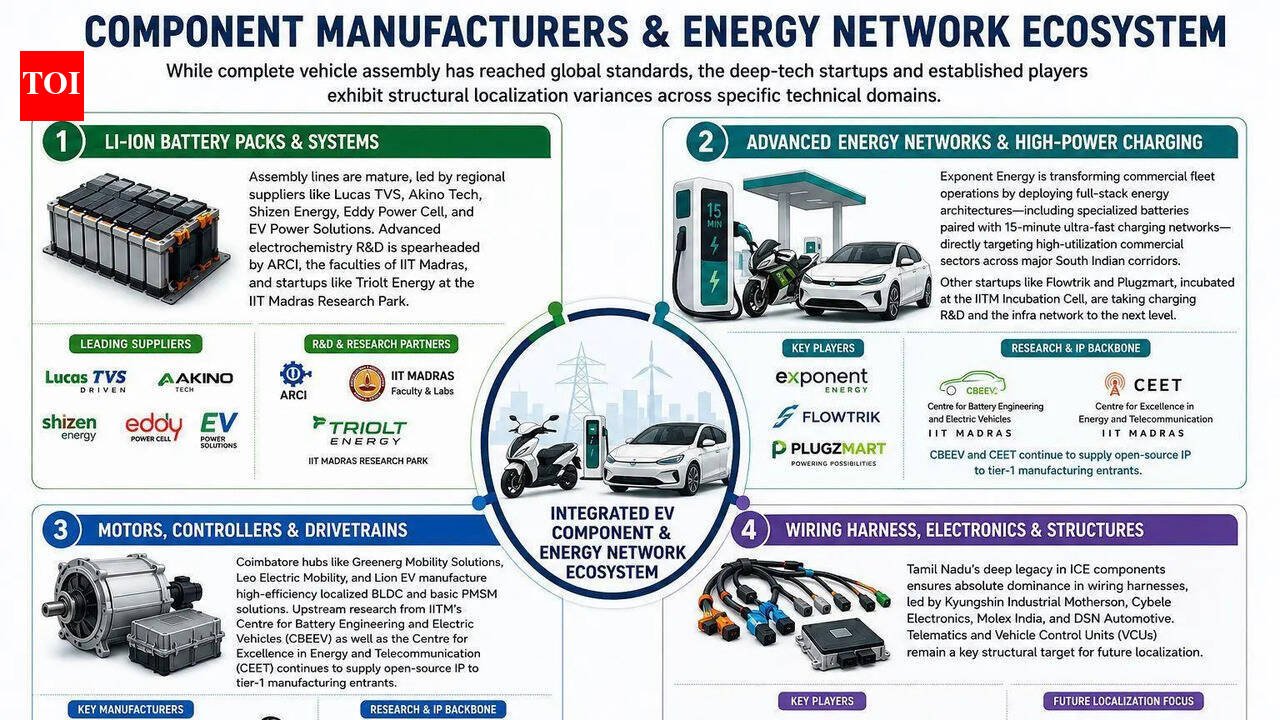
No account of India’s electric-vehicle (EV) transformation is complete without Tamil Nadu. The state produces more than half of the country’s electric two-wheelers and around 40% of its total EV output, making it the undisputed hub of the electric-mobility manufacturing ecosystem. Long known as an automotive powerhouse, TN has adapted to the shift towards electrification, attracting investments from domestic manufacturers and global players alike, most recently Vietnam’s VinFast.The broader market is moving in the same direction. EV adoption in India continues to accelerate as consumers embrace cleaner and more economical mobility options while manufacturers expand their product portfolios. In May, battery-powered vehicles crossed the 10% penetration mark for the first time, signalling that electric mobility is steadily moving to the mainstream.Tamil Nadu’s EV ecosystem boasts an impressive line-up of manufacturers across vehicle segments. In two-wheelers, TVS Motor, Ola Electric, Ather Energy, Greaves and Raptee Energy, joined more recently by Royal Enfield, have helped transform the state into one of India’s largest EV production hubs. Hyundai, BYD and VinFast anchor passenger-vehicle production, while Switch Mobility and Montra Electric have made the state a key base for electric buses, trucks and last-mile mobility solutions. Mahindra Research Valley near Chennai further strengthens the state’s EV engineering and R&D capabilities.“By almost any manufacturing metric, Tamil Nadu has emerged as India’s EV capital,” says Kaushal Kumar Jha, CEO of NoonRay Energy and Adjunct Professor of Engineering Design at IIT Madras. However, industry representatives argue that the state’s next phase of growth will depend less on vehicle assembly and more on its ability to build a robust ecosystem. “The next challenge is moving up the value chain into deep-tech capabilities that generate higher economic value and technological independence,” he says.TN already enjoys significant strengths inherited from its decades-old automotive industry. Wiring harnesses, automotive electronics and engineering services have a strong presence, while battery-pack assembly capabilities have matured. Start-ups from the IIT Madras ecosystem are advancing charging, battery and powertrain technologies.However, critical parts of the value chain continue to depend heavily on imports, particularly battery cells, power electronics and advanced vehicle software. Thiru Srinivasan, CEO of the Centre of Excellence in Advanced Automotive Research (CAAR), says the state trails competitors such as Pune and Bengaluru in several areas of EV component development. “The EV component ecosystem in TN has not developed very well. Pune seems to be ahead, while Bengaluru stays ahead in terms of engineering work,” he says.According to him, policy attention has largely focused on attracting large investments and Global Capability Centres (GCCs), while mid-sized enterprises and MSMEs—traditionally the backbone of the automotive supply chain—have not received sufficient support. “TN government has focused on large investors and GCCs, not in promoting mid-level and MSME-level companies. This is the heart of the component ecosystem,” he says.Also, several traditional auto parts groups have taken a cautious approach towards EV investments, slowing the emergence of a robust local supplier base. Industry experts broadly agree that battery cells, the single largest cost component in EVs, remain the biggest gap in the value chain. Although efforts are under way to localise cell manufacturing and battery materials, the ecosystem is still nascent. Srinivasan says Ola Electric has taken an early lead in cell manufacturing, while Harendra Saksena, Chief Procurement Officer, Ather Energy, sees significant opportunities across cell manufacturing, battery production and upstream technologies.“Traditional internal-combustion-engine suppliers established in Tamil Nadu are contributing to and transitioning towards the EV ecosystem. However, there is significant scope to grow in critical EV supply-chain segments such as cell manufacturing, battery production and upstream technologies,” says Saksena. Interestingly, Jha believes that one of the biggest challenges facing TN is not hardware manufacturing but software development. TN possesses strong engineering talent and research capabilities through institutions such as IIT Madras and specialised research centres. The difficulty lies in commercialising these innovations into automotive-grade products, he says.Battery Management Systems (BMS) illustrate the challenge. While hardware capabilities exist, the state still lacks sufficient firms capable of developing production-grade firmware that meets automotive safety and performance standards. Srinivasan shares a similar view. “Much of the capability building in BMS and related areas is happening in Bengaluru and Pune rather than Tamil Nadu, though there are some promising startups here,” he says.Saksena, however, sees a significant opportunity for TN. “Leveraging the significant engineering talent pool available, developing advanced BMS technologies presents a strategic opportunity to create a sustainable competitive advantage for the country,” he says.He also points out that significant localisation has been observed in cells and their upstream chemicals, particularly cathode active materials and anode materials.Domestic capabilities are also improving in power electronics, including motor controllers, inverters, onboard chargers and DC-DC converters. Traction motors are another area where progress has been visible, thanks to players such as Sona Comstar. Efforts in Coimbatore have also helped develop traction-motor capabilities, though these remain far from adequate.Jha points out that Tamil Nadu’s Semiconductor and Advanced Electronics Policy 2024 provides a strong platform to accelerate local semiconductor packaging, particularly in silicon carbide (SiC) and gallium nitride (GaN) technologies, helping bridge the gap in the power electronics segment.Industry experts suggest that Tamil Nadu’s next phase of EV growth will require a different strategy from the one that helped it emerge as a manufacturing leader. “TN needs to continue pursuing big investors, but it must also focus on developing engineering companies, component manufacturers, MSMEs, raw material suppliers and recycling companies,” says Srinivasan.Jha believes the state should focus on five priorities: creating predictable demand through government and fleet procurement, supporting supplier retooling, establishing shared testing and certification infrastructure, building a software-first EV ecosystem, and accelerating battery localisation.Tamil Nadu has already become an EV manufacturing capital. The next phase will be harder. Assembly lines can be built with capital; technological depth takes longer. If the state can build competitive capabilities in batteries, semiconductors, software and advanced electronics, it could emerge as one of Asia’s most important electric-mobility and deep-tech clusters.


