



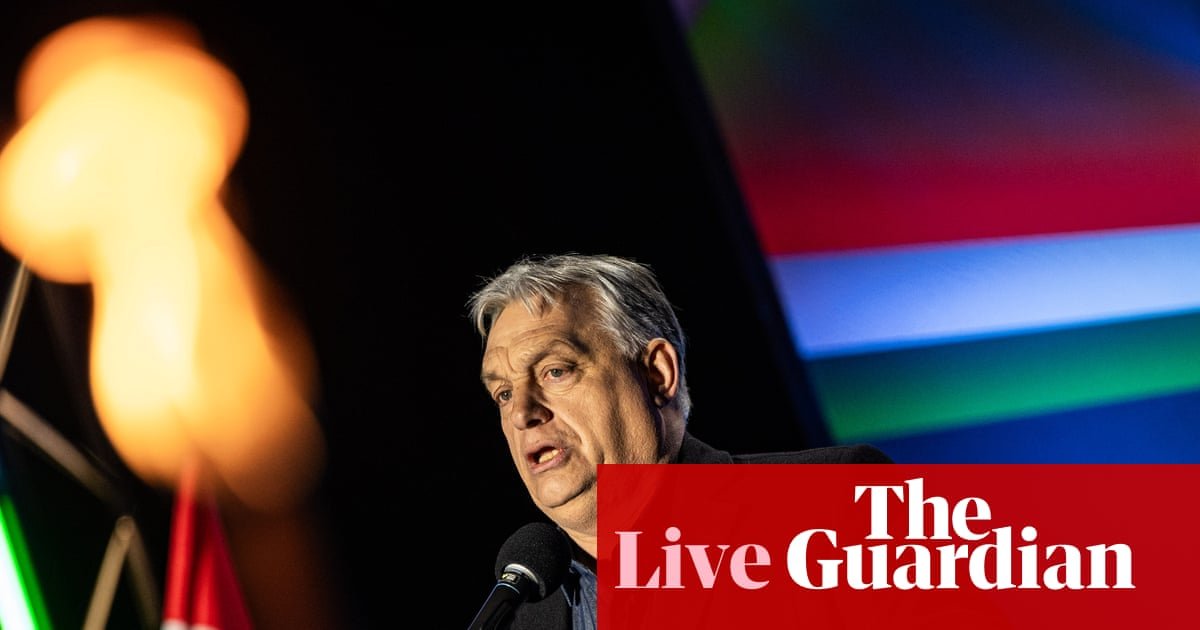
Europe needs to ‘lift sanctions on Russian energy immediately,’ Hungary’s Orbán says
The Hungarian prime minister, Viktor Orbán, urged Europe to “immediately” lift sanctions on Russian energy to shield its economy from “one of the most severe economic crises in its history” coming as a consequence of the Iran war.
In a response to Poland’s prime minister Donald Tusk’s warning about Trump and Orbán’s recent activities being like a “Putin’s dream plan” (10:47), the embattled Hungarian strongman seemingly doubled down on his calls for a pro-Russian change in the EU’s policy.
“We must think not about Putin, but about our own country and our peoples. Instead of warmongering, love and save your country, Donald,” he taunted Tusk.
The pair – once close political allies – repeatedly clashed in recent months over Orbán’s repeated attempts to block further sanctions on Russia and aid for Ukraine, with recent media reporting highlighting close ties between his government and Moscow.
Here is Orbán’s post in full:
“Europe is heading toward one of the most severe economic crises in its history. The world is facing a serious energy crisis. Europe is in grave danger. The only way out is to lift the sanctions imposed on Russian energy. Immediately.
We must think not about Putin, but about our own country and our peoples. Instead of warmongering, love and save your country, Donald!”
Orbán’s comments come just 10 days before a key parliamentary election in Hungary, with polls suggesting he could be ousted after 16 years in power amid growing frustration with the country’s economy and political class.
Key events
Closing summary
Jakub Krupa
… and on that note, it’s a wrap for today!
-
The Hungarian prime minister, Viktor Orbán, urged Europe to “immediately” lift sanctions on Russian energy to shield its economy from “one of the most severe economic crises in its history” coming as a consequence of the Iran war (15:12).
-
Earlier today, Poland’s prime minister, Donald Tusk, warned that Donald Trump’s repeated threats of breaking up Nato, the prospect of a “massive” energy crisis in Europe, and Viktor Orbán’s moves to block aid and money for Ukraine all look like “Putin’s dream plan” (10:47).
-
In response, Orbán taunted Tusk telling him to “think not about Putin, but about our own country and peoples”.
-
His comments come just 10 days before a key parliamentary election in Hungary, amid growing scrutiny of his pro-Russian policy positions after he faced robust criticism from other EU leaders.
-
Meanwhile, Ukraine started a 24/7 “online radio” broadcasting rebuttals to Orbán’s comments, urging Hungarians to “not trust the toxic anti-Ukrainian propaganda coming from officials on a daily basis.” (16:33).
Separately,
-
The French president, Emmanuel Macron, dismissed Donald Trump’s mocking comments about his marriage saying they were “neither elegant nor appropriate” and “they do not warrant a response” (12:14).
-
During a private event last night, Trump ridiculed France’s Emmanuel Macron for a 2025 incident in which he appeared to be getting shoved by his wife, Brigitte, mocking him for “still recovering from the right to the jaw” (10:17).
-
Trump also criticised “very bad” allies in Nato, saying the alliance was a “paper tiger,” with Macron condemning his comments for undermining the partnership (12:36).
-
Trump’s comments also drew widespread criticism in France, including from Macron’s political critics (11:28).
If you have any tips, comments or suggestions, email me at jakub.krupa@theguardian.com.
I am also on Bluesky at @jakubkrupa.bsky.social and on X at @jakubkrupa.
Ukraine starts online ‘radio’ to rebuke Orbán’s criticism 24/7 on loop
Back to Hungary for a second, Ukraine’s foreign ministry appears to be growing tired of Viktor Orbán’s regular use of anti-Ukrainian rhetoric in the final days of campaign.
So much so, that the authorities in Kyiv launched … an online “radio”, playing their explanations in Hungarian, English and Ukrainian on loop, 24/7.
When you tune in, it says:
“We reject manipulations regarding Ukraine, made on a regular basis by prime minister Orbán and his team. We condemn his consistent attempts to drag Ukraine into his domestic politics or electoral campaign. Ukraine has never meant and does not mean any harm to neighbouring Hungary.
We ask all Hungarians not to trust the toxic anti-Ukrainian propaganda coming from officials on a daily basis. We are doomed [sic!] to be good neighbours, members of the EU and Nato, not the Russian world.
Thank you for listening to the Hungarian Radio of Ukraine.”
The ministry’s spokesperson Heorhii Tykhyi said the Ukrainians were “tired of reacting to each” of “absurd statements about Ukraine” and this is their response.
When someone pointed it out to him that “doomed” was not the right word in the second last sentence, he promised it would get tweaked, before jokingly adding:
“Although in this case, maybe [we are] ‘doomed’”
Stolen 2,500-year-old Romanian gold helmet recovered after tricky search
In more uplifting news, a priceless ancient golden helmet from Romania that was stolen last year from a museum in the Netherlands has been recovered, Dutch authorities have said.
Under the guard of balaclava-wearing police, prosecutors unveiled the 2,500-year-old Coțofenești helmet during a news conference on Thursday in the eastern Dutch city of Assen.
The helmet, considered a cultural icon of Romania, was on loan to the Drents Museum when it was stolen more than a year ago along with other objects, when a gang of robbers used firework bombs to break into the museum in the northern Netherlands before smashing display cases inside. The theft sent shock waves through the art world.
Under huge pressure from Romania, Dutch authorities had made multiple attempts to convince the suspects to tell them where the treasures were stashed. Police offered to halve the sentence of one suspect if he revealed the location of the helmet. An undercover officer posing as a criminal mastermind reportedly offered another suspect €400,000 (£350,000) to tell him where the booty was hidden.
Three men are on trial for the theft but have largely remained silent in court.
Earlier on Thursday, the art detective Arthur Brand said:
It’s amazing. It’s the best news we could have got.
Europe needs to ‘lift sanctions on Russian energy immediately,’ Hungary’s Orbán says
The Hungarian prime minister, Viktor Orbán, urged Europe to “immediately” lift sanctions on Russian energy to shield its economy from “one of the most severe economic crises in its history” coming as a consequence of the Iran war.
In a response to Poland’s prime minister Donald Tusk’s warning about Trump and Orbán’s recent activities being like a “Putin’s dream plan” (10:47), the embattled Hungarian strongman seemingly doubled down on his calls for a pro-Russian change in the EU’s policy.
“We must think not about Putin, but about our own country and our peoples. Instead of warmongering, love and save your country, Donald,” he taunted Tusk.
The pair – once close political allies – repeatedly clashed in recent months over Orbán’s repeated attempts to block further sanctions on Russia and aid for Ukraine, with recent media reporting highlighting close ties between his government and Moscow.
Here is Orbán’s post in full:
“Europe is heading toward one of the most severe economic crises in its history. The world is facing a serious energy crisis. Europe is in grave danger. The only way out is to lift the sanctions imposed on Russian energy. Immediately.
We must think not about Putin, but about our own country and our peoples. Instead of warmongering, love and save your country, Donald!”
Orbán’s comments come just 10 days before a key parliamentary election in Hungary, with polls suggesting he could be ousted after 16 years in power amid growing frustration with the country’s economy and political class.
Austria says it denied US requests for military overflights as part of Iran operations
Back to Trump’s frustration with European allies – although it doesn’t involve a Nato member this time – Austria is the latest country to risk the US president’s wrath after a defence ministry spokesperson confirmed it denied all US requests for military overflights related to the Iran war.
“There have indeed been requests and they were refused from the outset,” Col Michael Bauer told AFP, adding that every time a similar request “involves a country at war, it is refused.”
France steps up security measures after foiled attack on Bank of America offices in Paris
France has stepped up security measures across the Paris region amid a heightened international threat environment, the Paris police authority said in a statement to Reuters, citing rising tensions and an elevated “terrorist threat” level.
Police have reinforced protection around religious and cultural sites, diplomatic premises and key economic interests linked to potentially targeted entities, Reuters reported, following a foiled attack on Bank of America offices in the city on 28 March.
AFP noted that the authorities have charged four people – a young adult and three minors – and placed them in pre-trial detention after someone placed an explosive device outside the bank’s branch in Paris.
The adult said he was contacted on a social network by someone who identified themselves as an intermediary and then sent him the device, Reuters said.
The device, a five-litre petrol can taped to a large pyrotechnic charge containing a 650-gram active-material cylinder, was the most powerful of its kind ever identified in France and could have generated “a powerful fireball several meters in diameter,” the anti-terrorism prosecutor’s office said in a statement quoted by agencies.
France’s National Counterterrorism Prosecutor’s Office (PNAT) said the incident could be linked to a little-known Islamist group with possible links to Iran, though no firm link has yet been established.
Police presence and vigilance have been increased across the wider Paris metropolitan area as part of efforts to prevent further threats, the authority added.
Following the threats, Goldman Sachs staff in Paris and Citigroup staff in Paris and Frankfurt were working from home today, agencies reported, saying it was a precautionary measure.
Czech Republic joins countries adopting measures to limit fuel price rises
Meanwhile, the Czech government agreed to cap fuel retailers’ margins and lower the excise tax to limit fuel price rises, prime minister Andrej Babiš said.
Prague joins a growing list of European countries – from Poland to Spain – that have also taken measures to limit the fuel price impact stemming from conflict in the Middle East and rising oil prices, Reuters reported.
But Babiš told a news conference that there was “chaos” caused by a lack of coordination among individual countries in central Europe which have been adopting various measures to limit the fallout from the energy crisis.
Slovakia recently proposed measures to restrict the sale of petrol to foreign drivers, amid fears about “petrol tourism” across the border, which the European Commission in turn said risked violating the bloc’s laws.
EU internal market spokesperson Siobhan McGarry said earlier this week that the Slovak measures were deemed to be “highly discriminatory and against EU law.”
“We understand the need to support citizens at this time. But measures should not discriminate based on nationality, nor should they, of course, undermine the integrity of the internal market,” she said.
France’s Macron pushes back at Trump’s comments on Nato
In his comments, Macron also mounted a passionate defence of the value of Nato, pointedly warning that regular comments questioning the US commitment to the alliance “erode its very substance” as he urged leaders to “be serious.”
“I believe that organisations and alliances like Nato are defined by what is left unsaid – that is, the trust that underpins them, and that has often been the case, incidentally, with military and strategic matters. If you cast doubt on your commitment every day, you erode its very substance,” he said.
He stressed that all signatories to the North Atlantic treaty signed up to the alliance, and shouldn’t offer running commentary on everything happening around the world, but just be there when the other party needs them.
“We need to be serious, and if you want to be serious, you don’t go around saying the opposite of what you said the day before” he said. “I think there is too much talk,” he added.
Separately, Macron said it would be unrealistic to launch a military operation to force open the strait of Hormuz, urging for renewed dialogue on resolving the conflict.
Trump’s mocking jibes ‘neither elegant nor appropriate,’ Macron says
Talking to reporters during his trip to South Korea, France’s Emmanuel Macron dismissed Trump’s mocking comments from last night (10:17) saying they were “neither elegant nor appropriate” and “they do not warrant a response”.
Instead, he pointed to the continuing impact of the war, including rising energy prices, saying that “what needs to be done is the word towards de-escalation, a ceasefire, and a resumption of negotiations, which are the only way to truly resolve what is happening in the region”.
Trump’s mockery of Macron sparks anger in France
And Donald Trump’s comments about Macron sparked anger in France (10:17), with politicians – including a Macron critic – were outraged by the US president’s attack, AFP reported.
“Honestly, it’s not up to par,” said Yaël Braun-Pivet, president of France’s lower house of parliament.
“We are currently discussing the future of the world. Right now in Iran, this is having consequences for the lives of millions of people, people are dying on the battlefield, and we have a president who is laughing, who is mocking others,” she told franceinfo.
Even Manuel Bompard, coordinator of the hard-left France Unbowed party, rushed to Macron’s defence.
“You are aware of the extent of my disagreements with the president, but for Donald Trump to speak to him like that and to speak of his wife in such a manner – I find that absolutely unacceptable,” Bompard told broadcaster BFMTV.
Nato threats, energy crisis and Orbán’s veto on Ukraine aid “all look like Putin’s dream plan,” Poland’s PM says
Poland’s prime minister Donald Tusk has warned that Donald Trump’s repeated threats of breaking up Nato, the prospect of a “massive” energy crisis in Europe, and Viktor Orbán’s moves to block aid and money for Ukraine all look like “Putin’s dream plan.”
In a rare social media post in English, he said:
“The threat of Nato’s break-up, easing sanctions on Russia, a massive energy crisis in Europe, halting aid for Ukraine and blocking the loan for Kyiv by Orbán – it all looks like Putin’s dream plan.”
Earlier this week, Tusk heavily criticised Hungary’s Viktor Orbán and his foreign minister, Péter Szijjártó, after media reports alleging the government’s close relationship with Russia.
Lithuania set to request legal assistance from US to help with its Epstein investigation
Meanwhile, Lithuanian prosecutor general Nida Grunskienė said she would request legal assistance from the US as the country continues a pre-trial investigation into potential human trafficking offences triggered by the release of Jeffrey Epstein’s correspondence.
The investigation was launched in February after several central and eastern European countries raised concerns about reports linking alleged Epstein’s associates with the region. Latvia and Poland also opened their separate inquiries.
Grunskienė told a press conference that the prosecutors spoke to some 20 people, with no victims identified yet, Lithuania’s public broadcaster LRT reported.
“Information is being gathered and analysed, and we are preparing to send a request for legal assistance to the United States,” she said.
Trump questions value of Nato, mocks France’s Macron in separate private lunch remarks
It’s worth noting that while Trump didn’t mention Nato or address the European allies in his main address to the nation, he did take some digs at the alliance in a separate speech earlier last night – but we were not meant to know about them.
In a video from his private lunch, which was briefly posted on the White House YouTube channel before it was taken down, he questioned the value of Nato, arguing that the Iran war showed him that the alliance “won’t be there if we ever have the big one; you know what I mean by the big one.”
(I, for one, don’t think it’s clear who ‘the big one’ is. Russia? China?)
Somewhat more worryingly for Europeans, he then continued, adding:
“If we ever have the big one – hopefully we won’t, [our] relationship is very good with the big one, better than with Nato – but they won’t be there.”
In another passage, he criticised “very bad” allies in Nato, and said the alliance was a “paper tiger,” simultaneously arguing it was disappointing that the allies didn’t help in Iran while it was also “the last thing I needed.”
Separately, he also ridiculed France’s Emmanuel Macron for his 2025 incident in which he appeared to be getting shoved by his wife, Brigitte.
Discussing his recent phone call with the French president, Trump said: ““I call up France, Macron – whose wife treats him extremely badly. Still recovering from the right to the jaw.”
He then mocked Macron’s accent in English and claimed the French president only wanted to help “after the war is won.”
Now, it’s worth remembering that these remarks were not meant to be public and were made at a private event, but they still tell us something about how Trump sees Nato and his European allies.
And who on earth is “the big one”!?
Morning opening: Much ado about nothing
Jakub Krupa
After all the excitement about Donald Trump’s rapidly escalating rhetoric on Nato and (his own) suggestions he would go even further in last night’s address to the nation, he … just didn’t say anything about it at all.
Whether it was the late phone call intervention by Europe’s finest Trump whisperer, Finland’s Alexander Stubb, or the prospect of next week’s Washington visit from Nato’s secretary general Mark Rutte, we will never know, but the fact is that we live to fight another day.
There were some usual swipes about “delayed courage” of unnamed allies, but we heard all of that before. In fact, the word “Nato” did not even feature in his speech. (As I kind of suggested was an option yesterday.)
Instead, Trump used a prime-time address to the nation to declare the month-long war in Iran a success “nearing completion”, despite, erm, a spiraling conflict that has caused economic turmoil across the globe, fractured transatlantic alliances and eroded the president’s approval ratings.
But the alarm caused by Trump’s comment remains real, even as some still doubt whether he would want to – or could – follow through on his dramatic comments about leaving the alliance.
The Guardian’s Julian Borger also rightly noted that any attempt to leave Nato formally would be likely to trigger a constitutional crisis that would almost certainly go to the US supreme court. However, the court has a record of siding with the executive in disputes over foreign policy issues.
But Ruth Deyermond, a senior lecturer at the department of war studies at King’s College London, said the crisis facing the alliance would not simply recede at the end of Trump’s White House tenure.
“This is wishful thinking,” Deyermond said on Bluesky. “The failure to understand the importance of the alliance for US security and the taking of allies for granted isn’t unique to the Trump administration.”
I will bring you some European reactions to Trump’s speech and all the other news from across the continent.
It’s Thursday, 2 April 2026, it’s Jakub Krupa here, and this is Europe Live.
Good morning.


