



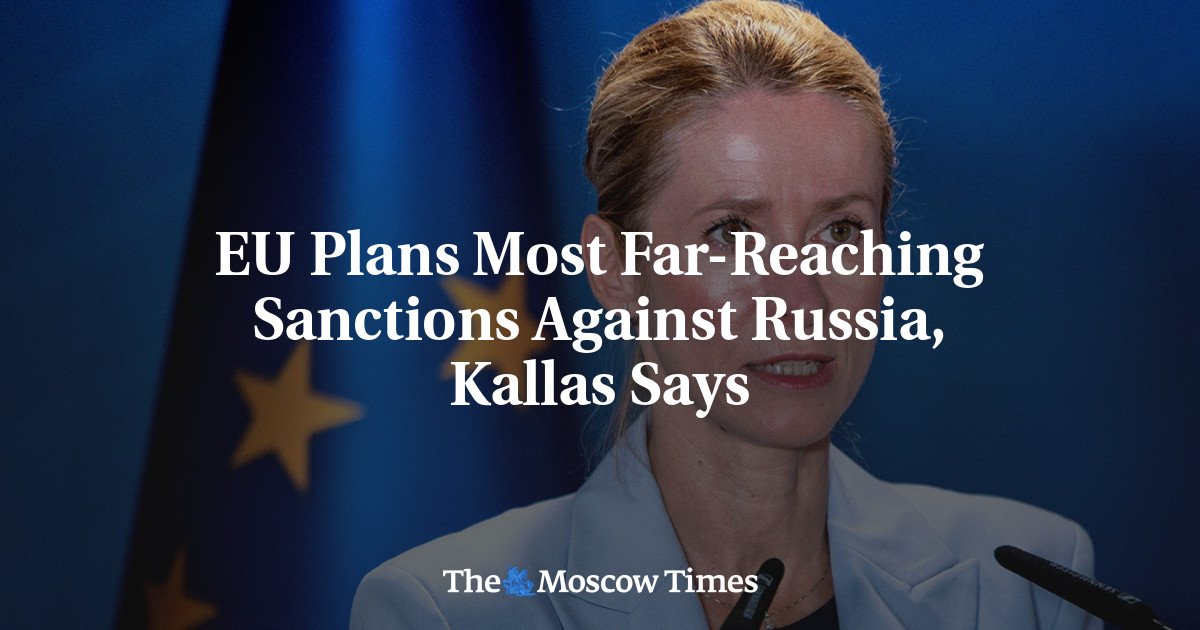
The European Union plans to significantly expand sanctions against Russia in the coming months over its war in Ukraine, the bloc’s foreign policy chief, Kaja Kallas, told the German newspaper Die Welt.
“EU sanctions have already cost Russia dearly, depriving Russia‘s war machine of over 1 trillion euros [$1.16 trillion], and for the fall I am putting forward the most far-reaching sanctions listings since the start of the war,” she told the newspaper.
“Once adopted, they would immediately raise the total number of sanctioned Russian entities by a third. The pressure must keep growing until Moscow ends its war,” said Kallas, who leads the European External Action Service (EEAS) — the EU’s diplomatic service.
She did not elaborate on timing or details of the new sanctions. However, EU diplomatic sources later told Reuters that the EEAS would propose targeting around 1,600 Russian individuals and entities, mostly linked to the military-industrial complex.
The designations will include travel and transaction bans as well as asset freezes, the sources added. The EU has already sanctioned nearly 3,000 people and companies.
The EEAS is expected to present the new sanctions list to EU countries in early September, with an aim to adopt them in October, the sources added. The listings are not expected to be accompanied by sectoral sanctions — which are under the European Commission’s purview — as part of an effort to speed up their adoption.
EU sanctions must be approved unanimously. Traditional EU packages against Russia, which combine sectoral measures and full designations, have frequently become dogged by lengthy disputes. During negotiations for the latest 21st package, Greece raised an issue over a forthcoming ban on Russian liquefied natural gas transfers.
That package was approved in July, imposing curbs on the Russia’s banking sector and cryptocurrency networks.
The EEAS also expects to propose more listings in September on those accused of trafficking Ukrainian children under the framework of human rights violations. Later in the fall, it will further propose designations penalizing those said to be involved in Russia’s hybrid warfare activities, including cyberattacks and misinformation campaigns.


